Biography · Chemist no. 169 of 350
Jens Christian Skou: The Physician Who Found the Sodium Pump
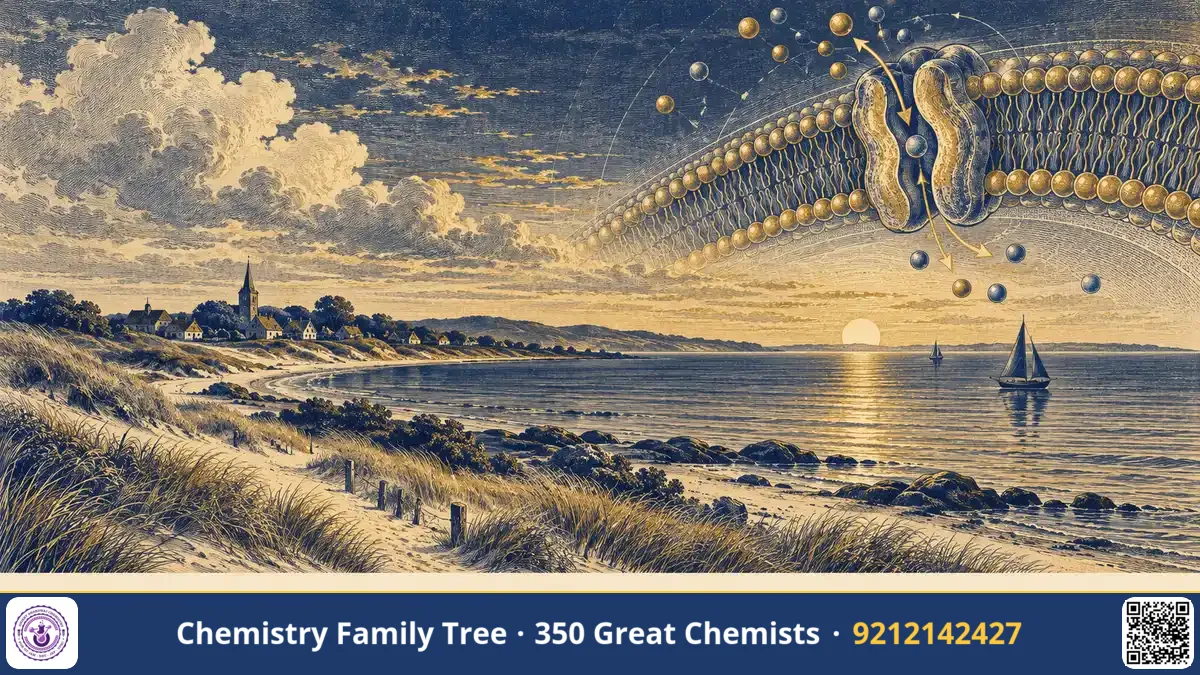
Jens Christian Skou (1918–2018) was a Danish physician and biophysicist who discovered the sodium-potassium pump (Na+,K+-ATPase). He received half of the 1997 Nobel Prize in Chemistry for this discovery. His story shows how a simple question about how anaesthetics work, followed by careful measurement, can uncover one of the most basic machines of life. Like Paul Boyer, he lived to the age of 99.
Early Life and Family
Jens Christian Skou was born on 8 October 1918 in Lemvig, a small town on the west coast of Jutland, Denmark. His father was a timber and coal merchant, and his family was comfortable but not scientific. He grew up in Lemvig. As a young man, he did not decide to be a researcher at once. He chose medicine, which was a respected profession and offered a practical career.
Education and Mentors
Skou studied medicine at the University of Copenhagen and graduated as a medical doctor in 1944. He worked for some time as a clinician and then moved to Aarhus, where he joined the Institute of Physiology. In Aarhus he began research on how local anaesthetics act on nerves. He received his doctorate (Dr. Med. Sci.) from Aarhus University in 1954 for his work on how local anaesthetics act on nerves. This research led him towards the question of membrane enzymes and then to the pump.
Career Timeline
| Year | Event |
|---|---|
| 1918 | Born in Lemvig, Denmark, on 8 October |
| 1944 | Graduated in medicine, University of Copenhagen |
| 1940s–50s | Clinical work, then research at the University of Aarhus |
| 1954 | Doctoral degree for studies on local anaesthetics |
| 1957 | Published the discovery of Na+,K+-ATPase from crab nerve |
| 1963 | Became professor of biophysics at Aarhus University |
| 1988 | Retired from his professorship but remained active in research |
| 1997 | Nobel Prize in Chemistry (half share) |
| 2018 | Died on 28 May, aged 99 |
Major Scientific Contributions
- Local anaesthetics and membranes. His early work suggested that anaesthetics act on the nerve membrane and change its properties. This research made him a membrane biophysicist.
- Discovery of Na+,K+-ATPase (1957). He found an ATP-splitting enzyme in crab nerve membrane that requires Na+, K+ and Mg2+, and is blocked by ouabain.
- Characterisation of the enzyme. Over the following years, he and his colleagues studied the phosphorylation of the enzyme, its dependence on ions and its inhibition by cardiac glycosides. This work fitted into the E1 and E2 cycle.
- A new concept. His discovery proved that active transport across membranes is performed by specific enzymes, which led to the understanding of the whole family of P-type ATPases, for example the Ca2+-ATPase of muscle and the H+,K+-ATPase of the stomach.
The detailed mechanism, stoichiometry (3 Na+ out and 2 K+ in) and exam points appear in our discovery post on the sodium-potassium pump.
Awards, Honours and the Nobel Prize
In 1997, the Nobel Prize in Chemistry was divided. One half went jointly to Paul D. Boyer and John E. Walker for their work on the mechanism of ATP synthesis, and the other half went to Jens C. Skou "for the first discovery of an ion-transporting enzyme, Na+,K+-ATPase". Although Skou was a physician and the work is relevant to physiology, the Nobel committee gave him the prize in Chemistry. He was 79 years old at that time. He also received other honours in Denmark and abroad.
Personality, Struggles and Lesser-Known Facts
- Years of little recognition. His 1957 paper was not widely noticed at first. Many physiologists were uncertain that a single enzyme could be the sodium pump, and it took several years for the field to accept it. The Nobel Prize came 40 years after the discovery.
- A clinician turned biophysicist. Skou worked first as a doctor and found that his interest was in basic questions of how cells function.
- Luck and preparation. Using crab nerves, which have a very high pump content, was an important decision. He tested conditions carefully and recognised an unusual result, that ATPase activity needed both Na+ and K+.
- Interest after retirement. After he retired in 1988 he continued to work and write on the pump and its mechanism, and he wrote about the story of the discovery in later years.
- Long life. Skou died in 2018 in Denmark, aged 99, a few months before his 100th birthday.
Legacy and Influence on Modern Chemistry
The discovery of the sodium pump started the modern study of membrane transport enzymes. The Na+,K+-ATPase is now a standard topic in biochemistry and physiology. The gradients it builds power nerve impulses, muscle contraction, kidney function and the uptake of nutrients such as glucose and amino acids. The same basic ideas help to design drugs for heart failure (digoxin), stomach acidity (proton pump inhibitors) and kidney disorders. For Indian students, the topic links directly to the physiology of ORS (oral rehydration solution), which relies on sodium-glucose co-transport made possible by the Na+ gradient.
Lessons for Students
- Ask a simple question. Skou started with how anaesthetics act and ended with a fundamental enzyme.
- Choose the right system. Crab nerve had a lot of the enzyme and made the effect clear.
- Change one variable at a time. Testing each ion separately showed that both ions were needed together.
- Be patient with recognition. Good science is often accepted slowly.
Quick Facts Box
- Born: 8 October 1918, Lemvig, Denmark
- Died: 28 May 2018, Denmark
- Nationality: Danish
- Field: Biophysics, membrane biochemistry
- Famous for: Discovery of the sodium-potassium pump (Na+,K+-ATPase)
- Nobel: Chemistry, 1997 (half share, with the other half to Boyer and Walker)
FAQ
Was Skou a chemist or a doctor?
He was trained as a medical doctor and worked as a biophysicist. His Nobel Prize was in Chemistry.
When did Skou discover the sodium pump?
He published the discovery in 1957, and the Nobel Prize was awarded in 1997.
Which university was he associated with?
Aarhus University in Denmark, where he was a professor of biophysics.
Who shared the 1997 Nobel Prize in Chemistry?
Paul D. Boyer and John E. Walker shared one half of the prize, and Skou received the other half.
Published by ABC Chemistry — IIT-JAM | CSIR-NET | GATE Chemistry Coaching. Visit abcchemistry.com
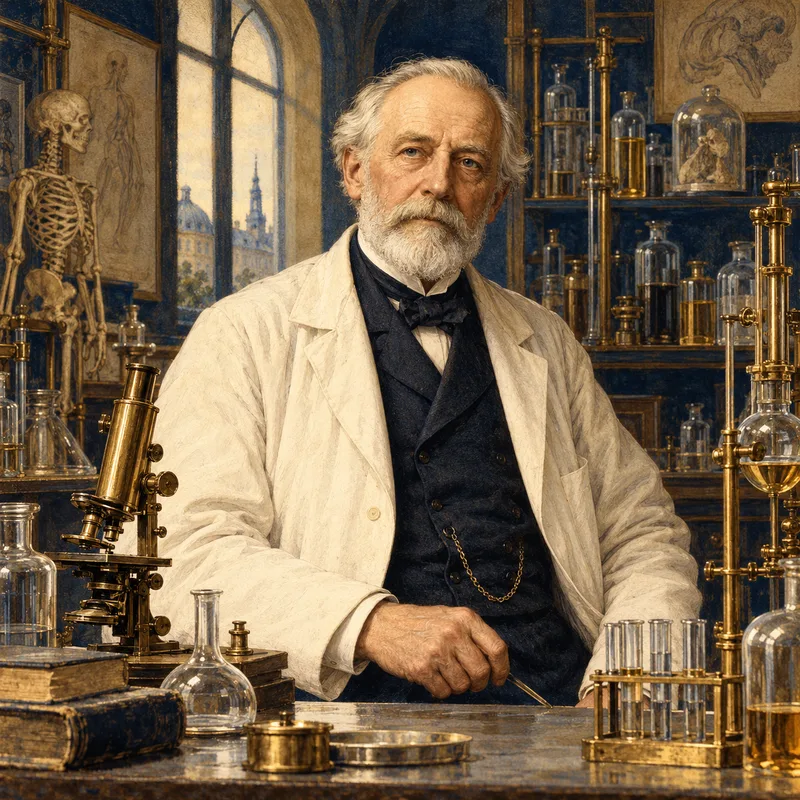
About the chemist
Jens Christian Skou
1918-2018 · Denmark · Nobel Chemistry 1997
Discovery of Na+,K+-ATPase