The discovery, explained · Chemist no. 169 of 350
Jens Christian Skou and the Discovery of the Sodium-Potassium Pump
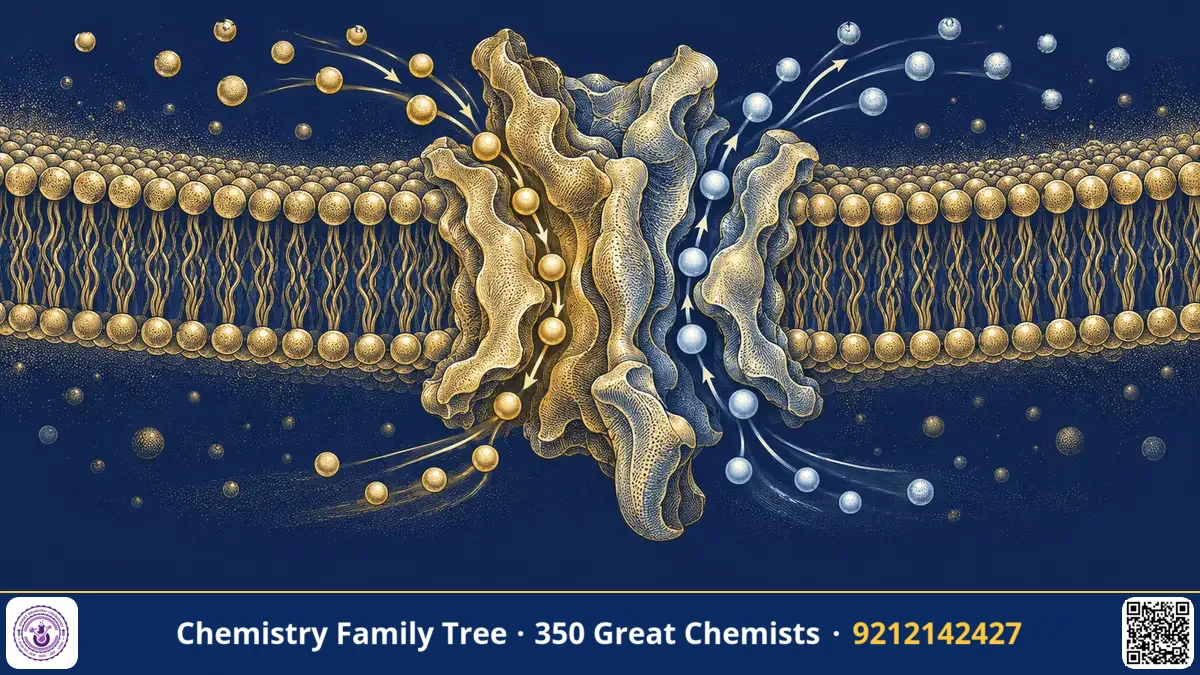
Every living cell keeps a high concentration of potassium inside and a high concentration of sodium outside. This difference does not come free: the cell must spend energy to maintain it. In 1957, a Danish physician and scientist, Jens Christian Skou, found the enzyme responsible: Na+,K+-ATPase, the sodium-potassium pump. It was the first ion-transporting enzyme ever identified. For this discovery he received half of the 1997 Nobel Prize in Chemistry, the other half being shared by Paul Boyer and John Walker. This post explains his experiment, how the pump works, and what students should remember.
The Scientific Problem Before the Discovery
Physiologists in the early twentieth century knew that animal cells contain much more K+ than Na+, while the extracellular fluid is the opposite. Typical values for a mammalian cell are approximately:
| Ion | Inside cell (mM) | Outside cell (mM) |
|---|---|---|
| Na+ | about 10–15 | about 140–145 |
| K+ | about 140–150 | about 4–5 |
Because ions leak through the membrane down their gradients, the cell must pump Na+ out and K+ in against the concentration gradients, which is active transport. The experiments of Hodgkin and Huxley on nerve conduction showed that these gradients create the resting potential and allow nerve impulses. But what was the molecular machine doing the pumping? Some researchers suspected a membrane enzyme using ATP, but no one had found it. Skou's question was: Is there an enzyme in the nerve membrane that breaks down ATP and depends on both Na+ and K+?
The Discovery: Experiment Step by Step
Skou worked at the University of Aarhus in Denmark. He was originally interested in how local anaesthetics act on nerve membranes. He chose the peripheral nerves of the shore crab (Carcinus maenas) as a source of membranes. His approach was simple and clever:
- He homogenised crab leg nerves and prepared a fraction rich in cell membranes.
- He incubated the membranes with ATP and Mg2+ and measured the release of inorganic phosphate (Pi), which shows ATP hydrolysis.
- He varied the ion composition of the solution. With Mg2+ alone, there was little activity. With both Na+ and K+ present together, a large extra ATPase activity appeared.
- Neither Na+ alone nor K+ alone could produce the effect. The activity needed the two ions at the same time and at concentrations similar to those that were needed for transport in intact cells.
- He found that the activity was blocked by ouabain, a plant glycoside known to inhibit active sodium and potassium transport in cells.
The match between enzyme activity and the properties of the transport system convinced Skou that he had isolated the pump itself. He published the work in 1957 in Biochimica et Biophysica Acta. At first, it received little attention, but later work by many laboratories confirmed that the Na+,K+-ATPase is present in the plasma membrane of nearly all animal cells.
The Chemistry Behind It
The overall reaction
3 Na⁺(in) + 2 K⁺(out) + ATP + H₂O → 3 Na⁺(out) + 2 K⁺(in) + ADP + Pi
For each ATP hydrolysed, the pump moves three Na+ out and two K+ in. It is therefore electrogenic: one net positive charge leaves the cell per cycle, which contributes a little to the membrane potential. The pump is an example of primary active transport.
The Post–Albers cycle
The pump belongs to the P-type ATPase family. "P" means that the enzyme is phosphorylated during its cycle: an aspartate residue is transiently phosphorylated by ATP. The enzyme exists in two main conformations, E1 and E2, which was worked out by Albers and Post:
- In E1, the ion-binding sites face the inside and have a high affinity for Na+. Three Na+ and ATP bind.
- ATP phosphorylates an aspartate, giving E1~P with Na+ occluded.
- The enzyme changes to E2-P; the sites face the outside, Na+ affinity falls and three Na+ are released.
- Two K+ bind from outside. This triggers dephosphorylation to E2(K2).
- ATP binds again, and the enzyme goes back to E1, releasing two K+ into the cell.
Energetics
The free energy needed to move ions against an electrochemical gradient is given by:
ΔG = RT ln([X]in / [X]out) + zFΔψ
ATP hydrolysis provides the energy to drive this process. Many cells use 20–40% of their resting energy to run this pump, and in neurons it can be even higher.
Structure
The pump has an α subunit (the catalytic subunit, with ten transmembrane helices) and a β subunit needed for proper folding and targeting. Some tissues also have an additional small FXYD protein. The high-resolution structure was determined much later by X-ray crystallography.
Applications Today
- Heart medicine: Digoxin and digitoxin, drugs derived from the foxglove plant (Digitalis), inhibit the pump in heart muscle and increase contraction force. The same family includes ouabain.
- Kidney physiology: The pump in kidney tubules drives reabsorption of sodium, which in turn drives water and nutrient transport. Diuretics act on related transport steps.
- Nerve signalling: The pump restores ion gradients after action potentials.
- Secondary transport: The Na+ gradient it creates powers the absorption of glucose in the intestine through SGLT proteins. This principle is central to oral rehydration therapy (ORS), which is widely used in India to treat diarrhoea.
- Related enzymes: The gastric H+,K+-ATPase is the target of proton pump inhibitors such as omeprazole.
Exam Corner
- Stoichiometry: 3 Na+ out and 2 K+ in per ATP; the pump is electrogenic.
- Inhibitor: ouabain and cardiac glycosides, such as digoxin, which bind to the extracellular face.
- P-type ATPase: forms a phosphoaspartate intermediate; E1 and E2 conformations (Post–Albers cycle).
- Sodium-potassium pump is primary active transport; glucose-Na+ symport is secondary active transport.
- Skou was awarded half of the 1997 Nobel Prize in Chemistry for the first discovery of an ion-transporting enzyme.
Common Misconceptions
- "The pump moves equal numbers of Na+ and K+." It moves three Na+ out for two K+ in.
- "The pump alone creates the resting potential." The main part of the resting potential comes from K+ leak channels. The pump maintains the gradients and adds a small direct contribution.
- "Skou received the Nobel Prize in Medicine." Although he was a medical doctor and the work is physiology-related, the prize was in Chemistry, 1997.
Quick Revision Box
- Discovered 1957 in crab leg nerve membranes at Aarhus.
- Needs Mg2+, ATP, and both Na+ and K+; inhibited by ouabain.
- 3 Na+ out, 2 K+ in, 1 ATP used.
- P-type ATPase with E1/E2 states and phosphoaspartate.
- First ion-motive enzyme ever identified.
- Nobel Prize in Chemistry 1997 (half share).
FAQ
Why did Skou use crab nerves?
Crab leg nerves are rich in membrane and easy to obtain, and the nerve was relevant to his original research on anaesthetics and membrane function.
What is the role of ouabain?
Ouabain blocks the Na+,K+-ATPase from the outside, which helped to show that the enzyme activity was the same as the cellular sodium pump.
Is the pump uniport, symport or antiport?
It is an antiport, because Na+ and K+ are moved in opposite directions.
Why is it important in medicine?
It is the target of cardiac glycoside drugs and it is essential for nerve function, kidney function and muscle contraction.
Published by ABC Chemistry — IIT-JAM | CSIR-NET | GATE Chemistry Coaching. Visit abcchemistry.com
About the chemist
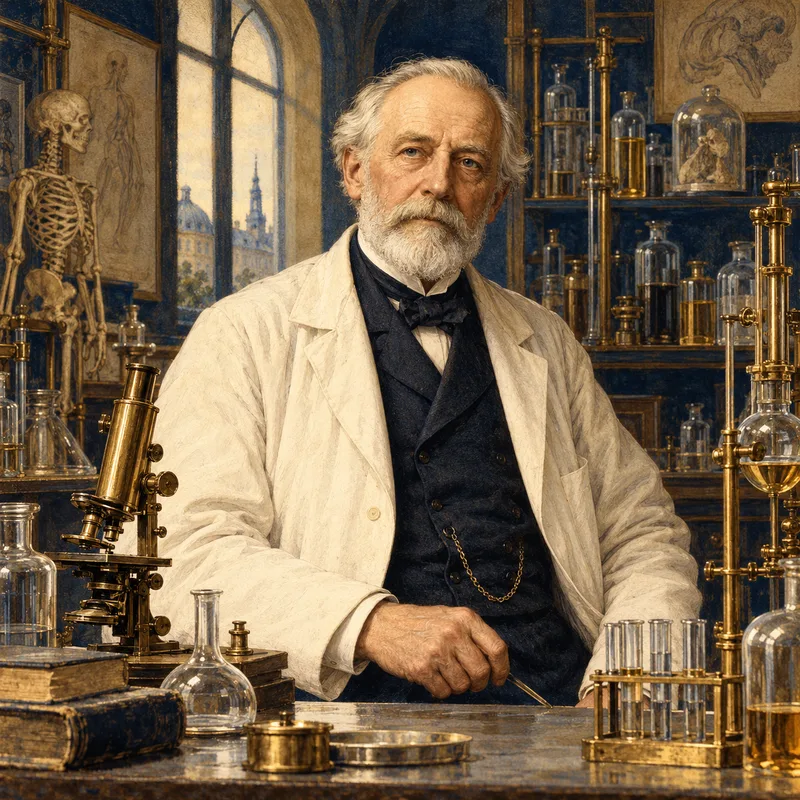
Jens Christian Skou
1918-2018 · Denmark · Nobel Chemistry 1997
Discovery of Na+,K+-ATPase