Biography · Chemist no. 210 of 350
Joachim Frank: The Physicist Who Taught Computers to See Molecules
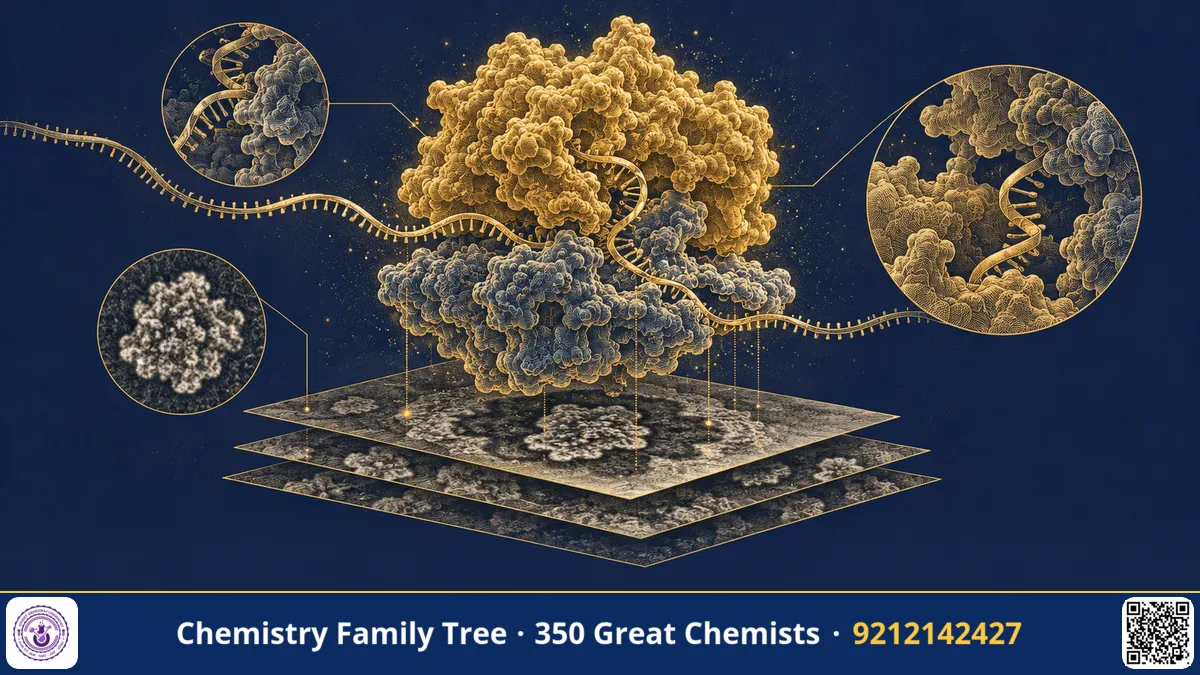
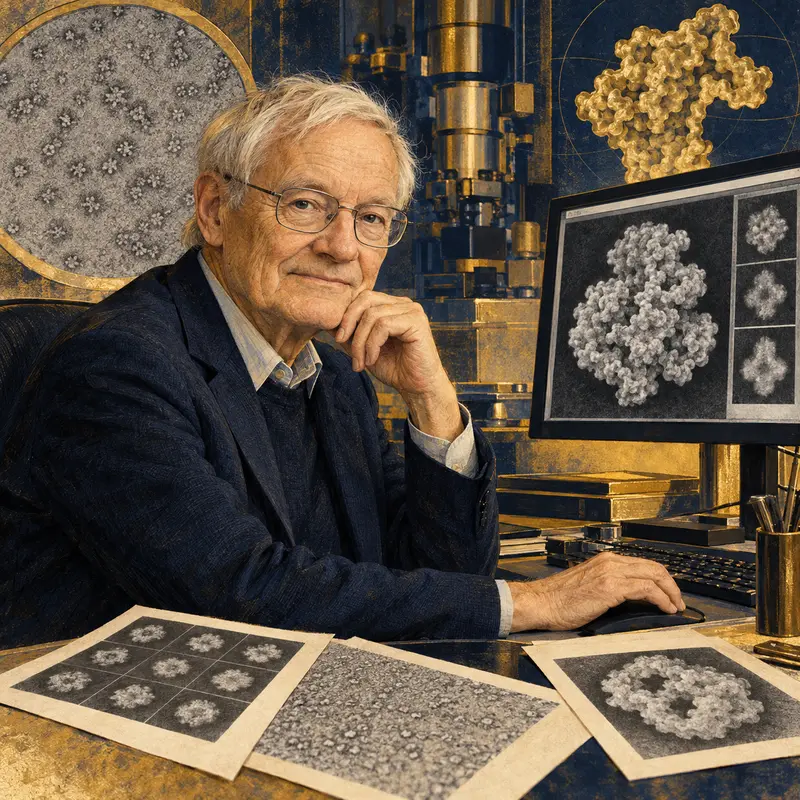
Joachim Frank (born 12 September 1940) is a German-American biophysicist and professor at Columbia University in New York. He shared the 2017 Nobel Prize in Chemistry with Jacques Dubochet and Richard Henderson. His legacy in one line: he built the mathematical and computational foundation that lets scientists reconstruct 3D structures of biomolecules from thousands of noisy electron microscope images.
Early Life and Family
Frank was born in Siegen, Germany, in 1940, during the Second World War. He grew up in post-war Germany, a period of rebuilding. Like many children of that time, he experienced the limits of material resources, but he showed early interest in science. Specific details of his family life are modestly documented, so we focus on his scientific journey.
Education and Mentors
Frank studied physics at the University of Freiburg and then at the Technical University of Munich, where he earned his doctorate in 1970. His PhD was in the area of electron microscopy and image analysis, under Walter Hoppe at the Max Planck Institute for Biochemistry in Martinsried near Munich. Hoppe was a pioneer in using electron microscopy for structural biology and in applying computational ideas to images. Frank spent time as a postdoctoral researcher at the Cavendish Laboratory in Cambridge, UK, and then at the Max Planck Institute in Munich again. In 1975 he moved to the United States, joining the Wadsworth Center of the New York State Department of Health in Albany.
Career Timeline
| Year | Event |
|---|---|
| 1940 | Born in Siegen, Germany |
| 1970 | Doctorate in physics from the Technical University of Munich |
| Early 1970s | Postdoctoral work at Cambridge and Munich |
| 1975 | Moves to the Wadsworth Center in Albany, New York |
| 1980s | Develops alignment, classification and reconstruction methods; SPIDER software |
| 1990s | 3D reconstructions of the E. coli ribosome from cryo-EM images |
| 2008 | Joins Columbia University as professor |
| 2017 | Shares the Nobel Prize in Chemistry |
Major Scientific Contributions
- Single-particle reconstruction: alignment, classification and averaging of images of non-crystalline particles.
- Correspondence analysis for image classification: a statistical approach used to sort images into classes.
- SPIDER: a widely used software system for electron microscopy image processing.
- Ribosome structure and dynamics: reconstructions showing tRNA positions and ratchet-like motion of ribosomal subunits during protein synthesis.
- Method of random-conical tilt: a technique for determining the orientation of particles from tilted-image pairs.
Our companion post on single-particle reconstruction explains the underlying method in detail.
Awards, Honours and Nobel Prize
The Nobel Prize in Chemistry 2017 was awarded to Jacques Dubochet, Joachim Frank and Richard Henderson "for developing cryo-electron microscopy for the high-resolution structure determination of biomolecules in solution". Frank is a member of the United States National Academy of Sciences and has received other honours. He holds the title of Professor of Biochemistry and Molecular Biophysics and of Biological Sciences at Columbia University.
Personality, Struggles and Lesser-Known Facts
- A physicist in biology: He trained as a physicist, and his shift into biology was driven by the wish to apply mathematical methods to living molecules.
- Decades of patience: His method took years to be accepted; many biologists were sceptical of reconstructing structure from noisy images.
- Interest in the arts: Frank has spoken of his interest in painting, and has made art connected with his science.
- Software for all: He released image-processing tools so that other laboratories could join the field, rather than keeping methods private.
- Machine-like precision: His ribosome work revealed that the ribosome is not a rigid block but a dynamic machine whose parts move.
Legacy and Influence on Modern Chemistry
Frank's work is part of the foundation of today's "resolution revolution" in structural biology. The ribosome is a major antibiotic target, and many antibiotics were studied by cryo-EM for their binding modes. His work also inspired the growth of software for cryo-EM processing, now used by researchers worldwide. For Indian students, the lesson is that mathematics, physics and computing are inseparable from modern chemistry.
It helps to see how Frank's work fits with the rest of structural biology. X-ray crystallography gave the first protein structures, but it needs crystals. Nuclear magnetic resonance gives structures in solution, but works best for small proteins. Frank's computational methods made it possible to study large, flexible complexes such as the ribosome, the spliceosome and many membrane assemblies, without crystals and in several conformations at once. This changed the questions that biologists could ask: instead of a single static picture, they could now see a molecular machine in different stages of its working cycle. His early insistence that images must be treated statistically, and that heterogeneity is information rather than a nuisance, is now built into every modern cryo-EM program. Students of chemistry and physics can take from this the lesson that data analysis and mathematical thinking are essential partners to experiment, and that a good algorithm can open a whole field.
Lessons for Students
- Learn maths well. Fourier transforms and statistics solved a biological problem.
- Cross boundaries. A physicist changed structural biology.
- Be persistent with a long-term goal. His methods matured over decades.
- Share tools. Open software helped the entire community advance.
- Keep other interests. Art and science can nourish each other.
Quick Facts Box
- Born: 12 September 1940, Siegen, Germany
- Died: Living (as of this writing)
- Nationality: German-American
- Field: Biophysics, electron microscopy, image processing
- Famous for: Single-particle cryo-EM reconstruction, ribosome structure
- Nobel: Chemistry 2017, shared with Dubochet and Henderson
FAQ
Where does Frank work?
At Columbia University in New York.
What was his doctoral field?
Physics, with research on electron microscopy and image analysis.
What is SPIDER?
A software package for electron microscopy image processing that he helped to develop.
What is the ribosome and why is it important?
It is the cellular machine, made of RNA and proteins, that translates mRNA into proteins. It is also a major target of antibiotics.
Published by ABC Chemistry — IIT-JAM | CSIR-NET | GATE Chemistry Coaching. Visit abcchemistry.com
About the chemist
Joachim Frank
1940- · United States · Nobel Chemistry 2017
Image processing for cryo-EM