Biography · Chemist no. 157 of 350
Johann Deisenhofer: Complete Life and Legacy of a Structural Biologist
Johann Deisenhofer, born in 1943 in Bavaria, is a German-American biophysicist and crystallographer. As a young researcher at the Max Planck Institute of Biochemistry near Munich, he solved the first three-dimensional structure of a membrane protein complex, the photosynthetic reaction centre of a purple bacterium. For this work he shared the 1988 Nobel Prize in Chemistry with Robert Huber and Hartmut Michel. He later moved to the United States and built a research career at the University of Texas Southwestern Medical Center in Dallas. His legacy: he proved that atomic-level pictures of membrane proteins are possible.
Early Life and Family
Johann Deisenhofer was born on 30 September 1943 in Zusamaltheim, a small village in Bavaria, Germany. His family were farmers, and the family farm was meant to pass to his elder brother, which left him free to follow an education. Growing up in a rural community in post-war Germany, he attended local schools and developed an early curiosity about how things work. He has described how practical skills learned on the farm helped him later in handling instruments and solving technical problems in the laboratory.
Education and Mentors
After military service, Deisenhofer studied physics at the Technical University of Munich (TUM). He completed his diploma in physics in 1971. He then carried out his doctoral research at the Max Planck Institute of Biochemistry in Martinsried, in the group of Robert Huber, and obtained his PhD in 1974. His thesis work involved protein crystallography, including studies of a human antibody fragment and a protein complex. Huber, a leading crystallographer, became his mentor and later co-laureate. Deisenhofer continued as a researcher in Huber's department until 1987.
Career Timeline
| Year | Event |
|---|---|
| 1943 | Born in Zusamaltheim, Bavaria, Germany |
| 1971 | Diploma in physics, Technical University of Munich |
| 1974 | PhD, Max Planck Institute of Biochemistry, Martinsried |
| 1974–1987 | Research at the Max Planck Institute of Biochemistry |
| 1982 | Hartmut Michel crystallises the bacterial reaction centre |
| 1984–1985 | Structure of the Rh. viridis reaction centre published |
| 1988 | Shared the Nobel Prize in Chemistry with Huber and Michel |
| 1988 onwards | Professor at the University of Texas Southwestern Medical Center, Dallas; investigator of the Howard Hughes Medical Institute |
Major Scientific Contributions
The main contribution is the structure of the photosynthetic reaction centre of Rhodopseudomonas viridis. Using the crystals made by Hartmut Michel, Deisenhofer and colleagues collected X-ray diffraction data, determined phases using heavy-atom derivatives, and built an atomic model at around 3 Å resolution. The structure revealed four subunits, L, M, H and a cytochrome, and the arrangement of the cofactors, including the special pair of bacteriochlorophylls, the pheophytins, quinones and a non-haem iron. It explained how light energy leads to an electron moving across the membrane.
Other contributions:
- Antibody structure: Early in his career he contributed to the structure of an immunoglobulin Fc fragment complexed with a bacterial protein, a case study in protein–protein recognition.
- Biomedical structures in Dallas: In Texas, his group turned to proteins of medical interest, including those involved in cholesterol and lipid metabolism.
Awards, Honours and Nobel Prize
The 1988 Nobel Prize in Chemistry was awarded jointly to Johann Deisenhofer, Robert Huber and Hartmut Michel "for the determination of the three-dimensional structure of a photosynthetic reaction centre." It is a Chemistry prize. Deisenhofer also received other scientific honours and was elected to national academies of science, and he held the Regental Professorship at UT Southwestern Medical Center.
Personality, Struggles and Lesser-Known Facts
- From farm to Nobel: He came from a farming family with no scientific background, and his path shows how talent can come from any village.
- Craftsman's hands: He has spoken about the value of practical skill, such as the ability to fix equipment, in experimental science.
- Computer graphics pioneer: Building atomic models from electron density maps on early graphics screens in the 1980s was slow and painstaking work compared with today's software.
- Team science: The reaction centre project needed crystal growth, diffraction, phasing and model building. He consistently credited his colleagues.
- Moved continents: Leaving Germany for Texas in 1988, he started a new research programme in a medical school environment.
Legacy and Influence on Modern Chemistry
The reaction centre structure showed how a protein holds pigments at precise distances and orientations so that light energy is converted into charge separation with very high efficiency. It established principles still taught today: transmembrane α-helices, hydrophobic surfaces facing lipids, and the role of protein environment in tuning redox potentials. It also inspired membrane protein crystallography as a field. Many current drugs act on membrane receptors, channels and transporters, and their structures follow the trail first blazed by this work. In India, structural biology groups at institutes such as IISc and the IISERs apply the same crystallographic methods to proteins of medical and agricultural importance.
Lessons for Students
- Do not accept "impossible". Membrane proteins were once thought impossible to crystallise.
- Learn physics and chemistry together. Deisenhofer trained as a physicist and worked on a chemical problem.
- Work in teams. Each Nobel laureate in this story supplied a different key skill.
- Background is not destiny. A village farm can be the starting point of world-class science.
Quick Facts Box
- Born: 30 September 1943, Zusamaltheim, Bavaria, Germany
- Died: Not covered here
- Nationality: German-American
- Field: Biophysics, protein crystallography
- Famous for: Structure of the photosynthetic reaction centre
- Nobel: 1988, Chemistry (shared with Robert Huber and Hartmut Michel)
FAQ
Where did Deisenhofer do his PhD?
At the Max Planck Institute of Biochemistry in Martinsried, under Robert Huber, finishing in 1974.
Where did he work after the Nobel Prize?
At the University of Texas Southwestern Medical Center in Dallas, United States.
What did the 1988 Nobel Prize in Chemistry honour?
The determination of the three-dimensional structure of a photosynthetic reaction centre.
What technique did he use?
X-ray crystallography, with phases obtained using heavy-atom derivatives.
Published by ABC Chemistry — IIT-JAM | CSIR-NET | GATE Chemistry Coaching. Visit abcchemistry.com
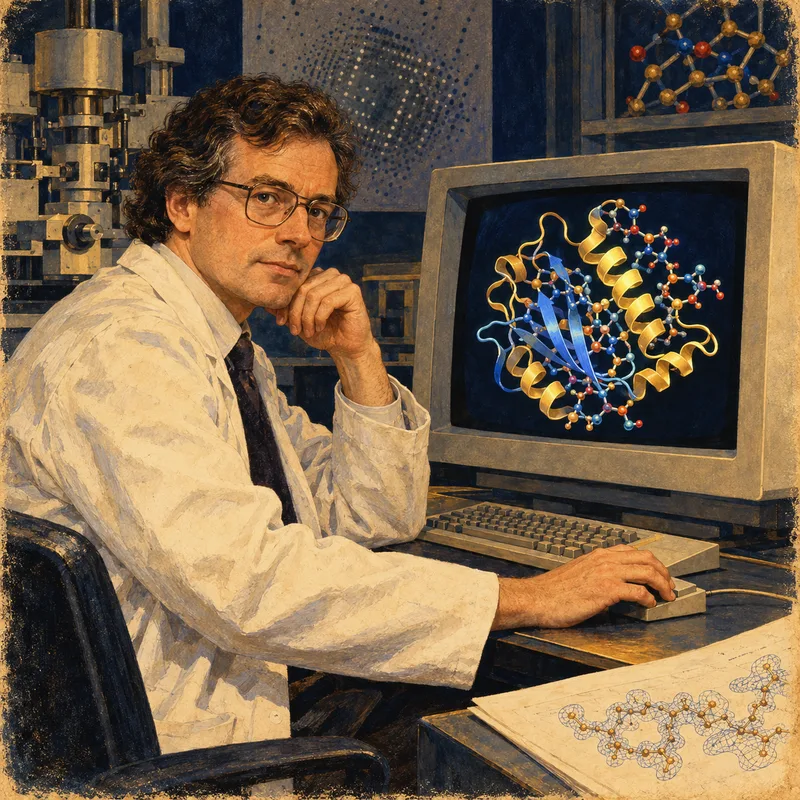
About the chemist
Johann Deisenhofer
1943- · Germany · Nobel Chemistry 1988
Structure of photosynthetic reaction centre