Biography · Chemist no. 168 of 350
Sir John E. Walker: The Man Who Saw ATP Synthase
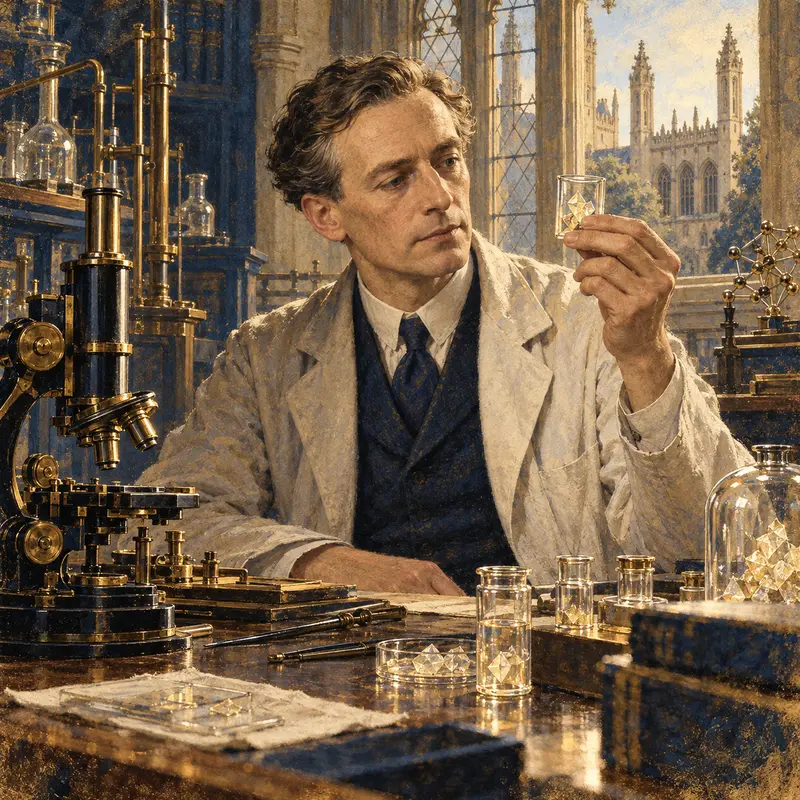
Sir John Ernest Walker, born in 1941 in Halifax, England, is a British chemist and structural biologist who solved the structure of the catalytic part of ATP synthase. He shared the 1997 Nobel Prize in Chemistry with Paul Boyer and Jens Skou. A scientist of patient and meticulous style, Walker spent his career at Cambridge, and his legacy is a detailed, atomic-level understanding of how mitochondria produce the energy that powers life.
Early Life and Family
John Walker was born on 7 January 1941 in Halifax, a mill town in Yorkshire, in northern England. His father was a stonemason, and his mother was a homemaker with a strong interest in music. Walker has spoken about a family atmosphere that valued hard work. As a child he enjoyed music and sport. He was educated at a grammar school in Rastrick, near Halifax, and public education gave him the chance to enter university.
Education and Mentors
Walker studied chemistry at St Catherine's College, Oxford, and graduated in 1964. He stayed at Oxford for his doctorate, working at the Oxford Laboratory of Organic Chemistry and the Dyson Perrins laboratory. His PhD work concerned the chemistry of peptide antibiotics and the structure of related peptides, under the supervision of Ted Abraham (as listed in several biographical accounts). After postdoctoral work abroad, he joined in 1969 the Medical Research Council (MRC) Laboratory of Molecular Biology at Cambridge, where Fred Sanger had developed protein and DNA sequencing, and this environment shaped Walker's career. Walker later became a Fellow of Sidney Sussex College, Cambridge.
Career Timeline
| Year | Event |
|---|---|
| 1941 | Born in Halifax, Yorkshire, on 7 January |
| 1964 | Graduated in chemistry from the University of Oxford |
| 1969 | Joined the MRC Laboratory of Molecular Biology, Cambridge, after postdoctoral work abroad |
| 1982 | Reported the Walker A and Walker B nucleotide-binding motifs |
| 1994 | Published the crystal structure of bovine F1-ATPase with colleagues |
| 1997 | Nobel Prize in Chemistry, shared with Paul D. Boyer and Jens C. Skou |
| 1999 | Knighted for services to molecular biology |
| 1998 | Became director of the MRC Dunn Human Nutrition Unit in Cambridge |
| 2000s onwards | Led the MRC Mitochondrial Biology Unit in Cambridge (the Dunn Unit was renamed accordingly) |
Major Scientific Contributions
- Protein sequencing of mitochondrial proteins. Walker's group worked out the complete amino acid sequences of many subunits of ATP synthase and of the proton-pumping complex I from bovine heart mitochondria.
- Walker A and B motifs. From comparison of sequences of ATP synthase and other proteins in 1982, his group identified conserved sequences for nucleotide binding. The Walker A motif GXXXXGK[T/S] is known to every biochemistry student.
- Structure of F1-ATPase (1994). The crystal structure showed three catalytic β subunits in different nucleotide states around an asymmetric γ shaft, which supported Boyer's binding change mechanism.
- Work on respiratory complex I. Later, his unit studied the very large complex I of the respiratory chain, using the bovine enzyme as a model. This is a medically important enzyme linked to many mitochondrial diseases.
- Inhibitor studies. The group studied natural inhibitors of ATP synthase and their binding in the F1 domain.
For the chemistry, structures and exam points, read our discovery post on the structure of ATP synthase.
Awards, Honours and the Nobel Prize
In 1997 the Nobel Prize in Chemistry was shared: one half to Paul D. Boyer and John E. Walker "for their elucidation of the enzymatic mechanism underlying the synthesis of adenosine triphosphate (ATP)" and the other half to Jens C. Skou for the Na+,K+-ATPase. Walker was elected a Fellow of the Royal Society (1995), became a member of the European Molecular Biology Organization, and was knighted in 1999 for his services to molecular biology. He is also a foreign member of several national academies of science. After the Nobel Prize he continued as a research leader and mentor at Cambridge.
Personality, Struggles and Lesser-Known Facts
- Music at home. His mother's love of music was part of his childhood, and he grew up in a modest working-class household in a Yorkshire mill town.
- A long project. The path from the first sequences of ATP synthase subunits in the late 1970s to the structure in 1994 took well over a decade of patient effort. Crystallising the enzyme was an especially hard step.
- Collaborative approach. He often credits his group, such as Jan Pieter Abrahams and Andrew Leslie, for the 1994 structure.
- Advocate for research funding. He has publicly spoken on the importance of stable government funding for basic research.
Legacy and Influence on Modern Chemistry
Walker's structure of F1 opened the path for hundreds of studies on the rotary mechanism of ATP synthase, and later for cryo-electron microscopy structures of the complete enzyme. His sequence motifs are still used to find ATP- and GTP-binding proteins in genomes. His work on mitochondrial complex I and other complexes is helping researchers understand rare mitochondrial diseases. The Mitochondrial Biology Unit at Cambridge, which he led, remains a key centre in the field. For Indian students, his work is a model example of how chemistry, structure and biology combine, and it appears in biochemistry and bioinformatics topics.
Lessons for Students
- Start with the basics. Sequencing and careful protein chemistry made the structure possible.
- Be patient. Great discoveries often need more than a decade.
- Government-funded education works. A grammar school student from a stonemason's family became a Nobel laureate.
- Combine methods. Biochemistry, genetics and crystallography together solved a problem that none could solve alone.
Quick Facts Box
- Born: 7 January 1941, Halifax, Yorkshire, England
- Died: Living (as of this writing)
- Nationality: British
- Field: Structural biology, bioenergetics, biochemistry
- Famous for: Structure of F1-ATPase; Walker A and B motifs
- Nobel: Chemistry, 1997 (shared with Paul D. Boyer and Jens C. Skou)
FAQ
Is John Walker alive?
Yes, to the best of our knowledge he is living. He was born in 1941.
Did Walker win the Nobel Prize alone?
No. He shared half the prize with Paul Boyer. The other half went to Jens Skou.
What are the Walker motifs?
They are conserved sequences, Walker A (the P-loop) and Walker B, found in many ATP- and GTP-binding proteins.
Where does he work?
He has worked at Cambridge, first at the MRC Laboratory of Molecular Biology and later at the MRC Mitochondrial Biology Unit, and he has been affiliated with Sidney Sussex College.
Published by ABC Chemistry — IIT-JAM | CSIR-NET | GATE Chemistry Coaching. Visit abcchemistry.com
About the chemist
John E. Walker
1941- · United Kingdom · Nobel Chemistry 1997
Structure of ATP synthase