Biography · Chemist no. 164 of 350
Michael Smith: Complete Life and Legacy of the Pioneer of Protein Engineering

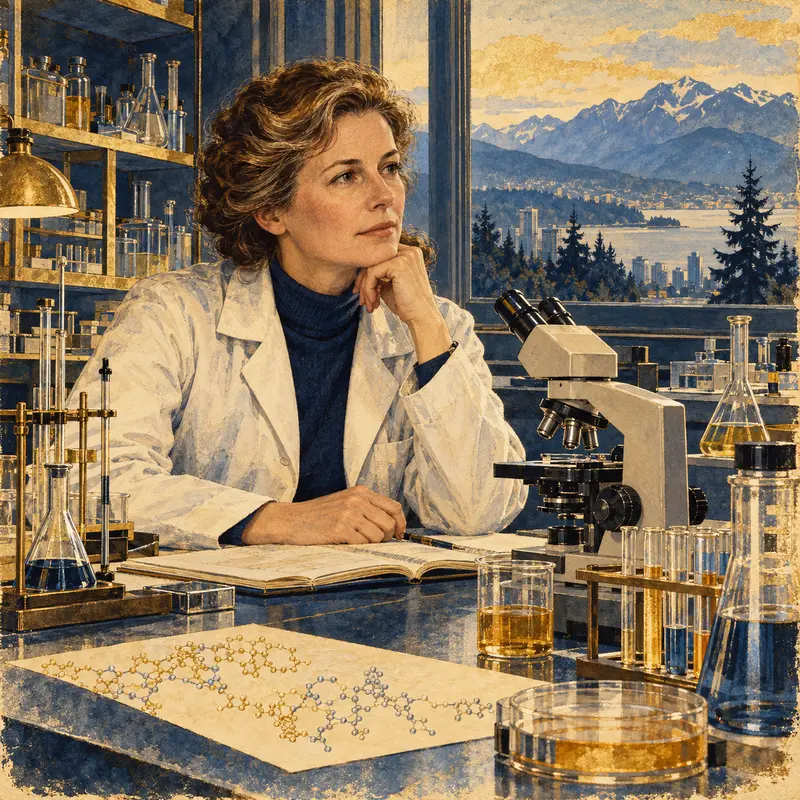
Michael Smith (1932–2000) was an English-born Canadian biochemist who spent most of his career at the University of British Columbia in Vancouver. He developed oligonucleotide-directed site-directed mutagenesis, a method that lets scientists change a gene at a chosen position and then see how the protein changes. He shared the 1993 Nobel Prize in Chemistry with Kary Mullis. Smith was also well known for generosity, and for helping to build biotechnology and genome science in Canada. His legacy: protein engineering as we know it started with his method.
Early Life and Family
Michael Smith was born on 26 April 1932 in Blackpool, in the north-west of England. His family was of modest means, and he grew up in the years of the Great Depression and the Second World War. He attended a local school, where he was a good student. His school education led him to the University of Manchester, which at that time was a leading university for chemistry. Details of his family life are less widely documented than for some other laureates, so this article keeps to what is well established: he came from an ordinary background and rose through study and effort.
Education and Mentors
Smith studied chemistry at the University of Manchester, earning a BSc in 1953 and a PhD in 1956. After the PhD he moved to Canada, to Vancouver, as a postdoctoral fellow in the laboratory of Har Gobind Khorana at the British Columbia Research Council. Khorana, who was born in a village in British India and later won the 1968 Nobel Prize in Physiology or Medicine, was developing methods for synthesising oligonucleotides, which became an important part of cracking the genetic code. Working with Khorana shaped Smith's career, giving him deep knowledge of nucleotide chemistry.
Career Timeline
| Year | Event |
|---|---|
| 1932 | Born in Blackpool, England |
| 1953 | BSc in chemistry, University of Manchester |
| 1956 | PhD, University of Manchester |
| 1956–1960 | Postdoctoral work with Har Gobind Khorana in Vancouver |
| 1960s | Research scientist at the Fisheries Research Board of Canada |
| 1966 | Joined the University of British Columbia |
| 1978 | Published the method of oligonucleotide-directed mutagenesis with colleagues |
| 1987 | Became founding director of the Biotechnology Laboratory at UBC |
| 1993 | Shared the Nobel Prize in Chemistry with Kary Mullis |
| 2000 | Died on 4 October in Vancouver |
Major Scientific Contributions
Smith's central contribution is site-directed mutagenesis. In 1978, he and his co-workers showed that a synthetic oligonucleotide containing one mismatched base can be annealed to a single-stranded DNA template (in their case the phage φX174), extended by DNA polymerase and sealed by DNA ligase, producing a mutant gene. When the DNA is replicated in cells, a proportion of progeny carry the intended change. This allowed researchers to replace any amino acid in a protein with any other, simply by changing a codon.
Other contributions and activities:
- Yeast genetics: Smith used the method to study the function of genes and proteins in yeast cells.
- Building a research community: He founded the Biotechnology Laboratory at UBC, which became a hub for molecular biology and, later, genome work.
- Genome science in Canada: In his last years he was involved in founding a genome sciences centre in Vancouver, which is now named in his honour.
Awards, Honours and Nobel Prize
The 1993 Nobel Prize in Chemistry was divided between Kary B. Mullis for the invention of PCR and Michael Smith "for his fundamental contributions to the establishment of oligonucleotide-based, site-directed mutagenesis and its development for protein studies." He also received the Gairdner Foundation International Award (1986) and was a Fellow of the Royal Society of Canada and the Royal Society of London. He became a Companion of the Order of Canada.
Personality, Struggles and Lesser-Known Facts
- Funding troubles: Early in his work on the method, he had difficulty getting research grants. He often acknowledged that support from Canadian funding agencies kept the work going.
- Generosity with prize money: Smith gave away his Nobel Prize money for causes such as research on schizophrenia and science education rather than keeping it for himself.
- Immigrant scientist: He moved from England to Canada as a young man and made it his home for the rest of his life.
- Promoter of science for the public: He spoke often about the need to explain science to society.
- Link to Khorana: The chain of ideas from Khorana's synthetic DNA chemistry to Smith's mutagenesis shows how basic chemical methods grow into biological tools.
Legacy and Influence on Modern Chemistry
Site-directed mutagenesis is taught in every molecular biology course. It lets scientists answer the question "what does this amino acid do?" by making the change and measuring the effect on kinetics, stability or binding. It is the basis of protein engineering, used to develop industrial enzymes, therapeutic antibodies and insulin analogues. The method also supports the study of disease mutations. Modern genome-editing tools such as CRISPR-Cas9 extend this idea to whole genomes, but site-directed mutagenesis remains a daily tool. In India, biotechnology and chemistry research groups apply it widely, and the topic appears in biochemistry syllabuses for CSIR-NET and GATE.
Lessons for Students
- Use chemistry as a tool for biology. Synthetic DNA chemistry made genetic experiments precise.
- Be persistent when funding is tight. Good ideas sometimes take time to be accepted.
- Share success. Smith used his prize to support others.
- Credit your teachers. He often acknowledged Khorana's influence.
Quick Facts Box
- Born: 26 April 1932, Blackpool, England
- Died: 4 October 2000, Vancouver, Canada
- Nationality: British-born Canadian
- Field: Biochemistry, molecular genetics
- Famous for: Oligonucleotide-directed site-directed mutagenesis
- Nobel: 1993, Chemistry (shared with Kary Mullis)
FAQ
Who was Michael Smith's mentor?
Har Gobind Khorana, with whom he worked as a postdoctoral researcher in Vancouver.
Where did he work most of his life?
At the University of British Columbia in Vancouver, Canada.
What is site-directed mutagenesis in one line?
A method that uses a synthetic mismatched primer to change a chosen base in a gene.
Was the Nobel Prize in Chemistry or Medicine?
Chemistry, in 1993, shared with Kary Mullis.
Published by ABC Chemistry — IIT-JAM | CSIR-NET | GATE Chemistry Coaching. Visit abcchemistry.com
About the chemist
Michael Smith
1932-2000 · Canada · Nobel Chemistry 1993
Site-directed mutagenesis