Biography · Chemist no. 148 of 350
Paul Berg: The Scientist Who Spliced Genes and Asked the Hard Questions
Introduction
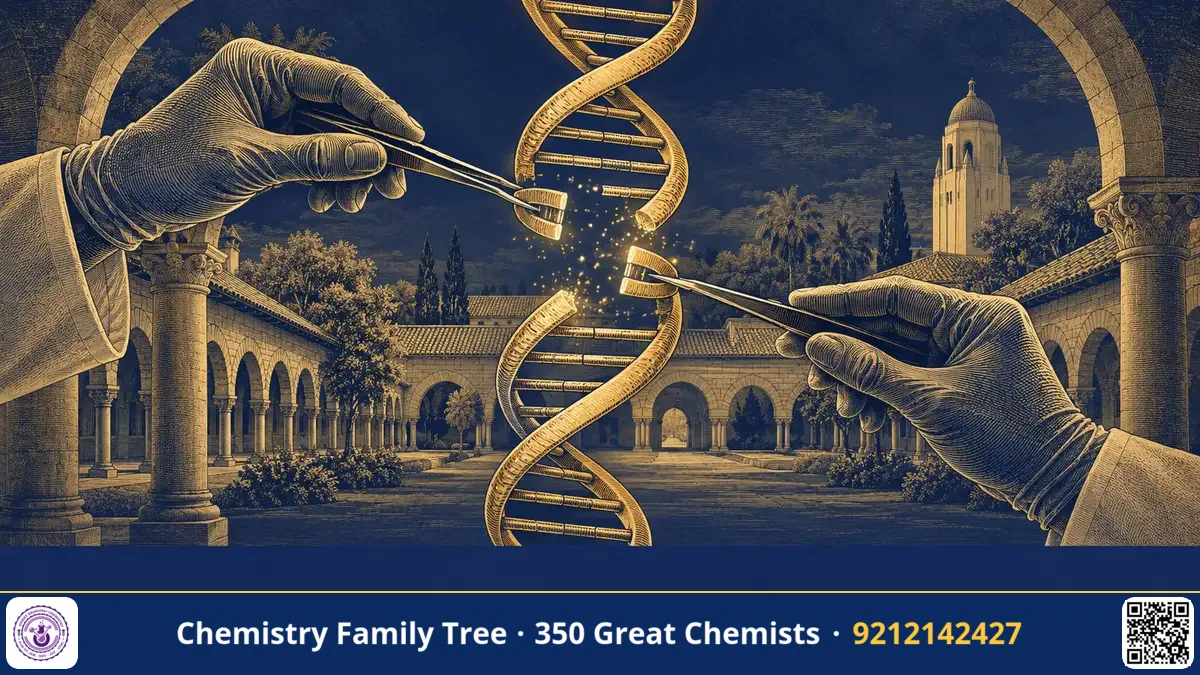
Paul Berg (1926-2023) was an American biochemist who made the first recombinant DNA molecules in 1972, opening the door to modern genetic engineering. He also played a leading role in the debate over how to do this research safely, and he shared the 1980 Nobel Prize in Chemistry. In one line: Berg showed that DNA can be cut and joined, and then insisted that scientists think about the consequences.
Early Life and Family
Paul Berg was born on 30 June 1926 in Brooklyn, New York, in a Jewish family. His father, Harry Berg, was a clothing manufacturer, and his mother, Sarah, took care of the family. He grew up in a modest home in a busy neighbourhood and went to Abraham Lincoln High School. As a boy he was fascinated by the questions "why" and "how" and became curious about science early. He did not come from a family of scientists, and for him, the laboratory was a new world.
Education and Mentors
Berg studied biochemistry at Pennsylvania State University and graduated in 1948. After a period of service in the US Navy during the Second World War, he completed his degree and then went to Western Reserve University (now Case Western Reserve University) in Cleveland, where he worked with Harland G. Wood and earned his PhD in biochemistry in 1952. He then went to Copenhagen to work with Herman Kalckar, and next to Washington University in St. Louis, where he joined the group of Arthur Kornberg, a future Nobel laureate who was an important mentor. Kornberg's laboratory was a centre for the enzymology of nucleic acids, and Berg learned there the rigorous approach to enzymes and metabolism that shaped his career.
Career Timeline
| Year | Event |
|---|---|
| 1926 | Born in Brooklyn, New York on 30 June |
| 1948 | BS in biochemistry, Pennsylvania State University |
| 1952 | PhD, Western Reserve University |
| 1950s | Postdoctoral work in Copenhagen and at Washington University, St. Louis |
| 1955 | Joins the Washington University faculty |
| 1959 | Moves to Stanford University, becoming a professor of biochemistry |
| 1950s | Works out the aminoacyl-adenylate mechanism of amino acid activation |
| 1972 | First recombinant DNA molecules made in his laboratory |
| 1974 | Leads a letter calling for a pause on certain recombinant DNA experiments |
| 1975 | Co-organises the Asilomar Conference on Recombinant DNA |
| 1980 | Nobel Prize in Chemistry |
| 1985 | Becomes director of the Beckman Center for Molecular and Genetic Medicine at Stanford |
| 2023 | Dies on 15 February in Stanford, California |
Major Scientific Contributions
Berg made two big contributions. In the first part of his career he explained the mechanism of amino acid activation for protein synthesis, showing that an aminoacyl-AMP intermediate is formed on the enzyme and that aminoacyl-tRNA synthetases play a key role in the accuracy of translation. In the second, he moved to the study of the tumour virus SV40 and created the first recombinant DNA molecules by joining SV40 DNA to bacterial and phage DNA. He then used SV40 as a vehicle to understand gene expression in animal cells. In the 1980s, he developed methods for gene targeting in mammalian cells, which led to the construction of specific mutants and is related to the development of knockout mice. The experimental details are given in the companion discovery post.
Awards, Honours and Nobel Prize
- Nobel Prize in Chemistry, 1980, awarded one half to Paul Berg for his fundamental studies of the biochemistry of nucleic acids, with particular regard to recombinant DNA. The other half was shared by Walter Gilbert and Frederick Sanger for work on determining base sequences in nucleic acids.
- National Medal of Science, United States, in 1983.
- Member of the United States National Academy of Sciences.
- Honorary degrees from many universities.
Personality, Struggles and Lesser-Known Facts
- The self-imposed moratorium. In 1974, Berg and other leading scientists published a letter in the journal Science asking researchers to voluntarily pause certain kinds of recombinant DNA experiments until the risks were understood. It was the first time that scientists had asked to limit their own research for safety reasons.
- Asilomar, 1975. He was a lead organiser of the Asilomar conference in California, where about 140 biologists, lawyers and physicians discussed guidelines. The meeting helped lead to national regulations and is regarded as a model for self-governance in science.
- Criticism from both sides. Some critics thought the scientists were too cautious, and others thought that they were too bold. Berg later said that the process, though imperfect, built public trust.
- A student of Kornberg. He often credited his years in Kornberg's laboratory for his scientific style.
- Family. He married Mildred Levy in 1947, and the couple had a son, John.
- Later advocacy. In later years he spoke in support of stem cell research and the public funding of science, and about the importance of education in science.
Legacy and Influence on Modern Chemistry
Berg's recombinant DNA work was a step in the creation of the biotechnology industry. Genetic engineering has given us medicines, vaccines, crops and new research methods. The Asilomar model of scientists engaging in an open discussion of safety remains a reference for debates about gene editing, synthetic biology and artificial intelligence. His earlier work on tRNA charging is still a core part of biochemistry textbooks.
Lessons for Students
- Master a basic subject such as enzymology; it can take you to unexpected places.
- Combine curiosity with responsibility. A powerful technology needs careful thought.
- Learn from great mentors and then follow your own questions.
- Communicate openly with the public about science.
- Be ready to be criticised and to listen.
Quick Facts Box
- Born: 30 June 1926, Brooklyn, New York, USA
- Died: 15 February 2023, California, USA
- Nationality: American
- Field: Biochemistry, molecular biology
- Famous for: First recombinant DNA; aminoacyl-AMP mechanism; Asilomar
- Nobel: Chemistry, 1980 (half; the other half Gilbert and Sanger)
FAQ
Did Paul Berg win the Nobel Prize in Medicine?
No, his prize in 1980 was in Chemistry.
Who shared the 1980 Nobel Prize in Chemistry?
Berg received one half. Walter Gilbert and Frederick Sanger shared the other half for DNA sequencing methods.
What was the Asilomar conference?
A 1975 meeting that set voluntary safety guidelines for recombinant DNA experiments.
Which institution was his main base?
Stanford University, where he worked from 1959 for the rest of his career.
Published by ABC Chemistry — IIT-JAM | CSIR-NET | GATE Chemistry Coaching. Visit abcchemistry.com
About the chemist
Paul Berg
1926-2023 · United States · Nobel Chemistry 1980
Recombinant DNA