The discovery, explained · Chemist no. 148 of 350
Paul Berg: Cutting and Joining the Molecules of Heredity
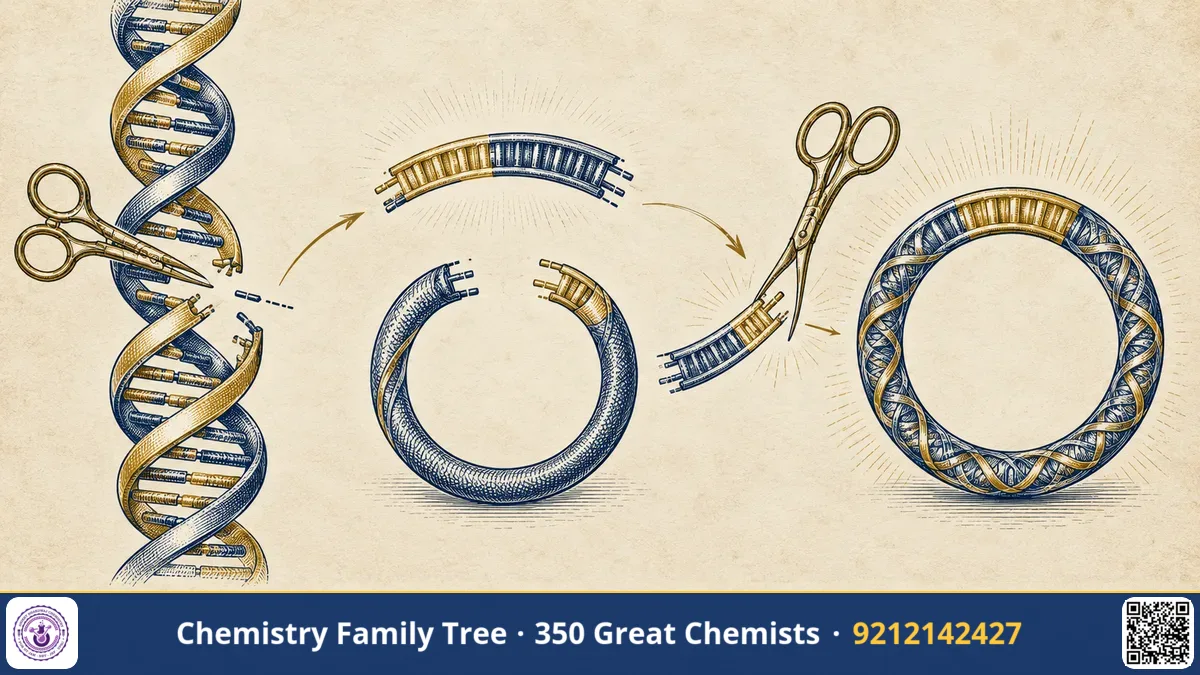
Today, bacteria produce human insulin in giant fermenters, scientists can read and edit genomes, and new vaccines can be designed in weeks. All of this rests on one basic technique - the ability to cut DNA from different sources and join the pieces into a new molecule. The first person to do this was the American biochemist Paul Berg (1926-2023), whose laboratory at Stanford created the first recombinant DNA molecules in 1972. Berg also helped to start the world's first discussion on the safety and ethics of genetic engineering. In 1980 he received half of the Nobel Prize in Chemistry for his fundamental studies of the biochemistry of nucleic acids, with particular regard to recombinant DNA. The other half was shared by Walter Gilbert and Frederick Sanger.
The Scientific Problem Before the Discovery
By the late 1960s, the structure of DNA, the genetic code and the mechanism of protein synthesis were largely understood. Yet molecular biologists were frustrated by a practical problem. DNA of higher organisms is huge, with millions or billions of base pairs, and individual genes make up only a tiny fraction. How could one gene be isolated, studied or made to function in a different organism? How could one ask what a gene of a virus does inside a bacterium or a mammalian cell?
Berg was studying tumour viruses, especially SV40 (simian virus 40), a small virus with a circular DNA genome of about 5,000 base pairs which can cause cancer in rodents. He wished to introduce foreign genes into animal cells using SV40 as a vehicle, to learn how genes are controlled in higher cells. For this he needed a way to splice DNA molecules together reliably.
The Discovery and Experiment
- Choice of DNAs. Berg's team (David Jackson, Robert Symons and Berg) chose to join SV40 DNA with DNA of bacteriophage lambda carrying the galactose operon genes of E. coli (lambda dvgal). Both are circular molecules.
- Opening the circles. Each circular DNA was converted into a linear molecule by a single cut. For SV40, they used the restriction enzyme EcoRI, which cuts the circle once; the lambda DNA was cut in a similar way.
- Making sticky ends. Lambda exonuclease chewed back the 5' ends, and terminal deoxynucleotidyl transferase added short homopolymer tails: poly(dA) on one DNA and poly(dT) on the other. The complementary tails can base-pair with each other, like Velcro.
- Joining. After annealing of the tails, the annealed molecules were treated with DNA polymerase I and DNA ligase to fill gaps and seal the nicks, giving a covalently closed hybrid circular DNA containing both SV40 and the galactose genes.
- Caution. Berg did not introduce the hybrid into bacteria, because of concern about the safety of putting SV40 sequences into E. coli, an organism that lives in the human gut. This decision was a major early example of scientific self-restraint.
The Chemistry Behind It
Restriction enzymes
Restriction endonucleases are bacterial enzymes which defend bacteria against viruses by cutting foreign DNA at specific short palindromic sequences. EcoRI cuts as follows:
5'-G | A A T T C-3'
3'-C T T A A | G-5'
Result: 5'-AATT overhangs ("sticky ends") on both fragments
Because the overhangs of any two EcoRI-cut DNAs are complementary, fragments from any source can pair. Werner Arber, Daniel Nathans and Hamilton Smith received the 1978 Nobel Prize in Physiology or Medicine for restriction enzymes and their use.
DNA ligase
DNA ligase seals the nick in the sugar-phosphate backbone, forming a phosphodiester bond between a 3'-OH and a 5'-phosphate. The E. coli enzyme requires NAD+, and the T4 ligase uses ATP. In both cases an enzyme-AMP intermediate is formed first, and then AMP is transferred to the 5'-phosphate of the DNA, which is attacked by the 3'-OH:
Enzyme + ATP → Enzyme-AMP + PPi
Enzyme-AMP + 5'-P-DNA → DNA-5'-PP-A + Enzyme
DNA-5'-PP-A + 3'-OH-DNA → DNA-3'-O-P-5'-DNA + AMP
Cloning
The later step, done by Stanley Cohen and Herbert Boyer in 1973, was to place the recombinant molecule in a plasmid vector and introduce it into E. coli by transformation. The bacteria multiply, copying the foreign DNA. Cells that have taken up the plasmid are selected on antibiotic plates, for example ampicillin, and identified by blue-white screening using lacZ and X-gal.
Berg's earlier work
Berg was also a distinguished enzymologist. He showed that amino acids are activated for protein synthesis by forming aminoacyl-adenylate (aminoacyl-AMP) intermediates from ATP, before being transferred to tRNA. This work on aminoacyl-tRNA synthetases showed that these enzymes recognise both the correct amino acid and the correct tRNA, thereby ensuring the accuracy of the genetic code:
amino acid + ATP → aminoacyl-AMP + PPi
aminoacyl-AMP + tRNA → aminoacyl-tRNA + AMP
Applications Today
- Medicine. Recombinant insulin, growth hormone, clotting factors, interferons and hepatitis B vaccine are produced using these methods. India's biotechnology companies produce recombinant insulin and vaccines at large scale.
- Gene therapy and editing. Vectors based on viruses carry genes into human cells. CRISPR-Cas9 editing tools are delivered using plasmids and viruses constructed with recombinant DNA techniques.
- Agriculture. Bt cotton, grown widely in India, carries a Bacillus thuringiensis gene for an insect toxin.
- Research. Cloning, sequencing, mutagenesis and expression of proteins in the laboratory depend on these methods. Berg later developed gene targeting in mouse cells.
- Diagnostics. Cloned DNA is the basis of probes and PCR assays.
Exam Corner
- First recombinant DNA (1972): SV40 + lambda dvgal, by Berg, Jackson and Symons at Stanford.
- EcoRI recognises 5'-GAATTC-3' (palindrome) and cuts between G and A, leaving 5' sticky ends.
- DNA ligase forms a phosphodiester bond; E. coli ligase uses NAD+, T4 ligase uses ATP.
- Cohen and Boyer made the first cloned recombinant plasmid in bacteria in 1973.
- Nobel Prize in Chemistry 1980: Berg (half); Gilbert and Sanger (other half).
Common Misconceptions
- "Berg cloned the first gene in bacteria." His 1972 hybrid was not put in bacteria; Cohen and Boyer's 1973 experiment did that.
- "Restriction enzymes were discovered for biotechnology." They evolved in bacteria as a defence against bacteriophage.
- "The 1980 prize was in Medicine." It was the Nobel Prize in Chemistry.
Quick Revision Box
- Berg's team made the first recombinant DNA in 1972 (SV40 + lambda dvgal).
- Tools: restriction enzymes, terminal transferase, DNA ligase.
- EcoRI site: GAATTC; cuts G^AATTC; sticky ends.
- Cohen and Boyer: plasmid cloning in E. coli, 1973.
- Berg's earlier work: aminoacyl-AMP intermediate in tRNA charging.
- Nobel Prize in Chemistry, 1980.
FAQ
What is recombinant DNA?
It is a DNA molecule made by joining DNA from two or more different sources, which would not normally occur together.
Why did Berg not put his hybrid into bacteria?
He was concerned about biosafety: SV40 can cause tumours in animals, and E. coli lives in the human gut.
What was the Asilomar meeting?
It was a 1975 conference in California, organised by Berg and others, where scientists discussed safety rules for recombinant DNA research. It produced guidelines for safe experiments.
How can I use this for JAM and NET?
Study restriction enzymes, ligase, vectors and cloning steps; they feature in biotechnology and biochemistry sections.
Published by ABC Chemistry — IIT-JAM | CSIR-NET | GATE Chemistry Coaching. Visit abcchemistry.com
About the chemist
Paul Berg
1926-2023 · United States · Nobel Chemistry 1980
Recombinant DNA