The discovery, explained · Chemist no. 167 of 350
Paul Boyer and the Binding Change Mechanism: How Cells Make ATP
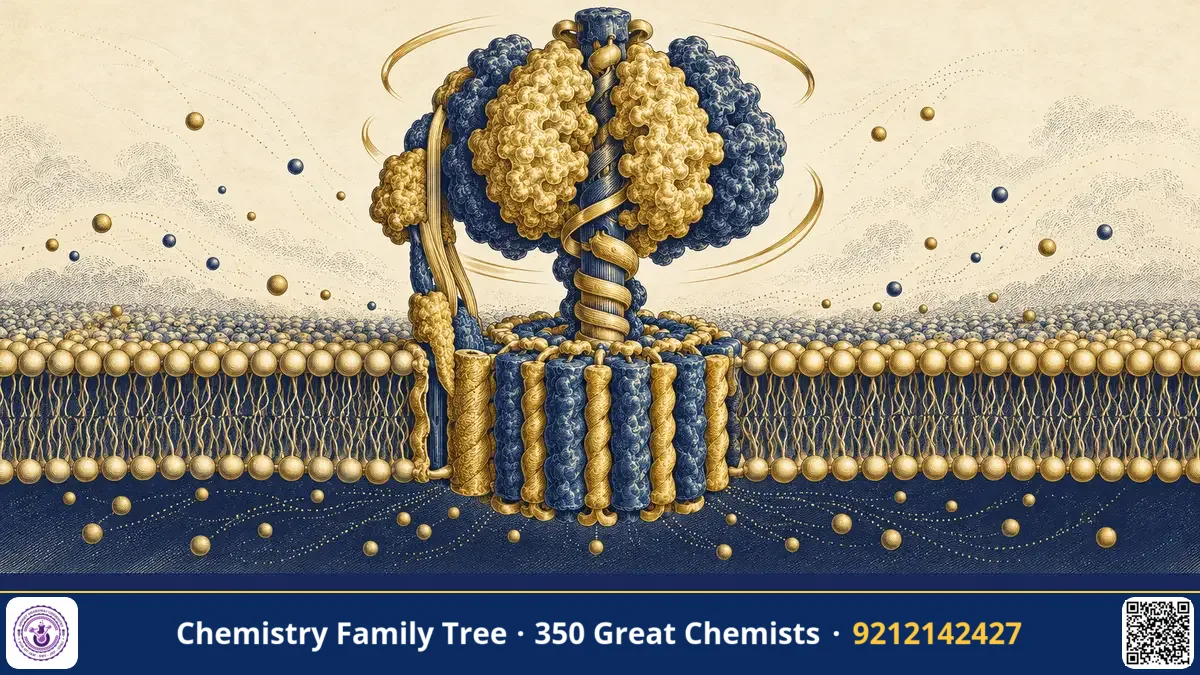
Every second, the human body recycles an enormous quantity of ATP, the energy currency of the cell. The enzyme that makes most of it, ATP synthase, is a tiny rotary machine in the inner membrane of mitochondria. The American biochemist Paul D. Boyer proposed how this machine works: the binding change mechanism and rotational catalysis. His model said that the energy of a proton gradient is not used to make the chemical bond of ATP, but to release ATP that is already formed tightly on the enzyme. Boyer shared the 1997 Nobel Prize in Chemistry with John E. Walker for this work, while the other half of the prize went to Jens Skou for the sodium-potassium pump.
The Scientific Problem Before the Discovery
By the 1950s, biochemists knew that oxidation of NADH and FADH2 in the electron transport chain is coupled to the phosphorylation of ADP. This is called oxidative phosphorylation:
ADP + Pi + energy → ATP + H₂O
But how was the energy transferred? Early ideas looked for a high-energy chemical intermediate, as in substrate-level phosphorylation. Nobody could find one. In 1961 Peter Mitchell proposed the chemiosmotic theory: electron transport pumps protons across the inner mitochondrial membrane, building an electrochemical proton gradient (the proton-motive force), and ATP synthase uses the flow of protons back into the matrix to make ATP. Mitchell's theory explained the source of energy, but it did not explain what happens inside the enzyme. How does a flow of protons make a P–O bond?
The Discovery: How Boyer Reached the Mechanism
Boyer's approach was careful chemistry with isotopes. He studied the exchange of oxygen atoms between water and phosphate using 18O. If ATP formation was a simple, energy-requiring step, then the reverse reaction, ATP hydrolysis, should be fully reversible only when energy was supplied. Instead he found that mitochondria and isolated enzymes catalysed rapid exchange of oxygen between phosphate and water even when no net ATP was made. In simple terms:
E + ADP + Pi ⇌ E·ATP (tightly bound) ⇌ E + ATP
This showed that ATP forms spontaneously at the active site, with very little change in free energy, because it is bound extremely tightly. The step that needs energy is the release of ATP from the enzyme. This was an important and surprising idea.
From these results and from kinetic studies, Boyer proposed in the late 1970s that the enzyme has three catalytic sites that work in sequence and in different states at the same moment:
- Open (O): binds ADP and Pi weakly; ATP can leave.
- Loose (L): binds ADP and Pi but they are not yet converted.
- Tight (T): ADP and Pi are converted to ATP, which is bound very tightly.
The proton flow causes a conformational change in which each site moves O → L → T → O. When the T site becomes O, ATP is released. Because three sites change together, the enzyme needs a central rotating shaft that pushes each site in turn. Boyer therefore predicted that part of the enzyme must physically rotate, an idea called rotational catalysis. At first this was controversial because nobody had seen a rotating enzyme.
The Chemistry Behind It
Structure of ATP synthase
ATP synthase has two parts. Fo sits in the membrane and has a ring of c-subunits through which protons flow. F1 projects into the mitochondrial matrix and contains the catalytic sites. F1 has the subunit composition α3β3γδε. The three β subunits carry the three catalytic sites, and the γ subunit is the asymmetric central shaft that turns inside the α3β3 hexagon.
Evidence for rotation
In 1994 John Walker and colleagues solved the crystal structure of bovine F1. It showed three β subunits in three different states, one with bound AMP-PNP, one with ADP, and one empty. This agreed exactly with Boyer's O, L and T picture. In 1997, Hiroyuki Noji, Masasuke Yoshida, Kazuhiko Kinosita and co-workers attached a fluorescent actin filament to the γ subunit and watched it rotate under a microscope as ATP was hydrolysed. Rotation of an enzyme was now directly seen.
Energy accounting
One full 360° turn of the shaft makes three ATP molecules. The number of protons needed per turn equals the number of c-subunits in the c-ring. For example, if the ring has 10 c-subunits, then 10 H+ are needed for 3 ATP, which is about 3.3 H+ per ATP. This ratio is the reason why the P/O ratio in textbooks is non-integral, for instance about 2.5 ATP per NADH and about 1.5 ATP per FADH2.
Applications Today
- Medicine: ATP synthase is a drug target. The antibiotic bedaquiline, used against drug-resistant tuberculosis, targets the ATP synthase of Mycobacterium tuberculosis. This is relevant for India, which has a heavy TB burden.
- Mitochondrial disease: Mutations in ATP synthase subunits cause energy-deficiency disorders, so the mechanism helps clinicians and researchers.
- Nanotechnology: Researchers use ATP synthase as a model for molecular motors and for designing artificial rotary machines.
- Bioenergetics teaching: The mechanism unifies respiration in mitochondria, photophosphorylation in chloroplasts and ATP formation in bacteria, as all use similar enzymes.
Exam Corner
- In Boyer's model, the energy-requiring step is the release of tightly bound ATP, not the synthesis of the P–O bond.
- Three β subunits exist in three conformations: open, loose and tight. The rotating γ subunit drives the change.
- Fo is the membrane proton channel (oligomycin sensitive). F1 is the soluble catalytic head.
- Nobel Prize in Chemistry 1997: Boyer and Walker for ATP synthesis; Skou for Na+,K+-ATPase.
- Peter Mitchell's chemiosmotic theory (Nobel Prize in Chemistry 1978) gives the proton-motive force; Boyer's theory gives the enzyme mechanism.
Common Misconceptions
- "Proton flow directly attaches phosphate to ADP." According to Boyer, ATP forms at the site with little energy input; the proton flow drives conformational change that releases ATP.
- "ATP synthase makes one ATP per proton." Several protons are needed for each ATP, and the ratio depends on the number of c-subunits.
- "Rotation of an enzyme is only a theory." It has been directly observed by single-molecule microscopy and supported by crystal structures.
Quick Revision Box
- Binding change mechanism: three catalytic sites, three states (O, L, T).
- ATP forms on the enzyme easily; energy is needed to release it.
- γ subunit rotates inside the α3β3 hexamer; c-ring rotates in Fo.
- Evidence: 18O exchange (Boyer), crystal structure (Walker 1994), single-molecule rotation (1997).
- One full rotation makes 3 ATP.
- Nobel Prize in Chemistry 1997 shared with John Walker and Jens Skou.
FAQ
What is the binding change mechanism?
It is a model in which each catalytic site of ATP synthase cycles through three states with different affinities for nucleotides. Energy from the proton gradient is used to change these affinities, so that ATP is released.
How did Boyer use isotopes?
He used 18O-labelled water and phosphate and followed the exchange of oxygen atoms. The exchange showed that ATP could form and break at the active site with little energy change.
What is the difference between Fo and F1?
Fo is embedded in the membrane and carries protons. F1 is attached on the matrix side and makes ATP.
Is the same enzyme found in plants and bacteria?
Yes. Chloroplasts and bacteria have closely related ATP synthases. The basic rotary design is conserved across all kingdoms of life.
Published by ABC Chemistry — IIT-JAM | CSIR-NET | GATE Chemistry Coaching. Visit abcchemistry.com
About the chemist
Paul D. Boyer
1918-2018 · United States · Nobel Chemistry 1997
ATP synthase mechanism