Biography · Chemist no. 167 of 350
Paul D. Boyer: The Biochemist Who Explained How Cells Make ATP
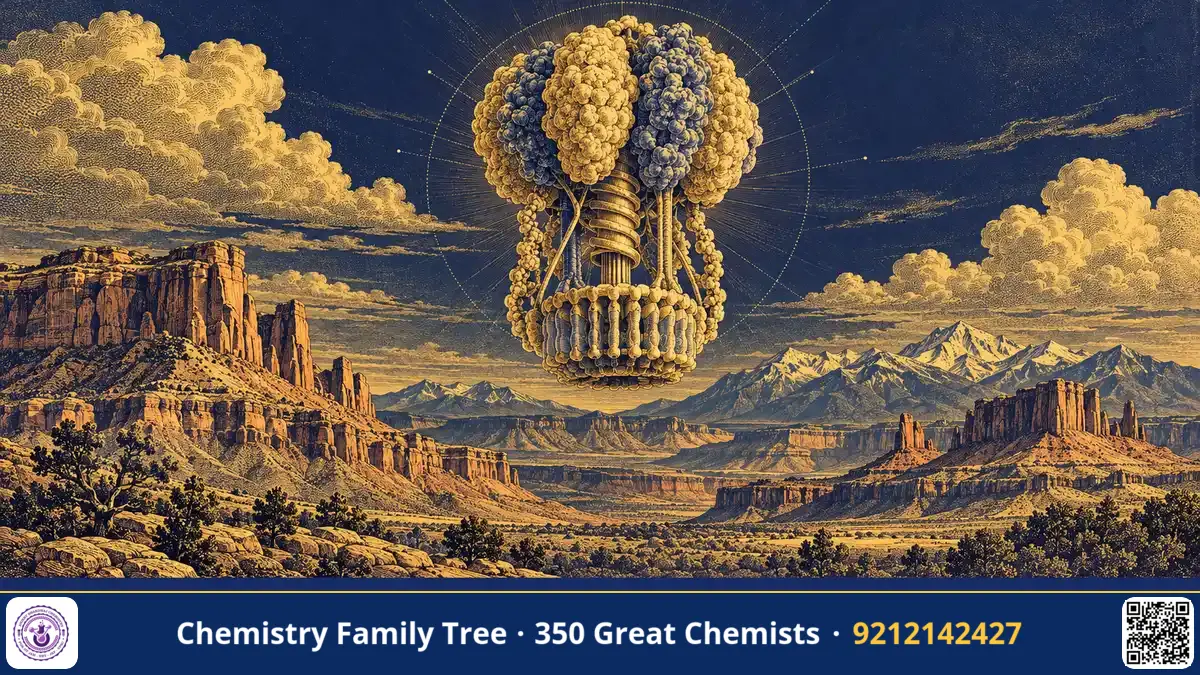
Paul Delos Boyer (1918–2018) was an American biochemist who spent most of his career at the University of California, Los Angeles (UCLA). He proposed the binding change mechanism of ATP synthase, and for this he shared the 1997 Nobel Prize in Chemistry with John E. Walker. Boyer lived to the age of 99. His legacy is a clear picture of how the cell's most important enzyme converts the energy of a proton gradient into the chemical energy of ATP.
Early Life and Family
Boyer was born on 31 July 1918 in Provo, Utah, in the western United States. He grew up in a family of modest means in Utah, where the Church of Jesus Christ of Latter-day Saints strongly influenced local culture. He attended local schools and became interested in science during his school years. Provo was a small city, and there was no tradition of Nobel-level research around him. His success shows how a student can reach the top from simple surroundings.
Education and Mentors
Boyer studied at Brigham Young University in Provo and received his bachelor's degree in 1939. He then went to the University of Wisconsin–Madison, which was a leading centre of biochemistry, and completed his PhD in 1943. His doctoral work was in enzymology and biochemistry under Paul Phillips and in an environment that also included other well-known biochemists at Wisconsin. After the PhD, he worked on topics related to the war effort, such as the stabilisation of blood proteins and the study of enzymes. He later moved to Stanford University for a postdoctoral period before taking a faculty position.
Career Timeline
| Year | Event |
|---|---|
| 1918 | Born in Provo, Utah, on 31 July |
| 1939 | Bachelor's degree, Brigham Young University |
| 1943 | PhD in biochemistry, University of Wisconsin–Madison |
| 1940s–1950s | Research at Stanford and then professor at the University of Minnesota |
| 1963 | Moved to UCLA as professor of chemistry |
| 1965 | Became the first director of the UCLA Molecular Biology Institute (as recorded in biographical accounts) |
| 1970s | Proposed the binding change mechanism of ATP synthase |
| 1997 | Nobel Prize in Chemistry, shared with John E. Walker and Jens C. Skou |
| 2018 | Died on 2 June in Los Angeles, aged 99 |
Major Scientific Contributions
Boyer worked for decades on the question of how energy is used to make ATP. His important contributions include:
- Phosphorylated enzyme intermediates. He showed that some enzymes form covalent phosphoenzyme intermediates, for example a phosphohistidine residue in certain reactions. This helped students understand the "ping-pong" type of enzyme mechanism.
- Oxygen-18 exchange studies. By following the exchange of oxygen between water and phosphate, he showed that ATP can form at the active site without much energy input.
- The binding change mechanism. In this model, three catalytic sites of ATP synthase alternate between open, loose and tight conformations, and the energy of the proton gradient is used to release tightly bound ATP.
- Rotational catalysis. He predicted that a central subunit of the enzyme turns, which was confirmed by structure and single-molecule experiments.
For the chemistry in detail, see our discovery post, which covers the Fo and F1 domains, the 3 ATP per rotation, and the P/O ratio.
Awards, Honours and the Nobel Prize
The Nobel Prize in Chemistry 1997 was divided: one half jointly to Paul D. Boyer and John E. Walker "for their elucidation of the enzymatic mechanism underlying the synthesis of adenosine triphosphate (ATP)", and the other half to Jens C. Skou for the discovery of the ion-transporting enzyme Na+,K+-ATPase. Boyer was elected to the United States National Academy of Sciences, and he was well known as a teacher, as editor of reference works such as Annual Review of Biochemistry (he edited it for many years) and the multi-volume series The Enzymes. He was awarded the Nobel Prize at the age of 79.
Personality, Struggles and Lesser-Known Facts
- A slow-burning idea. Boyer's mechanism took roughly two decades to be accepted. When he first suggested that part of an enzyme rotates, many biochemists were doubtful, as no enzyme was known to rotate.
- Proved right by others. The crystal structure of F1 by Walker (1994) and the video of a rotating γ subunit by Japanese scientists (1997) turned his hypothesis into established fact.
- Builder of institutions. He helped to create and lead the Molecular Biology Institute at UCLA, which brought together chemists, biologists and physicists.
- Long productive life. He continued to teach and to take part in the scientific community into his old age, and he was one of the longest-lived Nobel laureates in chemistry.
- Nobel for both mechanism and structure. The Nobel committee honoured a theorist-experimentalist (Boyer) and a structural biologist (Walker) in the same year for one problem, which shows how science advances from different directions.
Legacy and Influence on Modern Chemistry
Boyer's mechanism is in every biochemistry textbook, including the ones used in Indian B.Sc. and M.Sc. courses. It turned bioenergetics from a descriptive subject into a mechanistic one. It also inspired the field of molecular motors and single-molecule biophysics, and drug research on ATP synthase for tuberculosis and other diseases. Perhaps more important, it taught chemists that enzymes can be mechanical machines whose shape changes do real work.
Lessons for Students
- Use simple experiments with clever tools. Isotope exchange with 18O led to a big idea.
- Be patient with bold ideas. It may take years for the community to accept a good theory.
- Value teamwork. Proof of Boyer's theory came from crystallographers and physicists.
- It is never too late. Boyer's Nobel recognition arrived late in life, after decades of steady work.
Quick Facts Box
- Born: 31 July 1918, Provo, Utah, USA
- Died: 2 June 2018, Los Angeles, California
- Nationality: American
- Field: Biochemistry, bioenergetics
- Famous for: Binding change mechanism of ATP synthase
- Nobel: Chemistry, 1997 (shared with John E. Walker and Jens C. Skou)
FAQ
Was Boyer's Nobel Prize in Chemistry or Medicine?
It was the Nobel Prize in Chemistry in 1997, although the work is biochemistry. Skou, who shared the same year's prize, was a medical doctor but also received the prize in Chemistry.
Where did Boyer work for most of his career?
He was a professor at UCLA from 1963 and was associated with the university for the rest of his life.
Who shared the prize with Boyer?
John E. Walker of Britain shared half the prize with him, and Jens C. Skou of Denmark received the other half.
Why is Boyer important for exams?
Questions on oxidative phosphorylation, FoF1 ATP synthase and the binding change mechanism appear in biochemistry sections of CSIR-NET life and chemical sciences and in some GATE papers.
Published by ABC Chemistry — IIT-JAM | CSIR-NET | GATE Chemistry Coaching. Visit abcchemistry.com
About the chemist
Paul D. Boyer
1918-2018 · United States · Nobel Chemistry 1997
ATP synthase mechanism