The discovery, explained · Chemist no. 204 of 350
Paul Modrich and the Proofreader of the Genome: DNA Mismatch Repair
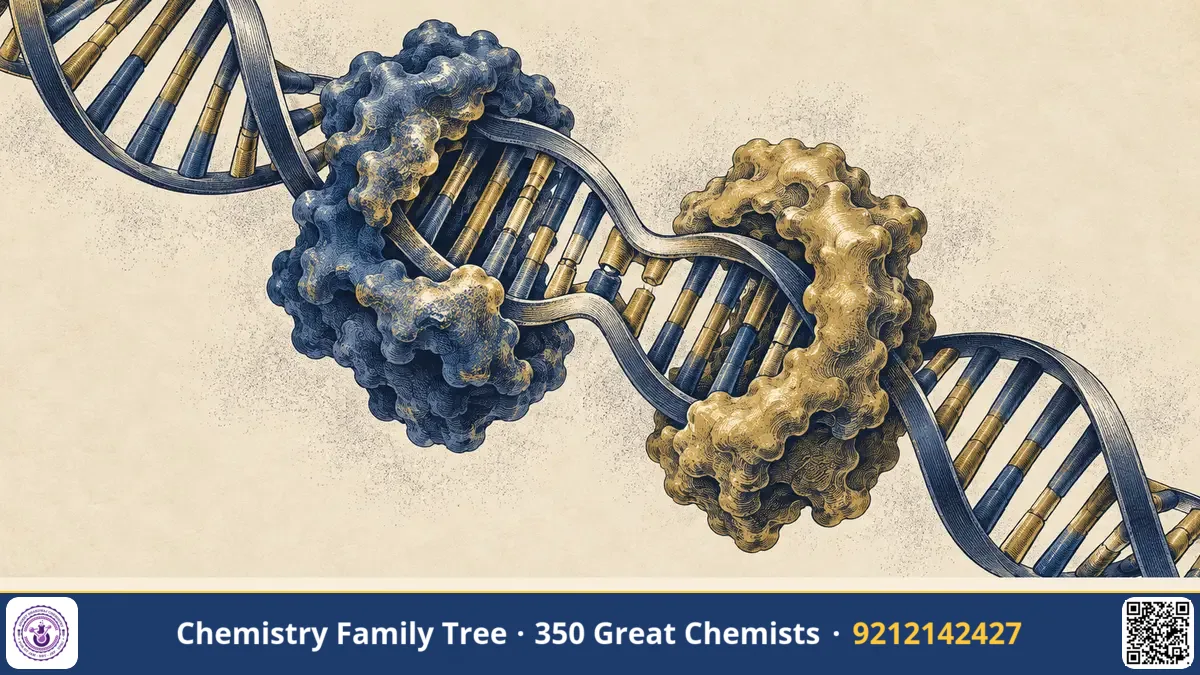
Every time a cell divides, it must copy about three billion base pairs of DNA. The copying enzyme, DNA polymerase, is very accurate, yet it still makes mistakes: occasionally the wrong base is inserted, such as G opposite T. If these mismatches remained, the daughter cell would carry mutations. Paul Modrich, a biochemist at Duke University, asked how a cell finds and fixes such errors, and how it knows which strand holds the mistake. By purifying the proteins and rebuilding the repair process in a test tube, he explained the answer for the bacterium E. coli and showed that the same system, when broken in humans, leads to cancer. For this he shared the 2015 Nobel Prize in Chemistry with Tomas Lindahl and Aziz Sancar.
The Scientific Problem Before the Discovery
DNA polymerase III in E. coli inserts the wrong nucleotide about once in every 10⁴ to 10⁵ bases. Its built-in 3'→5' exonuclease proofreading removes most of these errors and improves the accuracy by a factor of roughly 100. The final error rate would still be about 10⁻⁷ per base pair per replication, too high for a genome of millions or billions of bases. Experimental data showed that the actual rate of mutation is of the order of 10⁻⁹ to 10⁻¹⁰, so some further correction process must exist.
In the 1970s Matthew Meselson and colleagues proposed that cells can correct mismatches after replication, and genetic experiments with bacteria and yeast identified genes involved (mutS, mutL, mutH, uvrD in E. coli). But there was a puzzle. A mismatch, such as G:T, consists of one correct and one incorrect base. How does the cell know whether to replace the G or the T? If it chose at random, half of the corrections would make the error permanent. The cell needed a way to tell the new strand (copy) from the old strand (template). It was also unknown what the proteins did biochemically.
The Discovery: Step by Step
- Strand marking by methylation. In E. coli, an enzyme called Dam methylase adds a methyl group to adenine in the sequence 5'-GATC-3', giving N⁶-methyladenine. After replication, the new strand is briefly unmethylated, whereas the old strand is methylated. Modrich and others proposed that the cell uses this temporary difference as a mark: "repair the unmethylated strand".
- A test-tube assay. Modrich's laboratory made artificial heteroduplex DNA with a defined mismatch and with GATC sites methylated on only one strand. Cell extracts could repair the mismatch, and repair was directed to the unmethylated strand, confirming the model.
- Purifying the players. Through the 1980s, Modrich purified MutS, MutL and MutH and identified the other components: DNA helicase II (UvrD), exonucleases, single-strand binding protein (SSB), DNA polymerase III holoenzyme and DNA ligase.
- Reconstitution (1989). The group showed that these purified proteins together, with ATP, can carry out complete mismatch repair in the test tube. This proved the mechanism at the molecular level.
- Roles of each protein. MutS recognises and binds the mismatch. MutL is recruited and acts as a molecular matchmaker. MutH, an endonuclease, binds hemimethylated GATC sites and cuts the unmethylated strand. UvrD unwinds DNA from the nick, an exonuclease removes the section of the faulty strand to and past the mismatch, and DNA polymerase III resynthesises it, with ligase sealing the gap.
- Human mismatch repair. In 1993-1994, several groups discovered that human cancers with hereditary colon cancer carry mutations in genes similar to bacterial mutS and mutL (hMSH2, hMLH1). Modrich's group later purified human MutSα (MSH2-MSH6) and MutLα (MLH1-PMS2) and reconstituted human repair in vitro.
The Chemistry Behind It
The overall process can be summarised:
Mismatch (e.g. G:T) → MutS binds → MutL recruited (ATP) → MutH nicks the unmethylated GATC strand
→ UvrD unwinds + exonuclease removes strand through the mismatch → DNA pol III fills the gap → ligase seals
Methylation is an example of an epigenetic mark in bacteria. The methyl group on N⁶ of adenine is added by S-adenosylmethionine (SAM) acting as the methyl donor:
5'-GATC-3' + SAM → 5'-G(m⁶A)TC-3' + S-adenosylhomocysteine
MutS is an ATPase of the ABC-ATPase family that forms a clamp-like structure. When it binds a mismatch, it exchanges ADP for ATP and changes shape to a sliding clamp that can move along DNA and interact with MutL. This ATP-driven switch ensures communication between the mismatch and a nick that may be hundreds or thousands of base pairs away. In human cells there is no Dam methylation; the strand signal is thought to be nicks or gaps in the newly synthesised strand, such as the ends of Okazaki fragments, and the proliferating cell nuclear antigen (PCNA) clamp helps to direct the repair.
The contribution of the repair system to accuracy is multiplicative:
| Step | Approximate error rate per base pair |
|---|---|
| Base selection by DNA polymerase | 10⁻⁴ to 10⁻⁵ |
| After 3'→5' proofreading | about 10⁻⁷ |
| After mismatch repair | about 10⁻⁹ to 10⁻¹⁰ |
Applications Today
- Lynch syndrome. Inherited mutations in MSH2, MLH1, MSH6 or PMS2 cause hereditary nonpolyposis colorectal cancer, also called Lynch syndrome. Genetic testing allows early screening and prevention.
- Microsatellite instability (MSI). Tumours with defective mismatch repair show unstable repeat sequences, which serves as a diagnostic marker.
- Immunotherapy. Tumours with MSI have many mutations and respond to checkpoint inhibitor drugs, so mismatch-repair status guides treatment choice.
- Genome engineering. Understanding mismatch repair improves the efficiency and accuracy of gene editing and recombineering methods.
- Evolution and fidelity. The system explains how organisms keep mutation rates low while still allowing slow change.
Exam Corner
- Nobel Prize in Chemistry 2015: Lindahl (base excision repair), Modrich (mismatch repair), Sancar (nucleotide excision repair).
- In E. coli, methyl-directed mismatch repair uses MutS (recognises mismatch), MutL (coordinates) and MutH (nicks the unmethylated strand at GATC).
- Dam methylase methylates adenine N⁶ in GATC; the newly synthesised strand is transiently unmethylated.
- Mismatch repair improves replication fidelity by roughly 100- to 1000-fold.
- Defects in human MSH2/MLH1 cause Lynch syndrome and microsatellite instability.
Common Misconceptions
- "Proofreading and mismatch repair are the same." Proofreading occurs within the polymerase as the base is added; mismatch repair acts afterwards, by a separate set of proteins.
- "Mismatch repair removes damaged bases like UV dimers." It corrects replication errors (mispairs and small loops). UV damage is handled by nucleotide excision repair.
- "Human cells use Dam methylation as well." They do not; the strand discrimination signal in humans is different (nicks and PCNA).
Quick Revision Box
- Mismatch repair fixes base-base mismatches and small loops after replication.
- E. coli: MutS (detect), MutL (link), MutH (nick), UvrD (unwind), exonuclease, pol III, ligase.
- Strand choice: Dam-methylated GATC marks the parental strand.
- Complete system reconstituted in vitro by Modrich (1989).
- Human defects cause Lynch syndrome (MSH2, MLH1).
- Nobel Prize in Chemistry 2015.
FAQ
How does the cell know which strand is the new one?
In E. coli, the new strand is temporarily unmethylated at GATC sites. In humans, nicks and the PCNA clamp likely guide the process.
What is a heteroduplex?
A DNA double helix whose two strands come from different sources, so that it contains a mismatch.
What does MutS do with ATP?
It uses ATP to change conformation into a sliding clamp, which signals to MutL and the rest of the repair machinery.
Why is this relevant to cancer?
Loss of mismatch repair allows mutations to accumulate quickly, driving tumour development.
Published by ABC Chemistry — IIT-JAM | CSIR-NET | GATE Chemistry Coaching. Visit abcchemistry.com
About the chemist
Paul Modrich
1946- · United States · Nobel Chemistry 2015
Mismatch repair of DNA