Biography · Chemist no. 147 of 350
Peter Mitchell: The Outsider Who Explained Cellular Energy
Introduction
Peter Dennis Mitchell (1920-1992) was a British biochemist who explained how living cells make ATP, the energy currency of life. His chemiosmotic theory, first published in 1961, showed that a gradient of protons across a membrane provides the energy for ATP synthesis. After years of controversy it was accepted, and he received the Nobel Prize in Chemistry in 1978. In one line: Mitchell revealed that life runs on proton gradients.
Early Life and Family
Peter Mitchell was born on 29 September 1920 in Mitcham, Surrey, England. He went to Queen's College in Taunton and then to Cambridge. He was a bright and independent-minded young man, and that independence stayed with him throughout his life. Family funds later helped him to run his own laboratory.
Education and Mentors
Mitchell studied at Jesus College, Cambridge, where he turned to biochemistry. He began research in the Biochemistry Department at Cambridge on how penicillin affects bacteria. He obtained his PhD in 1950. His early research was concerned with the transport of substances across bacterial membranes, with ideas about group translocation. This early interest in membranes and transport shaped everything that followed.
Career Timeline
| Year | Event |
|---|---|
| 1920 | Born in Mitcham, Surrey on 29 September |
| 1950 | PhD, University of Cambridge |
| 1955 | Moves to the University of Edinburgh to start the Chemical Biology Unit |
| 1961 | Proposes the chemiosmotic hypothesis in Nature |
| 1963 | Leaves Edinburgh because of ill health |
| 1965 | Establishes the Glynn Research Laboratories at Glynn House in Cornwall |
| 1966 | Publishes the monograph on chemiosmotic coupling |
| 1974 | Racker and Stoeckenius vesicle experiments strongly support his theory |
| 1978 | Nobel Prize in Chemistry |
| 1992 | Dies in Bodmin, Cornwall on 10 April |
Major Scientific Contributions
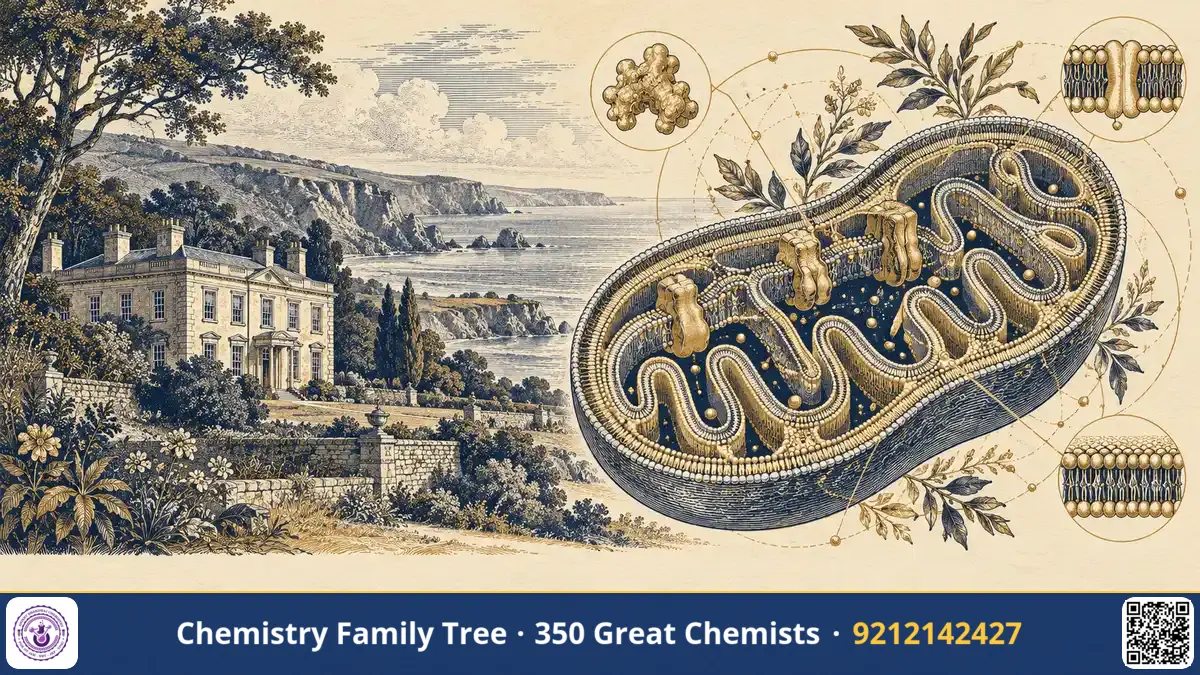
Mitchell's central contribution is the chemiosmotic coupling theory. He proposed that the respiratory chain and photosynthetic electron transport pump protons across the membrane and that ATP synthase uses the resulting proton motive force. He also introduced the concept of vectorial chemistry - chemical reactions that have direction in space across a membrane - and described the loop mechanism in which the arrangement of electron carriers and hydrogen carriers across the membrane results in proton translocation. Later he and his group worked on the Q cycle for Complex III, a model for how ubiquinone helps move protons. His book Chemiosmotic Coupling in Oxidative and Photosynthetic Phosphorylation set out the theory in detail. For the science itself, read the companion discovery post.
Why was the chemiosmotic idea so hard to accept? Most biochemists of the 1950s were trained to think in terms of soluble enzymes and chemical intermediates, as in glycolysis, where a high-energy phosphate compound is formed and then passes its phosphate to ADP. Mitchell was saying that the key event takes place across a membrane, a physical structure, and that the energy is stored as an electrochemical gradient, not in a molecule. He also proposed that the membrane must be closed and almost impermeable to protons, and that specific carriers move other ions. These were bold predictions, and each one was later confirmed in experiments.
The transition from a rejected hypothesis to a textbook fact is a good illustration of how science works. It does not depend on authority or on one decisive experiment, but on a growing body of results from different laboratories, such as measurements of proton movements, reconstitution of vesicles and later structural studies of the membrane complexes.
Awards, Honours and Nobel Prize
- Nobel Prize in Chemistry, 1978, for his contribution to the understanding of biological energy transfer through the formulation of the chemiosmotic theory. It was a sole award.
- Fellow of the Royal Society (elected 1974).
- Copley Medal of the Royal Society, 1981.
- Honorary degrees from several universities, and foreign memberships of academies.
Personality, Struggles and Lesser-Known Facts
- Illness and resignation. In the early 1960s, Mitchell suffered from severe ill health, including stomach ulcers, and he left his post at the University of Edinburgh in 1963.
- A private research institute. He and his colleague Jennifer Moyle restored the old Glynn House in Cornwall and built a laboratory there, which was financed partly from family funds and by raising money himself. He called it the Glynn Research Institute.
- Years of controversy. For more than a decade the chemiosmotic theory was fiercely disputed. Mitchell continued, patiently, to argue and to refine the theory. Many scientists in the field slowly changed their views as evidence accumulated.
- Collaboration with Moyle. Jennifer Moyle was a long-time partner in the experimental work, and Mitchell acknowledged her role.
Legacy and Influence on Modern Chemistry
Mitchell's theory is now at the centre of every textbook on cellular energy. His concept of proton motive force applies to mitochondria, chloroplasts and bacteria, and to many transport processes. His example of private, independent research is often discussed as a rare case in modern science. Modern structural biology, with cryo-electron microscopy of respiratory complexes and ATP synthase, continues to refine the picture he started.
Lessons for Students
- Be willing to challenge accepted ideas when the evidence points elsewhere.
- Back your ideas with predictions that others can test.
- Be patient; his theory took more than a decade to win acceptance.
- Acknowledge collaborators and predecessors.
- Real science can be done in unusual places, if the thinking is rigorous.
Quick Facts Box
- Born: 29 September 1920, Mitcham, Surrey, England
- Died: 10 April 1992, Bodmin, Cornwall, England
- Nationality: British
- Field: Biochemistry, bioenergetics
- Famous for: Chemiosmotic theory of oxidative phosphorylation
- Nobel: Chemistry, 1978
FAQ
Where did Mitchell do his major experiments?
Much of his later work was carried out at Glynn House in Cornwall, in a private laboratory that he and Jennifer Moyle set up.
Was his theory accepted at once?
No. It was disputed for many years, and then gradually accepted as experimental evidence grew.
Did he win a Nobel Prize in Medicine?
No, the 1978 prize was in Chemistry and was awarded to him alone.
Why is he important for Indian students?
Oxidative phosphorylation and ATP synthase are core topics in biochemistry in the syllabus of GATE, CSIR-NET and university courses.
Published by ABC Chemistry — IIT-JAM | CSIR-NET | GATE Chemistry Coaching. Visit abcchemistry.com
About the chemist
Peter Mitchell
1920-1992 · United Kingdom · Nobel Chemistry 1978
Chemiosmotic theory