The discovery, explained · Chemist no. 147 of 350
Peter Mitchell: The Proton Gradient That Powers Life
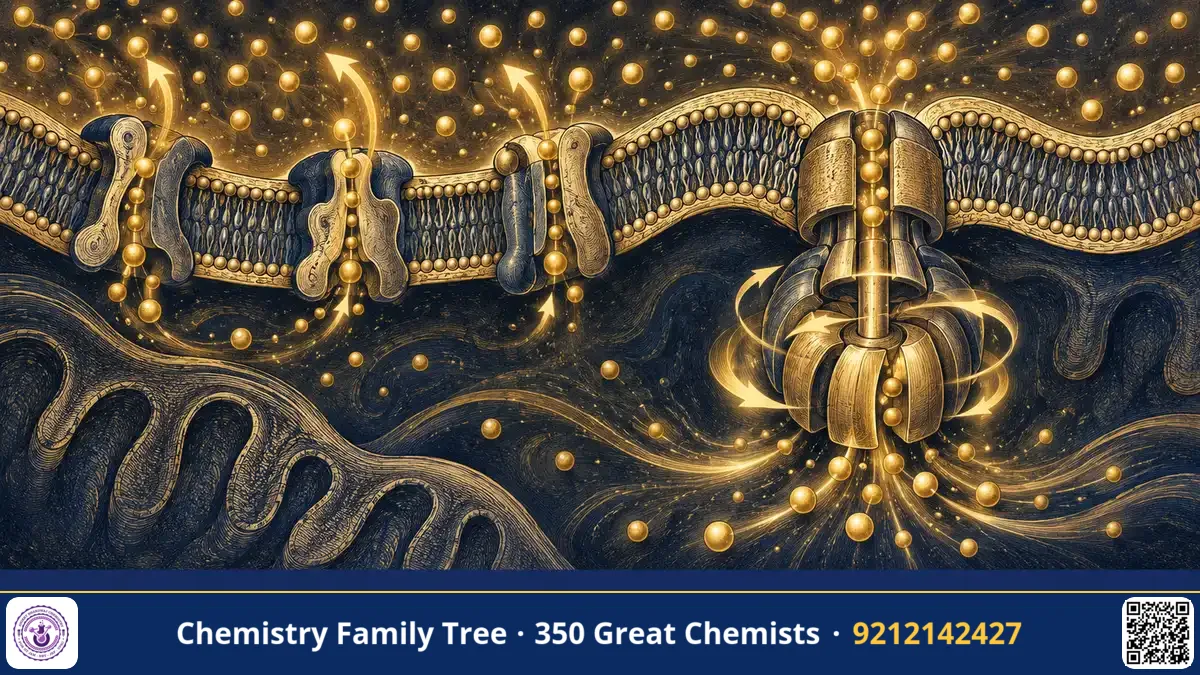
Every second, the cells of your body make and use ATP in huge amounts. A resting adult turns over roughly their own body weight in ATP each day. Where does it come from? The answer, known today to every school student, is that the electron transport chain in mitochondria pumps protons across a membrane, and the resulting gradient drives ATP synthesis. This idea - the chemiosmotic theory - was proposed by the British biochemist Peter Mitchell in 1961. At first it was greeted with scepticism and even hostility, but it was confirmed by experiment after experiment. In 1978 Mitchell received the Nobel Prize in Chemistry, alone, for his contribution to the understanding of biological energy transfer through the formulation of the chemiosmotic theory.
The Scientific Problem Before the Discovery
By the 1950s, biochemists knew the main reactions of glycolysis and the citric acid cycle, and they knew that the oxidation of NADH and FADH2 by oxygen in mitochondria is coupled to the phosphorylation of ADP. Overall, per NADH oxidised, a large amount of free energy is released:
NADH + H+ + ½O2 → NAD+ + H2O      ΔG°' ≈ -220 kJ/mol
ADP + Pi → ATP + H2O               ΔG°' ≈ +30.5 kJ/mol
How is the energy of the first reaction passed to the second? The ruling idea, modelled on substrate-level phosphorylation in glycolysis, was chemical coupling: the respiratory chain was thought to produce a high-energy chemical intermediate (written X~I or X~P) which would then transfer its energy to ADP. Many laboratories spent years searching for this intermediate, and none found it. Researchers like Edward Slater defended the chemical hypothesis, and the search for the elusive compound had become a long and frustrating effort.
The Discovery and the Argument
- A radical proposal (1961). Mitchell suggested that there is no chemical intermediate. Instead, electron transport pumps protons across the coupling membrane, creating an electrochemical gradient. ATP synthesis is driven by the flow of protons back down this gradient.
- Four requirements. The theory requires (a) a membrane that is impermeable to protons; (b) proton-pumping by the respiratory chain; (c) an ATP synthase (ATPase) that couples proton flow with ATP formation; (d) exchange carriers to move ions and metabolites across the membrane.
- Experimental support. Mitchell and Jennifer Moyle showed that actively respiring mitochondria expel protons from the matrix and acidify the medium. Later experiments showed that an artificial pH gradient could drive ATP synthesis: in 1966, André Jagendorf and Ernest Uribe made chloroplasts synthesise ATP in the dark after moving them from an acid bath to an alkaline medium.
- Reconstitution. In 1974, Efraim Racker and Walther Stoeckenius placed the light-driven proton pump bacteriorhodopsin and mitochondrial ATP synthase in artificial vesicles. Light caused ATP synthesis, a convincing demonstration that no chemical intermediate was needed.
The Chemistry Behind It
Proton motive force
The free energy stored in the gradient has two parts - an electrical potential difference (Δψ) across the membrane and a chemical concentration difference of protons (ΔpH):
Δp = Δψ - (2.303 RT/F) ΔpH
At 25 °C:  Δp = Δψ - 59 ΔpH   (in mV)
where Δp is the proton motive force (in volts), R the gas constant, T the temperature and F the Faraday constant. In mitochondria the main part is the membrane potential, with the matrix side negative, while in chloroplasts, the main part is the pH gradient.
Proton pumping
Complexes I, III and IV of the electron transport chain pump protons from the matrix into the intermembrane space, using energy from electron flow along a series of redox centres with increasing reduction potential. Complex II (succinate dehydrogenase) does not pump protons. The standard potential change from NADH (E°' = -0.32 V) to O2 (E°' = +0.82 V) is about 1.14 V, corresponding to ΔG°' = -nFΔE°' ≈ -220 kJ/mol for two electrons.
ATP synthase
ATP synthase (Complex V, or F1Fo-ATPase) has two parts. The Fo part is embedded in the membrane and forms a proton channel with a ring of c subunits. The F1 part projects into the matrix and has three catalytic sites. When protons pass through Fo, the ring rotates and turns a central stalk (gamma subunit) within F1. This rotation causes conformational changes at the three catalytic sites (the binding change mechanism of Paul Boyer) that release ATP. The rotation was demonstrated directly in the 1990s. Boyer and John Walker shared the 1997 Nobel Prize in Chemistry for the mechanism and structure of ATP synthase.
P/O ratio and inhibitors
Current estimates are about 2.5 ATP per NADH and 1.5 ATP per FADH2 (older textbooks use 3 and 2). Rotenone inhibits Complex I, antimycin A blocks Complex III, and cyanide, azide and carbon monoxide block Complex IV, while oligomycin blocks the Fo channel of ATP synthase. Uncouplers such as 2,4-dinitrophenol carry protons across the membrane, dissipating the gradient so that respiration continues but ATP is not made; the energy appears as heat. The brown adipose tissue protein thermogenin (UCP1) does the same naturally to produce heat.
Applications Today
- Medicine. Mitochondrial diseases, many drugs and toxins can be understood in terms of this mechanism. Cyanide poisoning, for example, arrests Complex IV.
- Bioenergetics research. Studies of ageing, cancer metabolism and neurodegeneration use measurements of mitochondrial membrane potential.
- Photosynthesis. Chloroplasts use the same principle, pumping protons into the thylakoid lumen and making ATP as protons flow out through CF1CFo ATP synthase.
- Bacteria. Proton gradients power ATP production, flagellar motors and transport in bacteria. Antibiotics like bedaquiline, used against drug-resistant tuberculosis, which is important in India, target the ATP synthase of Mycobacterium tuberculosis.
- Bio-inspired energy. Artificial membranes and fuel-cell research are inspired by the same coupling principle.
Exam Corner
- Chemiosmotic theory: electron transport pumps H+ across the inner mitochondrial membrane, and the proton motive force drives ATP synthesis through ATP synthase.
- Δp = Δψ - 59 ΔpH (mV at 25 degrees Celsius).
- Complexes I, III and IV pump protons; Complex II does not.
- 2,4-Dinitrophenol uncouples oxidative phosphorylation; oligomycin inhibits Fo; rotenone inhibits Complex I; cyanide inhibits Complex IV.
- Mitchell received the Nobel Prize in Chemistry in 1978; Boyer and Walker won in 1997.
Common Misconceptions
- "ATP is made directly by the electron transport chain." It is made by ATP synthase, driven by the proton gradient.
- "Mitchell won the Nobel Prize in Medicine." His prize was in Chemistry.
- "Uncouplers stop respiration." They actually allow respiration to continue (even faster) but without ATP formation.
Quick Revision Box
- Chemiosmotic hypothesis proposed 1961; Nobel Prize in Chemistry 1978.
- Proton motive force = membrane potential + pH gradient.
- ATP synthase: Fo channel and F1 catalytic head; rotary mechanism.
- About 2.5 ATP per NADH and 1.5 per FADH2.
- Evidence: Jagendorf acid-bath experiment, Racker-Stoeckenius vesicles.
- Uncouplers dissipate the gradient and generate heat.
FAQ
What is the chemiosmotic theory?
It states that the energy from electron transport is stored as a proton gradient across a membrane, and this gradient then drives ATP synthesis.
Why was the theory resisted?
Most researchers expected a chemical high-energy intermediate, and Mitchell's idea seemed to require too many new properties of membranes. Evidence gradually changed minds.
What is the role of oxygen?
Oxygen is the final electron acceptor at Complex IV, forming water. Without it, the chain stops and proton pumping stops.
Is this chapter important for exams?
Yes. Oxidative phosphorylation, inhibitors, uncouplers and ATP yield are asked repeatedly in biochemistry and life-science sections of GATE and CSIR-NET.
Published by ABC Chemistry — IIT-JAM | CSIR-NET | GATE Chemistry Coaching. Visit abcchemistry.com
About the chemist
Peter Mitchell
1920-1992 · United Kingdom · Nobel Chemistry 1978
Chemiosmotic theory