Biography · Chemist no. 211 of 350
Richard Henderson: The Scottish Scientist Who Proved Electron Microscopy Could See Atoms
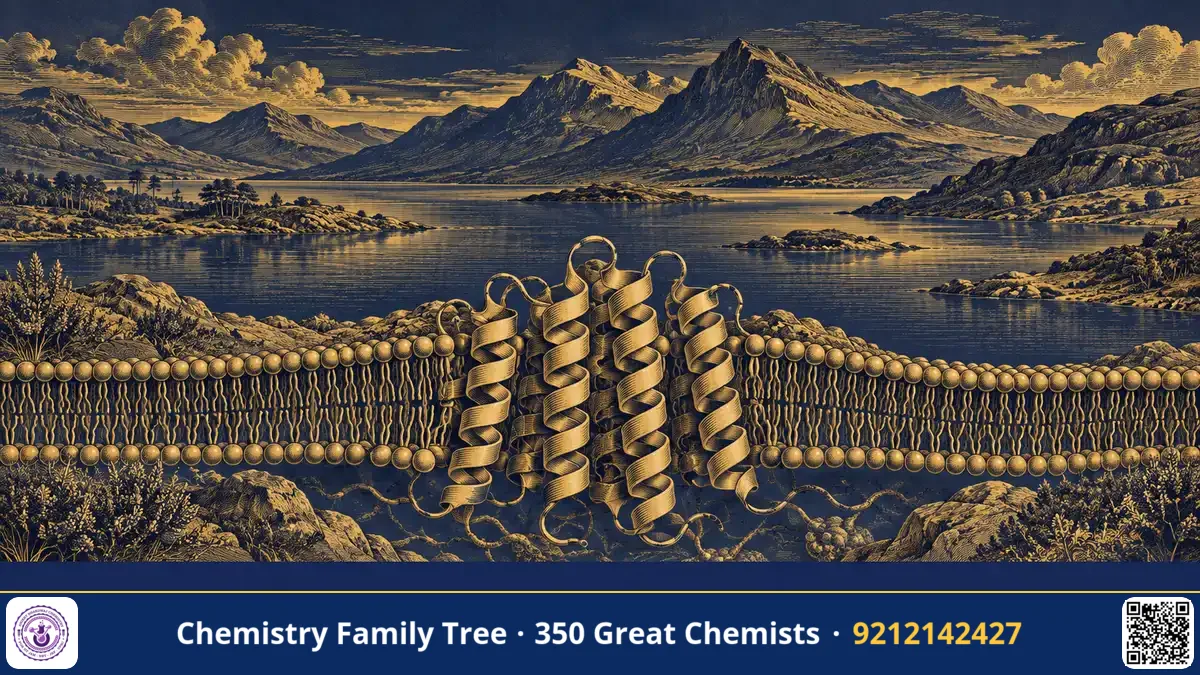
Richard Henderson (born 19 July 1945) is a Scottish molecular biologist and biophysicist who spent most of his career at the MRC Laboratory of Molecular Biology (LMB) in Cambridge. He shared the 2017 Nobel Prize in Chemistry with Jacques Dubochet and Joachim Frank. His legacy in one line: he showed, with bacteriorhodopsin, that electron microscopy could determine protein structures in detail, and he pushed the technology until cryo-EM matched X-ray crystallography.
Early Life and Family
Henderson was born in Edinburgh, Scotland, and grew up in Scotland, and attended school in Scotland. He has said that he was drawn to science and mathematics early on. Scotland's tradition of strong state education helped him move on to university study. Other details of his family are not widely documented, so we leave them out.
Education and Mentors
Henderson studied physics at the University of Edinburgh. He then moved to Cambridge for his doctorate at the MRC Laboratory of Molecular Biology, where he worked on the structure of the enzyme chymotrypsin by X-ray crystallography. His supervisor was David Blow. The LMB was home to Max Perutz, John Kendrew, Francis Crick and Fred Sanger at the time, and the atmosphere of ambitious structural biology influenced him strongly. He did a postdoctoral stay at Yale University in the United States, then returned to the LMB. There he began collaborating with Nigel Unwin on electron microscopy of membrane proteins.
Career Timeline
| Year | Event |
|---|---|
| 1945 | Born in Edinburgh, Scotland |
| 1960s | Studies physics at Edinburgh; PhD in Cambridge on chymotrypsin |
| 1970s | Postdoctoral work at Yale; returns to the LMB |
| 1975 | With Nigel Unwin, publishes the first 3D structure of a membrane protein, bacteriorhodopsin, at about 7 angstrom |
| 1990 | Publishes an atomic-level model of bacteriorhodopsin from electron crystallography |
| 1996-2006 | Serves as Director of the MRC Laboratory of Molecular Biology |
| 2010s | Advocates direct electron detectors, helping launch the cryo-EM resolution revolution |
| 2017 | Shares the Nobel Prize in Chemistry |
Major Scientific Contributions
- Bacteriorhodopsin structure: first 3D map of a membrane protein using electron microscopy, showing seven transmembrane helices.
- Electron crystallography methods: combining diffraction amplitudes with image phases, tilt series, and low-dose procedures.
- Early X-ray work: contributions to the mechanism of chymotrypsin, a serine protease.
- Cryo-EM advocacy: argued that cryo-EM could reach atomic resolution without crystals if detectors improved; around 2013 direct electron detectors began delivering near-atomic maps.
- Leadership: directed the LMB, one of the world's most productive biology institutes.
For the chemistry of bacteriorhodopsin and its photocycle, see our companion discovery post.
Awards, Honours and Nobel Prize
Henderson shared the 2017 Nobel Prize in Chemistry with Jacques Dubochet and Joachim Frank "for developing cryo-electron microscopy for the high-resolution structure determination of biomolecules in solution". He is a Fellow of the Royal Society, a Fellow of the Royal Society of Edinburgh and a Foreign Associate of the United States National Academy of Sciences. He has received other major prizes for his contributions to structural biology, including the Copley Medal of the Royal Society in 2016.
Personality, Struggles and Lesser-Known Facts
- A long wait: The 1975 result was celebrated, yet it took decades for the field to reach the point where cryo-EM matched crystallography.
- Honest about the limits: In the 1990s he wrote a well-known paper arguing, from physical principles, that cryo-EM could in principle determine structures of even small proteins, a prediction later fulfilled.
- Lab leader: As Director of the LMB, he managed a laboratory that has produced many Nobel Prize winners.
- Technological vision: He pressed for better detectors at a time when many doubted the effort would pay off.
- Modesty with humour: Colleagues describe him as direct and unpretentious.
Legacy and Influence on Modern Chemistry
Henderson's early work gave the first glimpse of how proteins sit in membranes. His later push for direct detectors ushered in an era in which cryo-EM routinely gives atomic-resolution structures of proteins that could not be crystallised. This has changed drug discovery, especially for membrane targets. His career is a good example of how a physicist's way of thinking about signal, noise and radiation damage can transform biology.
Henderson's career also shows the value of choosing a problem for which the right tools do not yet exist. In the 1970s, nobody had a detailed picture of how a protein spans a cell membrane, and the usual crystallographic route was closed. By choosing a naturally ordered system, the purple membrane, and by inventing the methods to handle it, he opened a door that others later used for different proteins. Years afterwards, as the director of a great laboratory, he supported younger colleagues who built the electron detectors and software that made single-particle cryo-EM routine. He remained a clear and sometimes provocative voice, arguing from basic physics what might be possible. For students, his path is a reminder that the best experiments are often limited by technique rather than by ideas, and that patience in improving technique can transform what science can see.
Lessons for Students
- Choose the right system. The natural crystal of the purple membrane made the breakthrough possible.
- Think quantitatively. Physics tells you what is theoretically achievable.
- Push technology. Better instruments open new science.
- Stay with a long vision. Persistence over decades is a hallmark of great science.
- Value collaboration. Unwin, colleagues at the LMB and engineers all played a role.
Quick Facts Box
- Born: 19 July 1945, Edinburgh, Scotland
- Died: Living (as of this writing)
- Nationality: British (Scottish)
- Field: Molecular biology, structural biology, biophysics
- Famous for: Bacteriorhodopsin structure; advancing cryo-EM
- Nobel: Chemistry 2017, shared with Dubochet and Frank
FAQ
Where did Henderson work?
At the MRC Laboratory of Molecular Biology in Cambridge, UK.
Who collaborated with him on the 1975 structure?
Nigel Unwin.
What is electron crystallography?
A method that determines structure from electron diffraction and images of two-dimensional crystals.
Was his Nobel in Physiology or Medicine?
No. It was the Nobel Prize in Chemistry, 2017.
Published by ABC Chemistry — IIT-JAM | CSIR-NET | GATE Chemistry Coaching. Visit abcchemistry.com
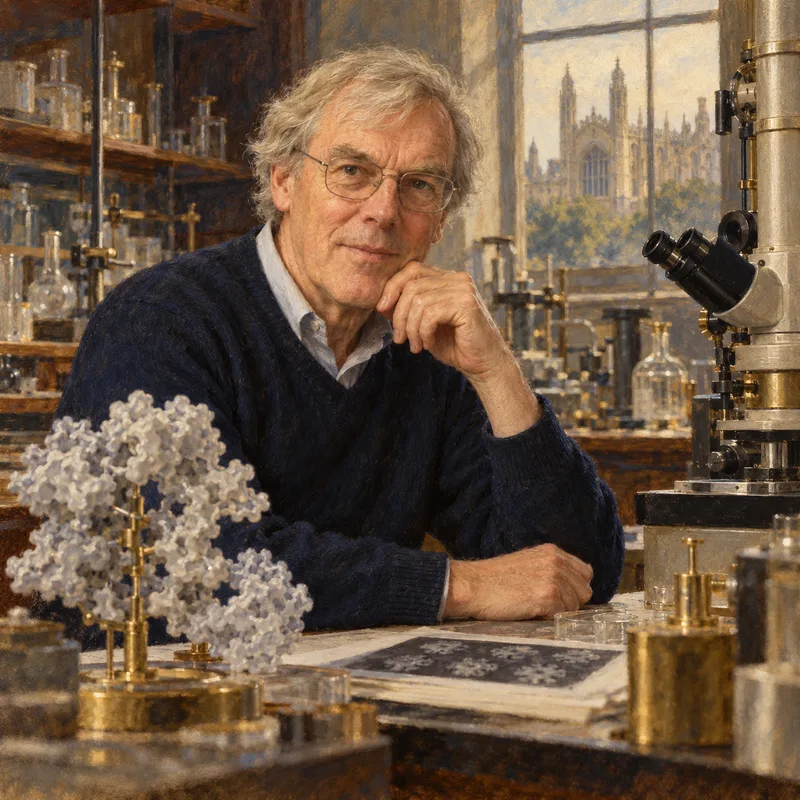
About the chemist
Richard Henderson
1945- · United Kingdom · Nobel Chemistry 2017
Cryo-EM of biomolecules