How to Find the Point Group of a Molecule: A Step-by-Step Flowchart
Determining the molecular point group becomes straightforward when you evaluate symmetry elements in a systematic sequence rather than guessing them all at once.
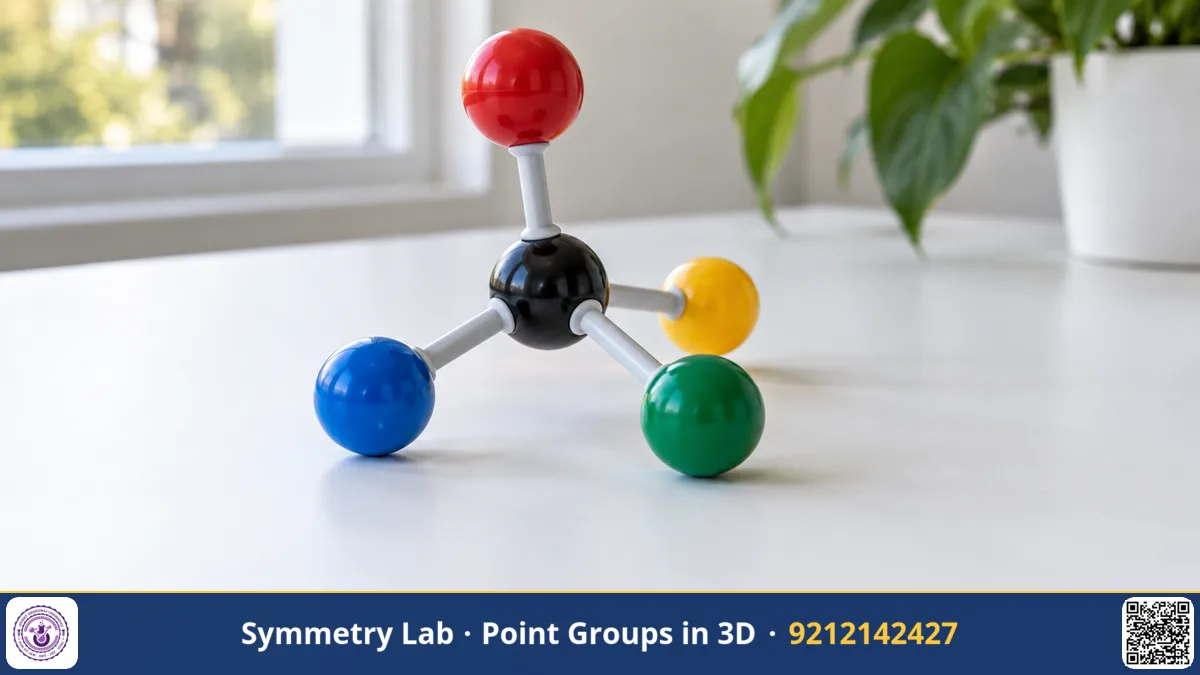
Step 1: Check for Linear Geometry and Cubic High-Symmetry Groups
The point group decision procedure begins with two structural screenings. First, inspect whether the molecule has linear geometry. Linear molecules possess an infinite-fold axis, C∞. If an inversion centre (i) exists, as in carbon dioxide (CO2), the point group is D∞h. If no inversion centre exists, as in hydrogen chloride (HCl), it belongs to C∞v.
Second, check for high-symmetry cubic polyhedra containing multiple intersecting high-order axes:
- Tetrahedral (Td): Contains four C3 axes, exemplified by methane (CH4).
- Octahedral (Oh): Contains three C4 axes and four C3 axes, such as sulfur hexafluoride (SF6).
- Icosahedral (Ih): Contains six C5 axes, found in icosahedral boranes and fullerenes.
Molecules lacking these special features proceed to standard rotational axis identification.
Step 2: Identify the Principal Rotation Axis and Low-Symmetry Groups
For any non-linear, non-cubic molecule, the next task is identifying its proper rotation axes. Search for all axes Cn where a rotation of 360/n degrees produces an equivalent orientation. The axis with the highest value of n is designated as the principal rotation axis and is placed vertically along the z-axis by convention.
If the molecule lacks any proper rotation axis of order two or higher, it belongs directly to one of three low-symmetry point groups:
- Cs: The molecule possesses only a single mirror plane (σ) and the identity operation (E).
- Ci: The molecule possesses only an inversion centre (i) and identity (E).
- C1: Contains no symmetry elements beyond identity (E), representing completely asymmetric molecules.
If a principal axis Cn with n ≥ 2 is present, move forward to the primary branching step.
Step 3: Test for Perpendicular Two-Fold Axes to Distinguish D and C Families
Once you locate the principal Cn axis, the decisive test is whether n two-fold rotation axes (C2) exist perpendicular to it. This step represents the most important fork in molecular symmetry, separating molecules into dihedral and cyclic branches.
Search carefully in the plane perpendicular to the vertical principal axis:
- If the principal axis is C3, you must search for three perpendicular C2 axes lying in the horizontal plane.
- If the principal axis is C2, you must search for two additional perpendicular C2 axes, giving three mutually perpendicular axes in total.
If n perpendicular C2 axes are present, follow the dihedral branch. If absent, follow the cyclic branch. Miscounting these perpendicular axes is a very common source of error in symmetry analysis.
Step 4: Classify Dihedral Molecules into Dnh, Dnd, or Pure Dn Groups
Molecules possessing n perpendicular C2 axes belong to the dihedral family. Mirror planes determine their specific point group.
Always check for a horizontal mirror plane (σh) first. A horizontal plane is perpendicular to the principal Cn axis. If present, the molecule is Dnh. For example, planar boron trifluoride (BF3) contains a C3 axis and a horizontal plane containing all four atoms, placing it in the D3h point group. Planar ethene (C2H4) contains three mutually perpendicular C2 axes and a horizontal plane, giving D2h.
If no σh exists, look for n dihedral mirror planes (σd) bisecting the angles between adjacent perpendicular C2 axes. If present, the molecule is Dnd (such as allene). If no mirror planes exist, the molecule belongs to the pure rotation group Dn.
Step 5: Classify Cyclic Molecules into Cnh, Cnv, S2n, or Pure Cn Groups
Molecules lacking perpendicular C2 axes belong to the cyclic family. Examine their mirror planes in strict order.
First, test for a horizontal mirror plane (σh) perpendicular to the principal Cn axis. If present, the molecule is Cnh. For instance, trans-diazene (trans-N2H2) possesses a C2 axis and a horizontal plane coincident with the molecular plane, giving C2h.
Second, if no σh exists, search for n vertical mirror planes (σv) containing the principal Cn axis. If present, the molecule belongs to Cnv. Water (H2O) has a C2 axis and two vertical planes, belonging to the C2v point group. Ammonia (NH3) contains a C3 axis and three vertical planes, giving C3v.
Finally, if no mirror planes exist, test for an improper rotation axis S2n collinear with Cn. If present, the group is S2n; otherwise, it is Cn.
Step 6: Avoid Common Symmetry Pitfalls and Master 3D Visualization
Assigning point groups solely from two-dimensional drawings causes errors because planar sketches hide three-dimensional relationships. Chemistry examinations frequently test these spatial details.
A widespread mistake is confusing dihedral planes (σd) with vertical planes (σv). Both contain the principal axis, but a vertical plane passes through bonded atoms, whereas a dihedral plane specifically bisects the angle between adjacent perpendicular C2 axes.
Another common pitfall involves tetrahedral geometry: students often forget that methane (CH4) possesses three S4 axes aligned with its C2 axes, in addition to its four C3 axes. Neglecting lone pair orientation also causes errors, as lone pairs lower overall molecular symmetry.
To build spatial intuition, examine molecules in the interactive Symmetry Lab viewer. You can rotate 277 molecules across 32 point groups and toggle individual axes, planes, and inversion centres to verify coordinates.
Step 7: The Complete Point Group Flowchart at a Glance
You can execute point group assignment reliably using this sequential checklist:
- Linear check: D∞h if an inversion centre exists (such as CO2); C∞v if absent (such as HCl).
- Cubic check: Td (CH4), Oh (SF6), or Ih based on multiple intersecting high-order axes.
- Principal axis: Identify Cn with highest n. If n < 2, assign Cs, Ci, or C1.
- Perpendicular C2 test: Presence routes to D groups; absence routes to C groups.
- Dihedral resolution: Check for σh (Dnh, like BF3 and D2h ethene), σd (Dnd), or none (Dn).
- Cyclic resolution: Check for σh (Cnh, like trans-N2H2), n σv (Cnv, like H2O and NH3), S2n, or pure Cn.
Consult the index of molecular point groups to study group orders and symmetry operations for every geometry.
Key takeaways
- Always test for linearity and special cubic symmetry before searching for individual rotation axes.
- The presence of n perpendicular two-fold axes separates dihedral groups from cyclic groups.
- Horizontal mirror planes take priority over vertical and dihedral planes during point group assignment.
- Visualizing molecules in three dimensions prevents missing improper rotation axes and inversion centres.
Frequently asked questions
What is the difference between a vertical and a dihedral mirror plane?
Both vertical and dihedral mirror planes contain the principal rotation axis. Vertical planes pass directly through molecular bonds or atoms, whereas dihedral planes specifically bisect the dihedral angles between adjacent perpendicular two-fold rotation axes.
Why is water classified as C2v rather than D2h?
Water possesses only a single two-fold rotation axis passing through the oxygen atom. Because it lacks two perpendicular two-fold axes and lacks a horizontal mirror plane perpendicular to the rotation axis, it belongs to C2v rather than D2h.
How do you identify the principal rotation axis in a molecule?
The principal axis is the proper rotation axis with the highest value of n, which is the smallest rotation angle 360/n degrees. If several axes share the highest order, as in D2h, the choice of axis does not change the point group.
Does a molecule with an inversion centre always belong to a centrosymmetric point group?
Yes, any molecule containing an inversion centre belongs to a centrosymmetric point group such as Ci, C2h, D2h, D3d, or Oh. Groups such as C1, Cs, C2v, C3v, and Td lack an inversion centre.
Open the Symmetry Lab. Rotate a molecule, switch its symmetry elements on one at a time and test yourself with the Symmetry Challenge.
Open the Symmetry Lab →