Point Groups of Common Molecules: A Quick Reference List
Determining the point group of a chemical molecule begins with identifying its three-dimensional equilibrium geometry predicted by electron pair repulsion principles.
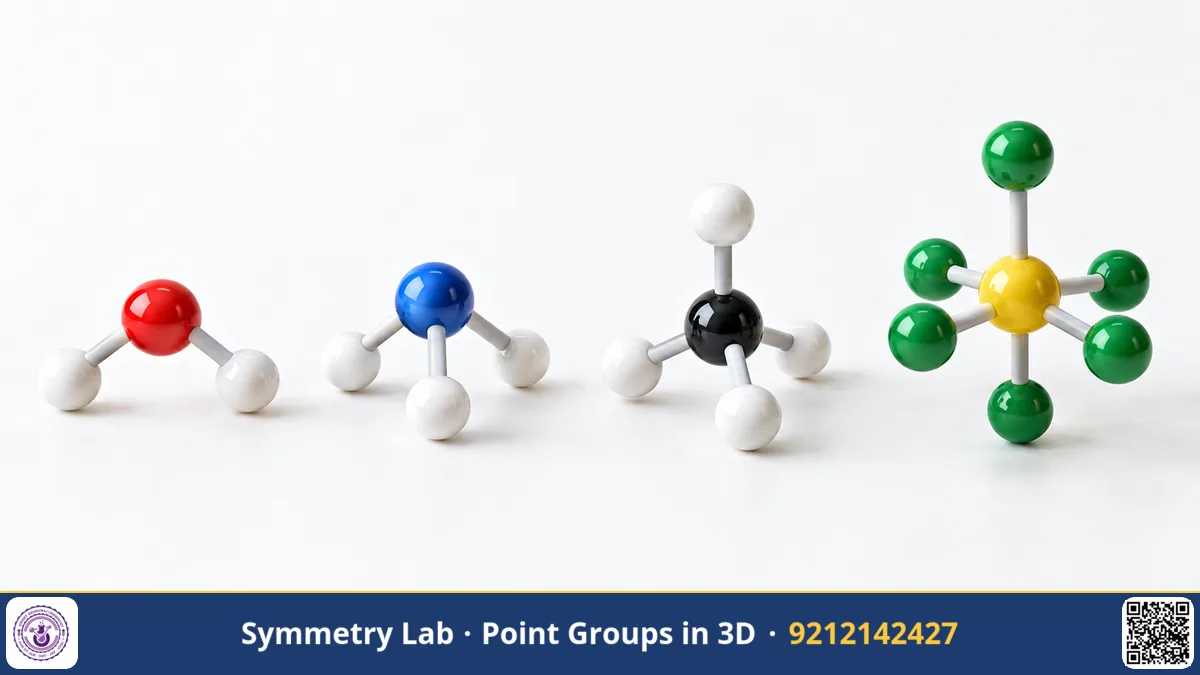
How Molecular Geometry Predicts Symmetry Point Groups
A molecule's symmetry point group represents the complete collection of geometric symmetry operations that leave its nuclear framework unchanged in three-dimensional space. These operations include proper rotation, reflection through a mirror plane, inversion through a central point, and improper rotation. The fundamental spatial geometry of a molecule directly determines which of these operations are present.
Valence shell electron pair repulsion provides the theoretical foundation for predicting molecular shape. By minimizing electrostatic repulsions among bonding pairs and non-bonding lone pairs around a central atom, this framework establishes bond angles and spatial orientation. Once the equilibrium nuclear coordinates are known, symmetry elements can be deduced systematically. Interactive tools like the 3D molecule viewer allow students to inspect these spatial arrangements and confirm symmetry planes and rotation axes directly against calculated atomic coordinates.
Low-Symmetry and Asymmetric Molecules
Certain molecules lack high-order rotational symmetry entirely. In such structures, the arrangement of atoms either provides no symmetry operations beyond the trivial identity or limits the symmetry to a single operation.
When a central tetrahedral atom is bonded to four distinct substituents, such as bromochlorofluoromethane (CHFClBr), all symmetry elements disappear except for the identity operation. This molecule belongs to the point group C1, which signifies total geometric asymmetry and chirality. If a planar or bent molecule lacks rotational axes but contains exactly one mirror plane, it belongs to the point group Cs. Similarly, molecules possessing only an inversion centre without any rotational axes belong to Ci. Identifying these low-symmetry cases early avoids unnecessary searches for higher-order rotation axes.
Linear Molecules and Infinite Rotational Symmetry
Linear molecules possess an infinite-fold rotational axis along their internuclear bond vector, because any rotation by an arbitrary angle about this axis leaves the molecule indistinguishable. The point group classification of a linear molecule depends strictly on whether it contains a centre of inversion.
Linear structures fall into two distinct symmetry groups:
- Heteronuclear linear molecules: Molecules such as hydrogen chloride (HCl) lack an inversion centre and perpendicular two-fold axes, classifying them into the C∞v point group with an infinite number of vertical mirror planes containing the bond axis.
- Centrosymmetric linear molecules: Molecules such as carbon dioxide (CO2) possess an inversion centre midway between identical oxygen atoms, accompanied by an infinite number of perpendicular two-fold axes and a horizontal mirror plane, placing them in the D∞h point group.
C-Group Molecules: Bent and Pyramidal Shapes
Molecules that possess a single principal rotation axis of order n without any perpendicular two-fold axes belong to C groups. When vertical mirror planes contain this principal axis, the molecule is classified into the Cnv point group.
Non-bonding electron pairs often lower the symmetry from idealized parent shapes to bent or pyramidal geometries:
- Water (H2O): Possesses a bent geometry resulting from four electron pairs (two bonding pairs and two lone pairs). It contains a two-fold rotational axis bisecting the H-O-H angle and two vertical mirror planes, belonging to the C2v point group.
- Ammonia (NH3): Displays a trigonal pyramidal shape with three bonding pairs and one lone pair. It exhibits a three-fold rotation axis along the nitrogen lone pair axis and three vertical mirror planes, placing it in C3v.
- Iodine pentafluoride (IF5): Possesses a square pyramidal geometry with five bonding pairs and one axial lone pair. This gives a four-fold rotation axis and four vertical mirror planes, establishing C4v symmetry.
D-Group Molecules: Dihedral, Planar, and Metallocene Systems
A molecule belongs to a dihedral point group when it possesses a principal n-fold axis and n perpendicular two-fold rotation axes. Adding horizontal or dihedral mirror planes distinguishes Dnh and Dnd systems:
- Boron trifluoride (BF3): Trigonal planar geometry with a principal three-fold axis, three perpendicular two-fold axes, and a horizontal mirror plane, giving D3h.
- Phosphorus pentachloride (PCl5): Trigonal bipyramidal geometry with axial and equatorial chlorine atoms, also belonging to D3h.
- Xenon tetrafluoride (XeF4): Square planar geometry with two trans lone pairs, containing a four-fold axis, four perpendicular two-fold axes, and a horizontal plane, establishing D4h.
- Ethene (C2H4): Planar structure with three mutually perpendicular two-fold axes and three mirror planes, classified as D2h.
- Benzene (C6H6): Planar hexagonal ring possessing a six-fold axis, six perpendicular two-fold axes, and a horizontal mirror plane, giving D6h.
- Ferrocene: Sandwich complex adopting D5h symmetry in its eclipsed conformation with a horizontal plane, and D5d symmetry in its staggered conformation with dihedral planes.
High-Symmetry Polyhedra: Tetrahedral and Octahedral Shapes
When a molecule contains multiple high-order rotation axes of equal degree, it cannot be defined by a single principal axis. Such structures represent regular closed polyhedra and belong to high-symmetry cubic point groups.
Methane (CH4) exemplifies regular tetrahedral geometry, where carbon forms four equivalent bonds directed toward the corners of a regular tetrahedron. It contains four three-fold rotation axes, three four-fold improper rotation axes, and six dihedral mirror planes, giving the Td point group.
Sulfur hexafluoride (SF6) exhibits regular octahedral geometry with six equivalent bonds. It contains three four-fold axes, four three-fold axes, nine mirror planes, and an inversion centre, defining the Oh point group. In both cases, substituting even a single ligand with a different chemical element breaks the equivalence of these axes and reduces the molecule to a lower-symmetry point group.
A Systematic Flowchart for Point Group Determination
Determining the symmetry classification of any chemical species is efficient when applying an orderly decision sequence based on structural features:
- Check for linearity: If the molecule is linear, determine whether it possesses an inversion centre (D∞h) or lacks one (C∞v).
- Identify high symmetry: Look for multiple intersecting high-order axes characteristic of regular polyhedra, such as tetrahedral (Td) or octahedral (Oh) shapes.
- Locate the principal rotation axis: Find the highest-order proper rotation axis Cn. If none exists, check for a single mirror plane (Cs), an inversion centre alone (Ci), or no symmetry elements (C1).
- Search for perpendicular two-fold axes: Check for n two-fold axes perpendicular to Cn. If present, the molecule belongs to a D group; inspect for a horizontal mirror plane (Dnh) or dihedral planes (Dnd). If absent, check for a horizontal mirror plane (Cnh) or vertical mirror planes (Cnv).
Key takeaways
- Molecular equilibrium geometry determined by electron repulsion directly dictates the set of symmetry operations present.
- Linear molecules are classified into C-infinity-v or D-infinity-h depending solely on the presence of an inversion centre.
- Non-bonding lone pairs reduce high-symmetry parent shapes into lower-symmetry bent, pyramidal, or planar groups.
- A systematic flowchart based on principal axes and perpendicular two-fold axes ensures reliable point group assignment.
Frequently asked questions
What is the difference between electron geometry and molecular shape in symmetry?
Electron geometry includes both bonding pairs and lone pairs around a central atom. Molecular shape accounts solely for the positions of atomic nuclei, which determines the actual symmetry elements and point group of the molecule.
Why does carbon dioxide have a different point group than water?
Carbon dioxide has a linear geometry with a centre of inversion midway between oxygen atoms, placing it in D-infinity-h. Water has a bent shape due to lone pairs, lacking an inversion centre and belonging to C2v.
How does conformational change affect the point group of ferrocene?
In ferrocene, the cyclopentadienyl rings can rotate relative to each other. The eclipsed conformation contains a horizontal mirror plane giving D5h, whereas the staggered conformation lacks a horizontal plane but contains dihedral planes giving D5d.
Can a chiral molecule possess any mirror planes?
No, a chiral molecule cannot possess any improper rotation axes, which include mirror planes and inversion centres. Chiral molecules typically belong to non-centrosymmetric point groups such as C1, Cn, or Dn.
Open the Symmetry Lab. Rotate a molecule, switch its symmetry elements on one at a time and test yourself with the Symmetry Challenge.
Open the Symmetry Lab →