Practising Point Groups in 3D: A Method for the Symmetry Lab and Its Challenge
Determining molecular point groups becomes far more reliable when students transition from two-dimensional textbook sketches to rotating real molecular coordinates in three dimensions.
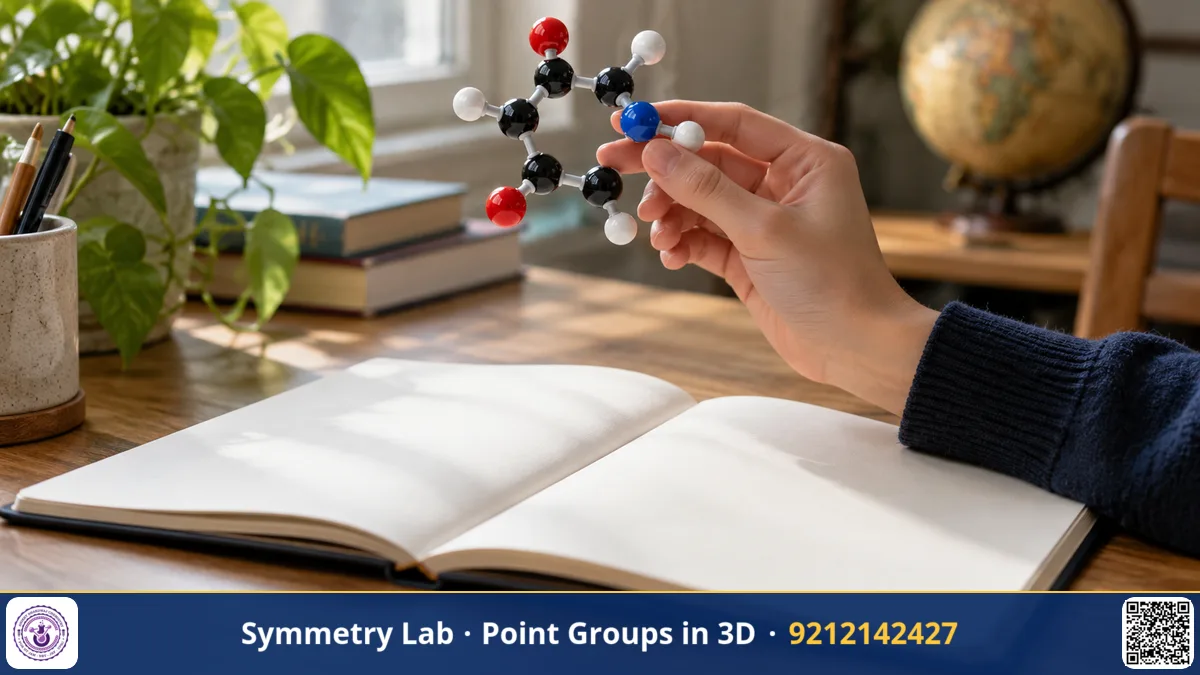
Overcoming the Limits of Flat 2D Chemical Diagrams
Determining point groups is a fundamental skill for chemistry students preparing for university examinations such as B.Sc and M.Sc degree courses, as well as competitive tests like CSIR-NET and GATE. Yet, standard two-dimensional textbook projections frequently obscure spatial geometry. A flat drawing of water, ammonia (NH3), or boron trifluoride (BF3) reduces a three-dimensional arrangement of atomic nuclei into arbitrary lines on a page. In flat representations, dihedral angles vanish, perpendicular rotation axes appear foreshortened, and inversion centres are easily overlooked.
True molecular symmetry depends strictly on equilibrium bond lengths and bond angles in Cartesian space. When students interact with molecules built directly from physical coordinates, abstract symmetry definitions become visible spatial realities. Understanding why a molecule possesses a specific set of operations requires viewing it from multiple perspectives rather than relying on rote memorisation of static formulas.
The Systematic Flowchart for Point Group Classification
To determine molecular point groups, chemists apply a systematic decision sequence. The Symmetry Lab implements this exact logical method:
- Check for linearity: Linear molecules with an inversion centre belong to D∞h; those lacking inversion belong to C∞v.
- Check for high symmetry: Polyhedra with multiple higher-order axes belong to cubic groups: regular tetrahedral Td, octahedral Oh, or icosahedral Ih.
- Find the principal axis Cn: Locate the highest-order proper axis. If none exists, identify a single mirror plane (Cs), an inversion centre (Ci), or no elements (C1).
- Check for perpendicular C2 axes: If n two-fold axes exist perpendicular to Cn, assign a D group (Dnh with a horizontal plane, Dnd with dihedral planes, or Dn). Otherwise, assign C or S groups (Cnh with a horizontal plane, Cnv with n vertical planes, S2n, or Cn).
Navigating the Twelve Point Group Families and Group Pages
The Symmetry Lab organises its molecules into twelve families: non-axial (C1, Ci, Cs), linear (C∞v, D∞h), cyclic (Cn), dihedral (Dn), pyramidal (Cnv), reflection (Cnh), prismatic (Dnh), antiprismatic (Dnd), improper rotation (S2n), tetrahedral (T, Th, Td), octahedral (O, Oh) and icosahedral (I, Ih).
In the point group index, every single point group has its own dedicated reference page. For example, visiting the C2v point group page provides its formal mathematical definition, the order of the group, complete symmetry operations (E, C2 and two vertical mirror planes), and a list of the molecules in that group. Studying these individual group pages allows students to correlate group order with operation counts and observe how subtle changes in ligand arrangement alter the overall symmetry classification.
Active Practice in the 3D Viewer Before Revealing Elements
Passive observation does not build reliable spatial problem-solving skills. In the Symmetry Lab 3D molecule viewer, which features 277 molecules across 32 point groups, learners should actively inspect structures before enabling visual aids. Begin by selecting a molecule via formula search, name search, or random selection. Rotate the model by dragging it across the screen to observe spatial angles and atom positions.
Before revealing any solutions, mentally predict the principal axis, perpendicular axes, mirror planes, and inversion centre. Then, switch each symmetry element—axis, plane, or centre—on one at a time to test your hypothesis against coordinates. Use display controls to inspect lone pairs, display atom labels, and cycle between ball-and-stick, glossy, space-fill, or wire styles. Switching colour modes between element types and symmetry operations further highlights how equivalent atoms exchange positions under specific operations.
Testing Under Exam Conditions with the Symmetry Challenge and Error Logs
Once basic symmetry concepts are understood, students should test their retrieval under exam-like conditions using the Symmetry Challenge. In this mode, the tool conceals the molecule's name and point group formula, presenting only an unlabelled 3D structure. The user must rotate the molecule freely, evaluate its symmetry operations without hints, select the predicted point group, and submit the answer. A coordinate-verified explanation appears immediately after submission, clarifying any overlooked elements.
To accelerate learning, maintain a structured written error log. Whenever a classification is incorrect, document the specific geometric cause:
- Confusing Dnh and Dnd due to overlooking staggered dihedral planes.
- Failing to detect perpendicular C2 axes in molecules that resemble planar systems.
- Mistaking an improper rotation axis S4 for a simple C2 operation.
- Ignoring unshared electron lone pairs when evaluating coordination geometry.
A Structured Seven-Day Practice Schedule for Students
A disciplined seven-day revision plan helps students systematically master all twelve symmetry families before examinations:
- Day 1: Low symmetry and linear molecules. Practice identifying C1, Cs, Ci, C∞v, and D∞h systems, focusing on inversion centres.
- Day 2: Cyclic and pyramidal systems. Work through Cn and Cnv molecules, comparing planar bent geometries with pyramidal structures like NH3.
- Day 3: Horizontal plane cyclic groups. Master Cnh molecules, verifying how σh combines with Cn to generate inversion centres in even-order groups.
- Day 4: Dihedral planar and prismatic systems. Examine Dn and Dnh molecules, identifying perpendicular C2 axes in planar systems such as BF3 and benzene.
- Day 5: Staggered conformations and improper axes. Study Dnd systems, such as allene and staggered ethane, alongside isolated S2n molecules.
- Day 6: High-symmetry polyhedra. Inspect tetrahedral Td complexes, octahedral Oh coordination compounds, and regular icosahedral Ih frameworks.
- Day 7: Comprehensive challenge testing. Run unassisted sessions in the Symmetry Challenge across random molecules, logging errors and reviewing weak areas.
Translating 3D Visual Intuition into Written Examination Precision
In university and competitive chemistry examinations, students must solve point group questions rapidly on paper without access to digital software. The primary objective of training with interactive 3D tools is internalising a reliable spatial framework. When rotating molecular models in three dimensions, students learn how molecular symmetry operations relate directly to bond angles, planar reflections, and coordinate inversions.
During an examination, when confronted with a complex coordination compound, organic conformer, or inorganic cluster drawn in two dimensions, a trained student mentally reconstructs the three-dimensional geometry. By applying the systematic flowchart—checking linearity, high symmetry, principal axes, perpendicular twofold axes, and mirror planes in sequence—the correct point group can be deduced with speed and confidence. Consistent visualization practice bridges the gap between abstract group theory and concrete chemical problem-solving.
Key takeaways
- Follow a systematic decision tree starting with linearity and high symmetry before finding proper rotation axes.
- Rotate three-dimensional structures and predict each symmetry element before toggling its visual display.
- Use the Symmetry Challenge to test point group recognition on unlabelled structures and record errors systematically.
- Follow a structured seven-day schedule covering all twelve point group families from low symmetry to cubic polyhedra.
Frequently asked questions
Why is determining molecular point groups difficult when using two-dimensional drawings?
Two-dimensional drawings flatten bond angles and distort spatial relationships. When molecules are drawn on flat paper, perpendicular rotation axes, dihedral planes, and inversion centres often overlap, making it difficult to recognise true molecular symmetry without three-dimensional coordinate visualisation.
What is the key difference between Dnh and Dnd point groups?
Both Dnh and Dnd groups possess an n-fold principal rotation axis and n perpendicular twofold axes. However, Dnh contains a horizontal mirror plane perpendicular to the principal axis, whereas Dnd contains n dihedral mirror planes bisecting the twofold axes without any horizontal plane.
How does the Symmetry Challenge test point group identification skills?
The Symmetry Challenge conceals the identity and symmetry label of a chosen molecule while allowing complete three-dimensional manipulation. Students must visually identify symmetry operations on the unlabelled structure, submit their chosen point group, and then review the coordinate-verified explanation.
Why should an error log be maintained during point group practice?
Maintaining an error log highlights recurring misconceptions, such as missing perpendicular twofold axes, misidentifying dihedral planes, or overlooking lone pairs. Reviewing these logged errors allows students to refine their visual inspection routine and prevents repeated misclassifications in exams.
Open the Symmetry Lab. Rotate a molecule, switch its symmetry elements on one at a time and test yourself with the Symmetry Challenge.
Open the Symmetry Lab →