Concept · Class 12 Maths
Vectors and 3D Geometry (Class 12 Maths): Key Formulas and Board-Style Questions
Dot and cross products, the angle between lines and planes, and the shortest distance between skew lines — the highest-yield block in the paper.
Class 12 · Mathematics · Concept · Updated 24 August 2026
Why this matters: Vectors and three-dimensional geometry together carry a substantial share of the Class 12 Maths paper, and the questions are formula-driven rather than trick-driven. This is one of the most reliably scoring areas available to you.
The two products, and what each is for
| Dot product | Cross product |
|---|
| Result | A scalar | A vector |
| Formula | a · b = |a||b| cos θ | a × b = |a||b| sin θ n̂ |
| Zero when | Vectors are perpendicular | Vectors are parallel |
| Used for | Angles, projections, work | Areas, normals, moments |
Formulas worth knowing cold
Projection of a on b = ( a · b ) / |b|
Area of triangle with sides a and b = ½ | a × b |
Shortest distance between skew lines r = a1 + λb1 and r = a2 + μb2 :
d = | ( a2 − a1 ) · ( b1 × b2 ) | / | b1 × b2 |
Angle between a line with direction b and a plane with normal n :
sin θ = | b · n | / ( |b| |n| )
The trap in line-and-plane angles
For two lines, or two planes, the angle uses cosine. For a line and a plane, it uses sine. The reason is geometric: the angle you are asked for is measured from the line to the plane, but the vector you have is the plane's normal, which is perpendicular to the plane — so the two angles are complementary.
- Line and line → cos θ = | b1 · b2 | / ( |b1| |b2| )
- Plane and plane → cos θ = | n1 · n2 | / ( |n1| |n2| )
- Line and plane → sin θ = | b · n | / ( |b| |n| )
Exam tip: Take the modulus in the numerator of every angle formula above. Forgetting it can produce an obtuse angle where the question expects the acute one, which costs the final mark even when the working is right.
FAQs
When do I use sine instead of cosine for an angle?
Sine is used only for the angle between a line and a plane, because the plane is represented by its normal. Line-to-line and plane-to-plane both use cosine.
How do I know if two lines are skew?
They are skew if they are neither parallel nor intersecting. If the shortest-distance formula gives a non-zero value, the lines are skew.
What does the cross product give geometrically?
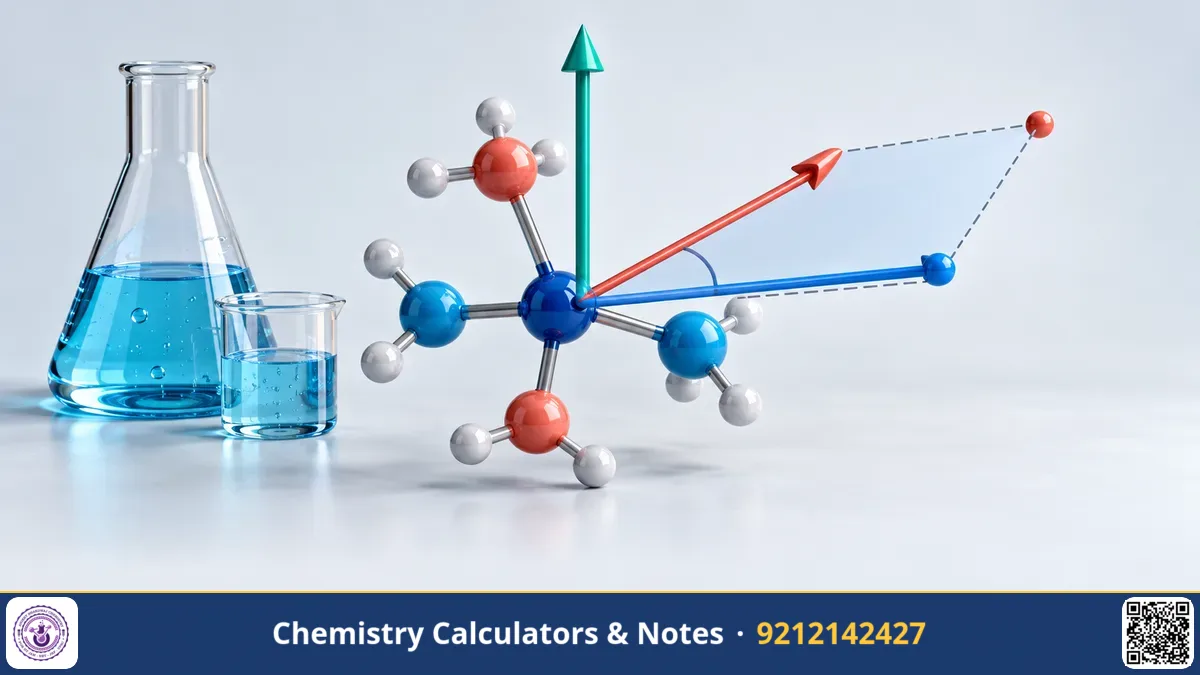
A vector perpendicular to both inputs, with magnitude equal to the area of the parallelogram they span.
Is the dot product commutative?
Yes, a · b = b · a. The cross product is not — a × b = −(b × a).
Need help with this topic?
ABC Chemistry offers Home, Online, Group and One-to-One tuition for Class 11 & 12 Chemistry and Maths in Dwarka and Gurugram.
Call / WhatsApp: +91 92121 42427