Heat of Combustion and Calorific Value of Fuels: Per Mole, Per Gram and Per Litre
Which fuel gives more heat: methane, hydrogen or carbon? The answer depends on whether you compare per mole or per gram. Class 11 thermochemistry gives the enthalpy of combustion in kJ per mole, while everyday and industrial talk uses calorific value, the heat released per unit mass of fuel. Moving between the two is a small unit-conversion skill that appears in numericals again and again.

Definitions
Standard enthalpy of combustion (ΔcH°) is the enthalpy change when one mole of a substance burns completely in oxygen under standard conditions. It is negative, because combustion releases heat.
Calorific value is the heat released when a unit mass of fuel is burned completely. It is quoted as a positive number in kJ g−1 or MJ kg−1.
- |ΔcH| is the size of the enthalpy of combustion, ignoring the minus sign.
- M is the molar mass of the fuel.
- Heat needed to warm a substance: q = m × c × ΔT, where c is specific heat capacity (for water, 4.18 J g−1 K−1 is the usual textbook value).
The enthalpy values below are typical textbook values used for practice. In your exam, always use the data printed in your question or your own textbook, because small differences exist between books.
Worked examples
Example 1: calorific value of methane. Given ΔcH°(CH4) = −890 kJ mol−1. Find the heat per gram.
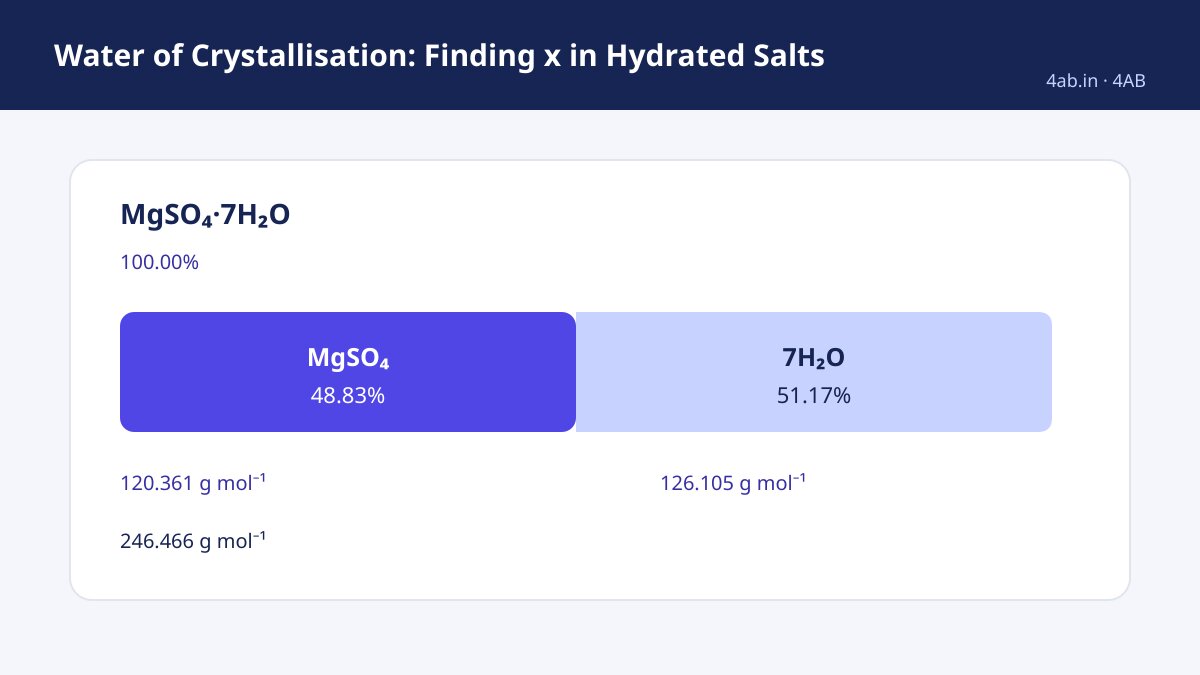
M(CH4) = 12.011 + 4(1.008) = 16.043 g mol−1.
Calorific value = 890 ÷ 16.043 = 55.5 kJ g−1 (55.48 before rounding).
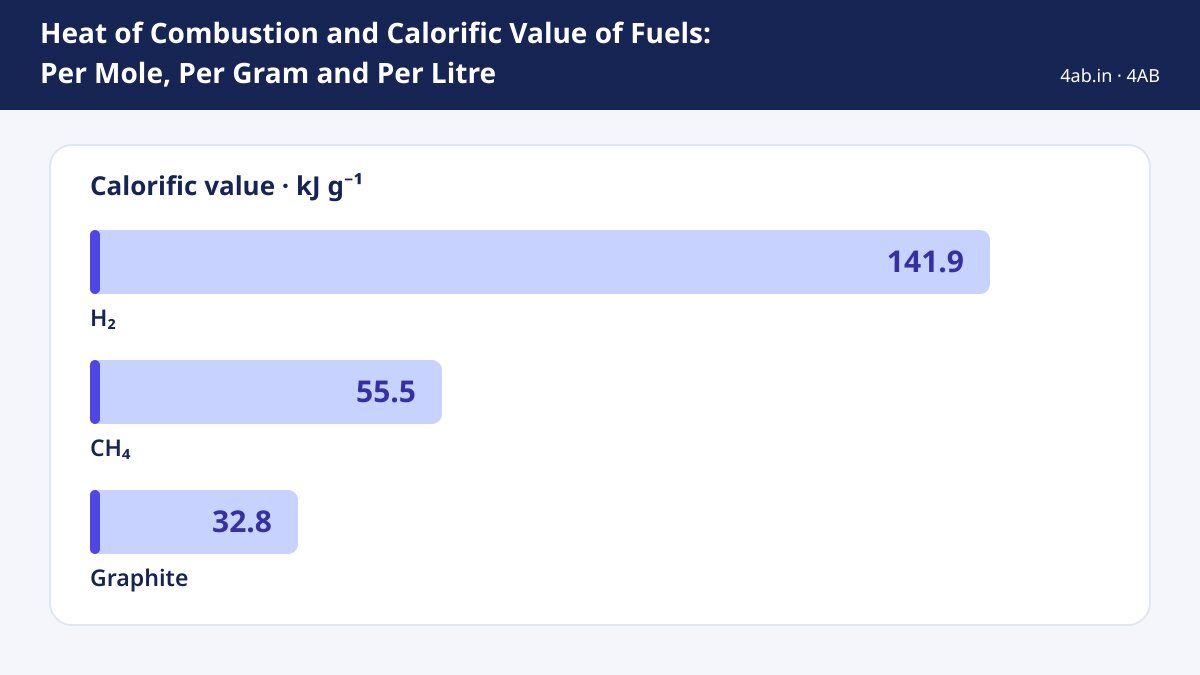
Example 2: comparing three fuels per gram. Given ΔcH° values: hydrogen −286 kJ mol−1 (forming liquid water), methane −890 kJ mol−1, graphite −393.5 kJ mol−1.
Hydrogen: M(H2) = 2.016 g mol−1, so 286 ÷ 2.016 = 141.9 kJ g−1.
Methane: 55.5 kJ g−1 (from Example 1).
Graphite: M = 12.011, so 393.5 ÷ 12.011 = 32.8 kJ g−1.
Per mole, methane gives the most heat of the three. Per gram, hydrogen is far ahead, because a mole of hydrogen is very light. This is why “best fuel” depends on the basis you choose, and why mass-based calorific value is used when the weight of fuel to be carried matters.
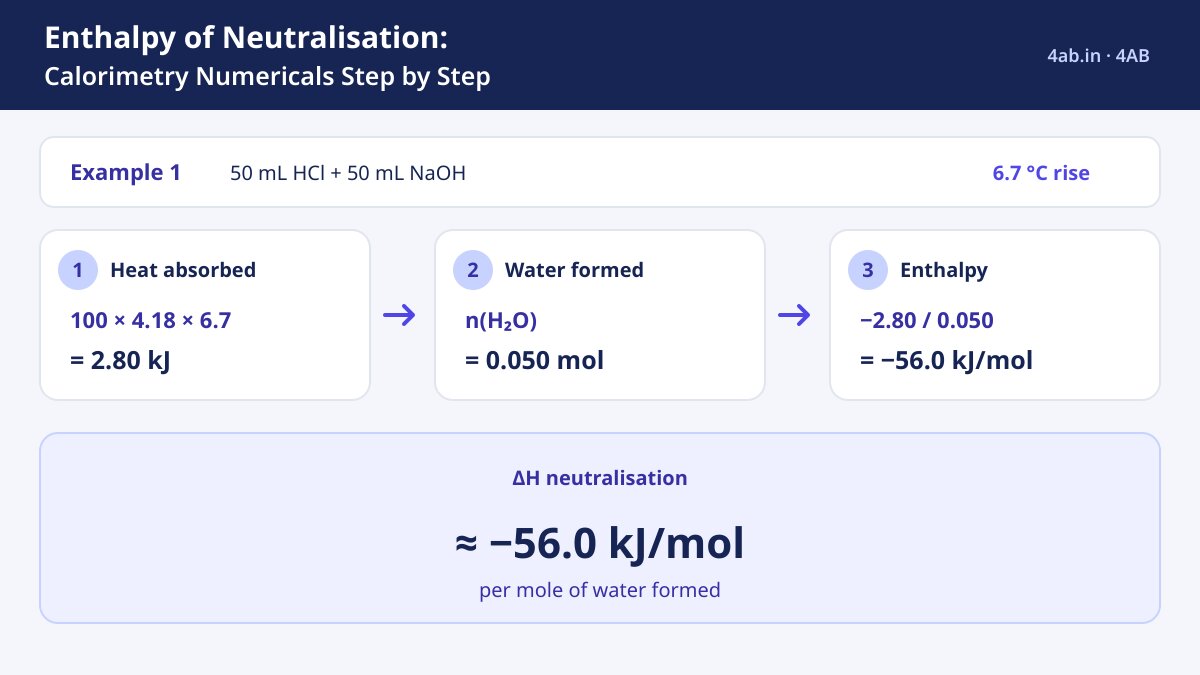
Example 3: fuel needed to heat water. What mass of methane must be burned to heat 1.00 kg of water from 25 °C to 100 °C, assuming all the heat goes into the water? Use c = 4.18 J g−1 K−1.
q = m c ΔT = 1000 g × 4.18 × (100 − 25) = 1000 × 4.18 × 75 = 313 500 J = 313.5 kJ.
Mass of methane = 313.5 kJ ÷ 55.48 kJ g−1 = 5.65 g.
Real-life version: a stove wastes much of the heat. If only 60% reaches the water, the heat the fuel must supply is 313.5 ÷ 0.60 = 522.5 kJ, and the mass needed is 522.5 ÷ 55.48 = 9.42 g.
Example 4: heat from a given mass. How much heat is released by burning 2.00 g of hydrogen completely, using ΔcH° = −286 kJ mol−1?
Moles of H2 = 2.00 ÷ 2.016 = 0.992 mol.
Heat = 0.992 × 286 = 284 kJ.
Cross-check by calorific value: 2.00 g × 141.9 kJ g−1 = 283.8 kJ ≈ 284 kJ. ✓
Common mistakes
- Keeping the minus sign in calorific value. The sign in ΔcH shows heat released; the calorific value is quoted as a positive amount of heat.
- Dividing by the wrong molar mass, for example using 2 for H2 but 12 for CH4. Add all atoms: CH4 is 16.043.
- Mixing joules and kilojoules in q = mcΔT. Specific heat in J g−1 K−1 gives joules; divide by 1000 to get kJ.
- Using ΔcH for the wrong product state. Hydrogen burning to liquid water gives a different value than burning to steam. Use the value that matches the question.
- Forgetting that ΔT in °C and K is the same size, but the temperature itself is not.
- Assuming 100% efficiency when the question mentions heat loss.
Exam-relevance table
| Question type | Method |
|---|---|
| Given kJ per mole, find heat from a given mass | mass ÷ M → moles → × |ΔcH| |
| Find calorific value | |ΔcH| ÷ M |
| Mass of fuel to heat water | q = mcΔT, then q ÷ calorific value (adjust for efficiency) |
| Compare fuels | State the basis (per mole or per gram) in your answer |
Check your own syllabus for how much emphasis it places on fuels and calorific value.
Check the molar mass of every fuel before you divide: it is the number that most often goes wrong in these numericals.
Open the Molar Mass & Composition Calculator →Turn this concept into marks: solve previous-year CSIR-NET questions and take a timed quiz.
More Thermodynamics articles