Class 11 chemistry numericals: unit habits for mole and gas problems
Many Class 11 students know the formula but still lose marks in physical chemistry numericals.
This post shows which unit and significant-figure slips cause it, and a routine your child can follow at home.
Why units cause trouble in Class 11
In Class 10, most numericals are short. In Class 11 chemistry, one question can carry three or four steps. A student may find moles from mass, then use the gas equation, then convert the answer to another unit.
Each step is a chance to slip. A student who understands the chemistry can still get a wrong final answer because one number was in kilograms instead of grams, or in °C instead of kelvin. The examiner sees a wrong answer and a messy method, and marks are lost.
Parents in Dwarka and Gurgaon often say that their child understands the topic in class but still makes careless errors. In most cases these are not random. They come from a missing habit, and a habit can be taught.
Common errors in mole problems
A mole is a fixed amount of a substance. It is the amount that contains as many particles as there are atoms in exactly 12 g of carbon-12. Mass, moles and number of particles are linked, so a unit mistake in one step carries into the next.
- Mixing mass units. Molar mass is in g mol-1. If the question gives kilograms or milligrams, convert to grams first.
- Using the mass of an atom for a molecule. Oxygen gas is O2, so its molar mass is double that of a single oxygen atom. Check the formula of the substance before you pick the molar mass.
- Forgetting the volume unit. Molarity is moles per litre. If the volume is given in mL, change it to litres first. A millilitre is one-thousandth of a litre.
- Dropping units midway. A bare number hides the mistake. A number with its unit shows it.
Common errors in gas problems
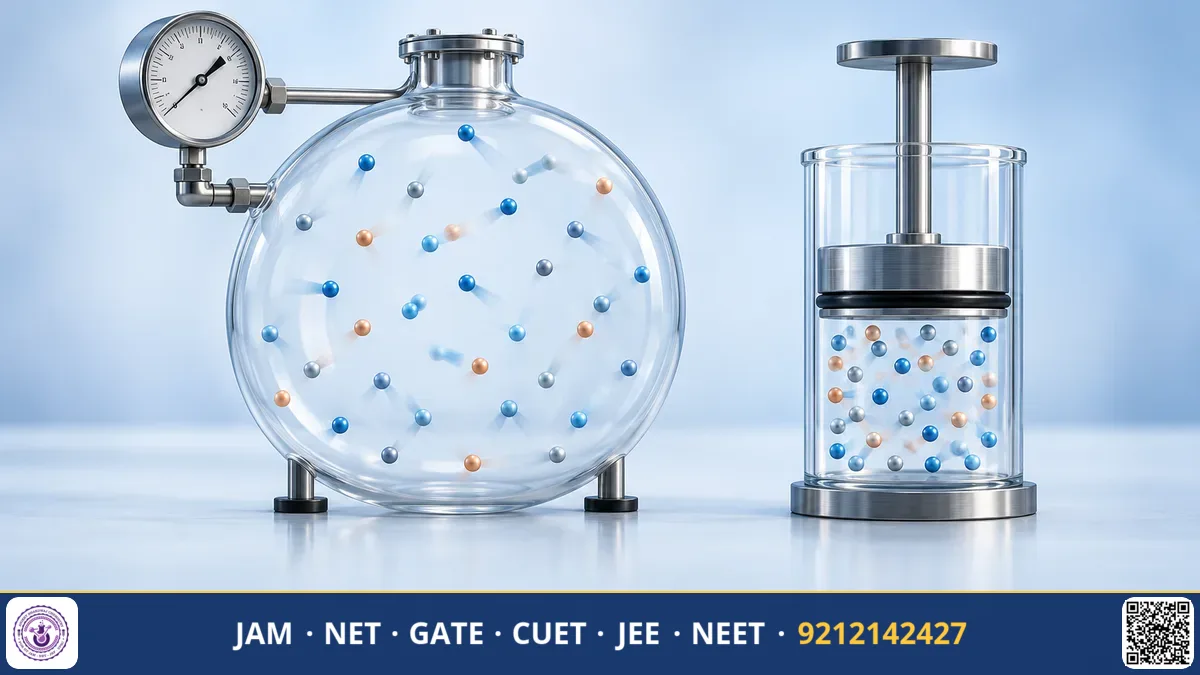
Gas problems add temperature and pressure, so there are more places to go wrong. The ideal gas equation is PV = nRT. Here P is pressure, V is volume, n is moles, T is temperature in kelvin, and R is the gas constant.
The value of R depends on the units. Pick the R that matches your units, not the one you remember best.
| Quantity | Common mistake | What to do |
|---|---|---|
| Temperature | Putting °C into the equation | Add 273 (or 273.15) to get kelvin before substituting |
| Volume | Using mL or cm3 with R in litres | Convert to litres first |
| Pressure | Mixing atm, bar, Pa and mmHg | Convert to the unit that matches your R |
| R value | Using the SI value with litres and atm | Use 0.0821 L atm K-1 mol-1 with L and atm. Use 8.314 J K-1 mol-1 with SI units |
| Molar volume | Using one value for every question | Check which standard conditions the question uses |
On molar volume: STP means standard temperature and pressure. Older conventions use 0 °C and 1 atm, which gives 22.4 L for one mole of an ideal gas. NCERT uses 273.15 K and 1 bar, which gives about 22.7 L. Ask your child's teacher which one the school expects, and write the conditions in the answer.
A worked example with units kept
Question: A gas sample has 0.50 mol in a 2.0 L vessel at 27 °C. Find the pressure in atm.
- Convert temperature. T = 27 + 273 = 300 K.
- Check volume. V = 2.0 L. It is already in litres.
- Choose R. Volume is in L and pressure is wanted in atm, so R = 0.0821 L atm K-1 mol-1.
- Substitute. P = nRT / V = (0.50 mol × 0.0821 L atm K-1 mol-1 × 300 K) / 2.0 L.
- Cancel units. mol, K and L cancel. Only atm is left. This tells you the setup is right.
- Calculate and round once. The calculator gives a long decimal starting with 6.1. The data has two significant figures, so round at the end.
Answer: P = 6.2 atm.
Had the student written 27 instead of 300, the answer would be far too small. Cancelling units in step 5 would not catch that slip, because the units would still cancel. So the °C-to-kelvin check in step 1 is a separate habit.
Significant figures: round late, round once
Significant figures are the digits in a measured number that carry meaning. The number 2.0 L has two significant figures. It tells us the volume was measured to the nearest tenth of a litre.
Students lose marks in two ways here.
- Rounding too early. If you round the moles to two digits and use that number in the next step, a small error grows. Keep extra digits on the calculator and round only the final answer.
- Giving too many digits. In the example above, writing every digit from the calculator looks precise, but the data has only two significant figures. So the answer should have two.
Two basic rules are enough for most Class 11 questions. In multiplication and division, the answer has as many significant figures as the least precise number. In addition and subtraction, the answer follows the fewest decimal places. Exact numbers, such as the factor between litres and millilitres, do not limit the answer.
Also check what your school expects. Some teachers want the final answer in a set number of decimals. In tests, follow the teacher's instruction.
A routine that builds the habit
Do not try to fix everything in one week. Pick a short routine and repeat it.
- Write a given list first. Every numerical starts with the data and its units, one under the other.
- Convert before substituting. Grams, litres, kelvin and a pressure unit that matches R. Tick each one.
- Carry units through every line. They should cancel to the unit you want.
- Round once, at the end. Match the significant figures of the data.
- Do a one-line sense check. Is the answer reasonable? A negative volume or a negative number of moles is not.
- Keep an error log. After each worksheet, write one line for each mistake, such as a missed volume conversion or a wrong molar mass. Read this log before the next test.
A few questions each school day work better than one long session at the weekend. The aim is that the checks become automatic.
How a home tutor helps with this
In a classroom, the teacher usually marks the final answer. A one-to-one tutor can watch the working as it is written. That is where unit slips show up first: the student pauses over a conversion or skips writing the unit.
The tutor can fix the habit at that moment, not after the test. The tutor can also read the error log, see which slip repeats, and set questions aimed at that one slip.
Great Home Tutors offers home tuition only, with no coaching centre and no group batch. You tell us the class, subject, board and your locality, and a person calls you back to understand the student. Tutors we have checked ourselves carry a Verified mark and are listed first. A first class lets you see the fit before anything is fixed. Families in Dwarka and in Gurgaon, including Sectors 108 to 113, can use the same process.
Key takeaways
- Most lost marks in Class 11 mole and gas numericals come from units and rounding, not from weak concepts.
- Convert first: grams, litres, kelvin, and a pressure unit that matches the value of R.
- Carry units in every line. If they do not cancel to the wanted unit, the setup is wrong.
- Round only at the final step, and match the significant figures of the data.
- An error log and a short daily routine build the habit better than one long weekly session.
Frequently asked questions
Which value of R should my child use?
Use the one that matches the units in the question. With litres and atm, use 0.0821 L atm K-1 mol-1. With SI units, use 8.314 J K-1 mol-1. Writing the units next to R makes the choice clear.
Is molar volume 22.4 L or 22.7 L?
It depends on the conditions. 22.4 L is for 0 °C and 1 atm. About 22.7 L is for 273.15 K and 1 bar, which NCERT uses. Ask your child's teacher which one the school follows, and write the conditions in the answer.
How many significant figures should the final answer have?
For multiplication and division, match the data with the fewest significant figures. For addition and subtraction, match the fewest decimal places. Round only at the end.
Should my child convert °C to kelvin if the question gives a temperature difference?
A change in temperature has the same size in °C and in kelvin, so a difference needs no conversion. For an actual temperature used in PV = nRT, always convert to kelvin.
How do I request a home tutor?
Fill in the request form on the Great Home Tutors page with the student's class, subject, board and locality. A person from Great Home Tutors will call you back to understand what the student needs.
What to do next. Try it yourself on the page below.
Great Home Tutors — home tuition at your home · 4AB →