Q126 · CSIR NET Chemistry, December 2011
Paper: CSIR NET December 2011 · Subject: Physical Chemistry · Chapter: Thermodynamics · Topic: Thermodynamics – General · Marks: 2 · Difficulty: Hard
For the reaction $\mathrm{H}_{2} \mathrm{O}(\mathrm{g})+\mathrm{C}$ (graphite) $\rightleftharpoons$ $\mathrm{CO}(\mathrm{g})+\mathrm{H}_{2} \mathrm{O}(\mathrm{g})$, the variation of energy parameter $\Delta \mathrm{G}_{0}, \Delta \mathrm{H}_{0}$ and $\mathrm{T} \Delta \mathrm{S}_{0}$ of the reaction over a large temperature range is shown below. The correct identification of the curves is given by 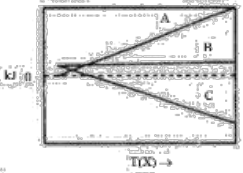
(a)$\mathrm{A} \rightarrow \Delta \mathrm{G}, \mathrm{B} \rightarrow \Delta \mathrm{H}, \mathrm{C} \rightarrow \mathrm{TAS}$
(b)$\mathrm{A} \rightarrow \Delta \mathrm{H}, \mathrm{B} \rightarrow \Delta \mathrm{G}, \mathrm{C} \rightarrow \mathrm{T} \Delta \mathrm{S}$
(c)$\mathrm{A} \rightarrow \Delta \mathrm{G} . \mathrm{B} \rightarrow \mathrm{T} \Delta \mathrm{S}, \mathrm{C} \rightarrow \Delta \mathrm{H}$
(d)$\mathrm{A} \rightarrow \mathrm{TAS}, \mathrm{B} \rightarrow \Delta \mathrm{H}, \mathrm{C} \rightarrow \Delta \mathrm{G}$
Answer
Answer: D ✓ checked by 4AB · confidence medium
Explanation
ΔH° is nearly constant (B). ΔS° > 0 for C + H₂O → CO + H₂ (gas is formed), so TΔS° rises (A) and ΔG° = ΔH° − TΔS° falls (C). A→TΔS, B→ΔH, C→ΔG (d).
Study loop for Thermodynamics