Q74 · CSIR-NET Chemistry, December 2011
Paper: CSIR-NET December 2011 · Subject: Organic Chemistry · Chapter: Organic Spectroscopy · Topic: Combined Structure Elucidation · Marks: 2 · Difficulty: Hard
An organic compound having molecular formula $\mathrm{C} \quad{ }_{\mathrm{15}} \mathrm{H}_{\mathrm{14}} \mathrm{O}$ exhibited the following ${ }^{\mathrm{1}} \mathrm{H}$ and ${ }^{\mathrm{13}} \mathrm{C}$ NMR spectral data. ${ }^{\mathrm{1}} H ~ N M R ~ : ~ \delta$ 2.4(s), $7.2(\mathrm{d}, \mathrm{J}=\mathrm{8} ~ H z), \mathrm{7 . 7}(\mathrm{d}, \mathrm{J}=\mathrm{8} ~ H z)$ ${ }^{13} \mathrm{C}$ NMR : $\delta 21.0,129.0,130.0,136.0,141.0,190.0$
(a)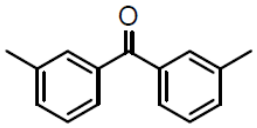
(b)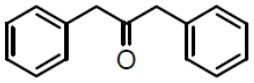
(c)

(d)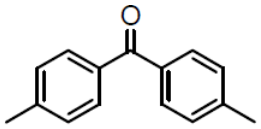
Answer
Answer: D ✓ checked by 4AB · confidence high
The source book printed no answer; this one was worked out and checked — see the explanation.
Explanation
One CH₃ singlet (δ 2.4), an AA′BB′ pair of doublets, and 6 ¹³C signals with C=O at 190 point to the symmetric di-p-tolyl ketone (d).
Study loop for Organic Spectroscopy