Q19 · CSIR-NET Chemistry, December 2012
Paper: CSIR-NET December 2012 · Subject: Organic Chemistry · Chapter: Pericyclic Reactions · Topic: Pericyclic Reactions – General · Marks: 2 · Difficulty: Medium
In the following sequence of pericyclic reactions X and Y are 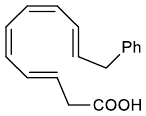


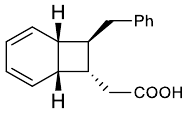


(a)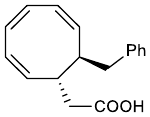

(b)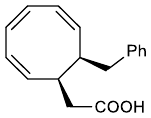

(c)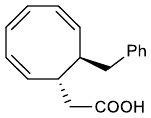 $\Delta /$ DIS
$\Delta /$ DIS(d)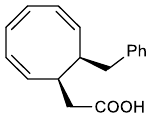 $\Delta /$ CON
$\Delta /$ CONAnswer
Answer: C ✓ checked by 4AB · confidence medium
The source book printed B; on checking, C is correct — see the explanation.
In the final product the two ring-fusion H atoms are both wedged, so the fusion is cis. A cis fusion from a 6π closure requires thermal disrotatory, so Y = Δ/DIS. The product's CH2Ph (wedge) and CH2COOH (hash) are trans, and the 6π step does not touch those carbons, so X must be trans. That is option (c), the printed key C. The displayed key (b) gives hν/CON, which would make a trans fusion, and puts X cis; both contradict the drawn product.
Explanation
Work back from the product. In the bicyclo[4.2.0]octadiene shown, the two ring-fusion H atoms are cis (both wedged), and CH₂Ph and CH₂COOH are trans on the cyclobutane. The second step, X → product, is a 6π electrocyclic closure of the cyclooctatriene. A cis ring fusion requires a disrotatory closure, and a 6π disrotatory closure is thermal. A photochemical 6π closure would be conrotatory and give a trans fusion. So Y = Δ/DIS. The two sp³ carbons that carry CH₂Ph and CH₂COOH are not involved in the 6π step, so their trans relationship must already be present in X. X is therefore the cyclooctatriene with CH₂Ph and CH₂COOH trans. The only option that combines trans-X with Δ/DIS is (c).
Study loop for Pericyclic Reactions