Q21 · CSIR-NET Chemistry, December 2012
Paper: CSIR-NET December 2012 · Subject: Organic Chemistry · Chapter: Reagents, Reaction Mechanisms & Named Reactions · Topic: Reagents, Reaction Mechanisms & Named Reactions – General · Marks: 2 · Difficulty: Medium
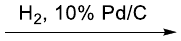
In the following reaction, the reagent A and the major product B are 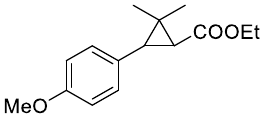


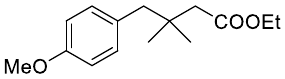
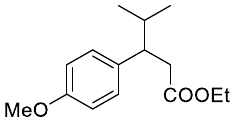
(a)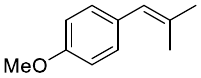
 $\mathrm{N}_{2} \mathrm{CHCOOEt}, \mathrm{Cu}(\mathrm{acac})_{2}$
$\mathrm{N}_{2} \mathrm{CHCOOEt}, \mathrm{Cu}(\mathrm{acac})_{2}$(b)$\mathrm{N}_{2} \mathrm{CHCOOEt}, \mathrm{Cu}(\mathrm{acac})_{2}$
(c)NaH , 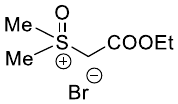
(d)NaH , 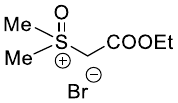
Answer
Answer: A ✓ checked by 4AB · confidence medium
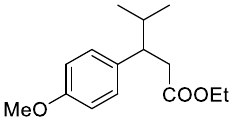
Key (a) confirmed. The explanation said the benzylic bond to the gem-dimethyl carbon is cleaved, which would give ArCH₂CH(COOEt)CHMe₂, not the product of (a).
Explanation
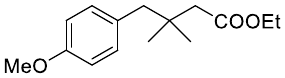
The alkene is electron-rich, not a Michael acceptor, so the sulfoxonium ylide (NaH / Me₂S(O)⁺CH₂COOEt) cannot cyclopropanate it; the copper carbenoid from ethyl diazoacetate does. Reagent A = N₂CHCOOEt, Cu(acac)₂. Over H₂/Pd–C, the cyclopropane opens at the bond between the aryl-bearing (benzylic) carbon and the ester-bearing carbon; this bond is activated by both groups and is the least hindered. This gives MeOC₆H₄CH₂C(CH₃)₂CH₂COOEt, ethyl 4-(4-methoxyphenyl)-3,3-dimethylbutanoate (B). Answer: (a)
Study loop for Reagents, Reaction Mechanisms & Named Reactions