Q24 · CSIR-NET Chemistry, December 2012
Paper: CSIR-NET December 2012 · Subject: Organic Chemistry · Chapter: Reagents, Reaction Mechanisms & Named Reactions · Topic: Reagents, Reaction Mechanisms & Named Reactions – General · Marks: 2 · Difficulty: Easy
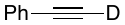
The major product B formed in the following reaction sequence is 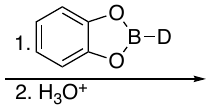



(a)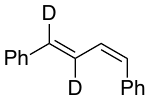
(b)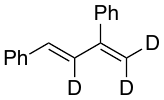
(c)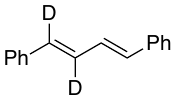
(d)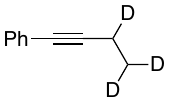
Answer
Answer: A ✓ checked by 4AB · confidence high
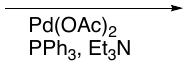
Key A confirmed. Catechol vinylboronates hydrolyse to boronic acids rather than protodeboronate, so the coupling is Suzuki-type; the earlier protodeboronation/Heck account was not the correct mechanism.
Explanation
Catecholborane-D adds syn across Ph–C≡C–D: boron goes to the D-bearing carbon (away from Ph) and the new D to the Ph-bearing carbon. H₃O⁺ hydrolyses the catechol ester to the vinylboronic acid A, Ph(D)C=C(D)B(OH)₂, in which Ph and B are trans. Pd(OAc)₂/PPh₃/Et₃N then couples A (Suzuki-type) with (Z)-β-iodostyrene, with both alkene geometries retained. This gives (1E,3Z)-1,4-diphenylbuta-1,3-diene-1,2-d₂ — option (a).
Study loop for Reagents, Reaction Mechanisms & Named Reactions