Q21 · CSIR-NET Chemistry, December 2013
Paper: CSIR-NET December 2013 · Subject: Organic Chemistry · Chapter: Photochemical Reactions · Topic: Photocycloaddition · Marks: 2 · Difficulty: Medium
The major product formed in the following photochemical reaction is 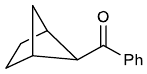
(a)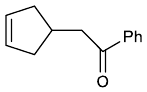
(b)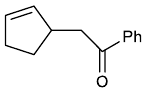
(c)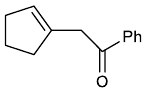
(d)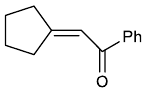
Answer
Answer: B ✓ checked by 4AB · confidence medium
The source book printed C; on checking, B is correct — see the explanation.
The reactant is 5-benzoylbicyclo[2.1.1]hexane; there is no cyclopropane. Norrish II γ-H abstraction followed by β-cleavage of C1–C5 places the new C=C in the five-membered ring either next to (γ-H from the C6 bridge) or one carbon away from (γ-H from C2) the CH2COPh carbon, giving (b) or (a). A cyclopent-1-enyl or ylidene product (c, d) cannot form. The printed key B, which the source attributes to abstraction of the proximal γ-H, is restored.
Explanation
The substrate is 5-benzoylbicyclo[2.1.1]hexane. On irradiation the n,π* excited C=O abstracts a γ-hydrogen from the nearby one-carbon bridge (Norrish type II), giving a 1,4-biradical. β-Cleavage of the strained C1–C5 bond then forms an enol (C5=C(OH)Ph) and a new C=C in the remaining five-membered ring, next to the carbon that carries C5. The enol tautomerises to the ketone, giving 3-(phenacyl)cyclopentene, with PhCOCH₂ on the allylic carbon: option (b). A cyclopent-1-enyl or ylidene product (c, d) is not possible by this route.
Study loop for Photochemical Reactions