Q80 · CSIR-NET Chemistry, December 2015
Paper: CSIR-NET December 2015 · Subject: Inorganic Chemistry · Chapter: Organometallic Compounds · Topic: Cluster Compounds Wade Rules · Marks: 2 · Difficulty: Hard
Reaction of $\left[\mathrm{Mn}_{2}(\mathrm{CO})_{10}\right]$, with $\mathrm{I}_{2}$, results in A without loss of CO. Compound A, on heating of $120^{\circ} \mathrm{C}$ loses a CO ligand to give B , which does not have a $\mathrm{Mn}-\mathrm{Mn}$ bond. Compound B reacts with pyridine to give 2 equivalents of C . Compounds $\mathrm{A}, \mathrm{B}$ and C from the following respectively, are (I) 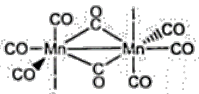 (II)
(II) 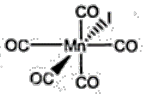 (III)
(III) 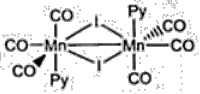 (IV)
(IV) 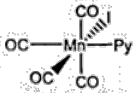 (V)
(V) 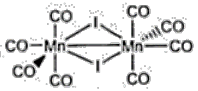
(II) (III) (IV) (V) (a)II, V and IV
(b)II, III and IV
(c)V, III and IV
(d)II, V and III
Answer
Answer: A ✓ checked by 4AB · confidence high
Explanation
I₂ cleaves the Mn–Mn bond, giving Mn(CO)₅I (II). Heating loses CO, giving the iodide-bridged [Mn(CO)₄I]₂ (V) with no Mn–Mn bond. Pyridine splits it into 2 Mn(CO)₄(py)I (IV) (a).
Study loop for Organometallic Compounds