Q24 · CSIR-NET Chemistry, December 2016
Paper: CSIR-NET December 2016 · Subject: Physical Chemistry · Chapter: Chemical Kinetics · Topic: Steady State Approximation · Marks: 2 · Difficulty: Hard
Under review — part of this question (a structure or an option) is not clear in the source scan. 4AB is checking it against the original book; the answer shown may change.
A reaction goes through the following elementary steps 

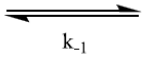


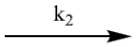
 Assuming that steady state approximation can be applied to $\mathrm{C}$, on doubling the concentration of , the rate of production of D will increase by (assume $K_2[A] \ll K_{-1}[C]$)
Assuming that steady state approximation can be applied to $\mathrm{C}$, on doubling the concentration of , the rate of production of D will increase by (assume $K_2[A] \ll K_{-1}[C]$)(a)2 times
(b)4 times
(c)8 times
(d)$2\sqrt{2}$ times
Answer
Under review — not yet confirmed.
Answer: D
The source book printed no answer; this one was worked out and checked — see the explanation.
Explanation
With k₂[A] ≪ k₋₁[C], the steady-state [C] reduces to the pre-equilibrium value √(K[A][B]). Rate = k₂[A][C] ∝ [A]^(3/2)[B]^(1/2), so doubling [A] raises the rate by 2^(3/2) = 2√2 (d).
Study loop for Chemical Kinetics