Q56 · CSIR-NET Chemistry, December 2017
Paper: CSIR-NET December 2017 · Subject: Organic Chemistry · Chapter: Pericyclic Reactions · Topic: Pericyclic Reactions – General · Marks: 2 · Difficulty: Medium
In the following transformation, the mode of electrocyclization A and the major product B are  heat
heat 
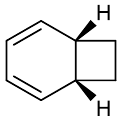
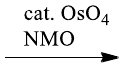 B
B
heat B(a)$A=(4n)e^{-}$, dis; B= 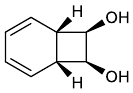
(b)$A=(4n+2)e^{-}$, dis; 
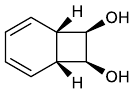
(c)$A=(4n)e^{-}$, con; B= 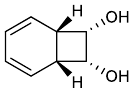
(d)$A=(4n+2)e^{-}$, con; 
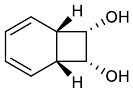
Answer
Answer: B ✓ checked by 4AB · confidence medium
Explanation
COT → bicyclo[4.2.0]octatriene is a 6π (4n+2), thermal disrotatory closure. OsO₄ then dihydroxylates the cyclobutene from the convex face, on the same side as the ring-fusion H (b).
Study loop for Pericyclic Reactions