Q65 · CSIR-NET Chemistry, December 2017
Paper: CSIR-NET December 2017 · Subject: Physical Chemistry · Chapter: Group Theory · Topic: Character Tables · Marks: 2 · Difficulty: Hard
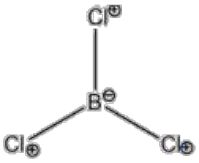
Given below is a specific vibrational mode of $\mathrm{BCl_3}$ with ⊕ and ⊖ denoting movements of the respective atoms above and below the plane of the molecule respectively. The irreducible representation of the vibrational mode and its IR / Raman activity are
| $\mathrm{D_{3h}}$ | E | $2\mathrm{C_3}$ | $3\mathrm{C_2}$ | $\sigma_h$ | $2\mathrm{S_3}$ | $3\sigma_v$ | |
|---|---|---|---|---|---|---|---|
| $\mathrm{A_1}'$ | 1 | 1 | 1 | 1 | 1 | 1 | |
| $\mathrm{A_2}'$ | 1 | 1 | -1 | 1 | 1 | -1 | $R_z$ |
| E' | 2 | -1 | 0 | 2 | -1 | 0 | (x,y) |
| $\mathrm{A_1}''$ | 1 | 1 | 1 | -1 | -1 | -1 | |
| $\mathrm{A_2}''$ | 1 | 1 | -1 | -1 | -1 | 1 | z |
| E'' | 2 | -1 | 0 | -2 | 1 | 0 | $(R_x,R_y)$ |
(a)$\mathrm{A}_{2}^{\prime}$; neither IR nor Raman active
(b)E' ; both IR and Raman active
(c)$\mathrm{A}_{1}^{\prime}$; Raman active
(d)$\mathrm{A}_{2}^{\prime \prime}$; IR active
Answer
Answer: D ✓ checked by 4AB · confidence high
Explanation
All atoms moving perpendicular to the BCl₃ plane (B one way, Cl the other) is the out-of-plane bend A₂″ of D₃h, which transforms like z: IR active, Raman inactive — 'A₂; IR active' (d).
Study loop for Group Theory