Q8 · CSIR-NET Chemistry, December 2018
Paper: CSIR-NET December 2018 · Subject: Organic Chemistry · Chapter: Reagents, Reaction Mechanisms & Named Reactions · Topic: Reagents, Reaction Mechanisms & Named Reactions – General · Marks: 2 · Difficulty: Hard
The mechanism of acid catalysed hydrolysis of benzonitrile involves-
(a)
(b)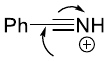

(c)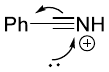

(d)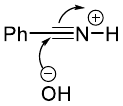
Answer
Answer: B ✓ checked by 4AB · confidence high
The source book printed C; on checking, B is correct — see the explanation.
Scan: in (b) the water lone pair attacks the nitrilium carbon and the C≡N π electrons move onto N, which is correct. In (c) water attacks N⁺ and the π arrow goes toward Ph, which is wrong. The printed key B was right, and the later change to C was an error.
Explanation
In acid, the nitrile nitrogen is protonated first, giving the nitrilium ion Ph–C≡N⁺H. Water then attacks the electrophilic nitrile carbon while the C≡N π electrons move onto nitrogen. Loss of a proton gives the imidic acid, which tautomerises to benzamide and is then hydrolysed further.
Only (b) shows these arrows. (a) shows neutral nitrile attack without activation. (c) has water attacking N⁺ with π electrons pushed toward Ph. (d) uses OH⁻, which belongs to base-mediated hydrolysis.
Answer: (b)
Study loop for Reagents, Reaction Mechanisms & Named Reactions