Q28 · CSIR-NET Chemistry, December 2019
Paper: CSIR-NET December 2019 · Subject: Organic Chemistry · Chapter: Reagents, Reaction Mechanisms & Named Reactions · Topic: Reagents, Reaction Mechanisms & Named Reactions – General · Marks: 2 · Difficulty: Medium
In the following transformation, the enantiomerically pure lactone A is 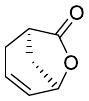
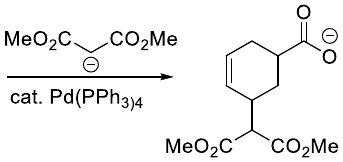
(a)Equimolar amounts of syn and anti diastereomers of B , both of which are racemic.
(b)Equimolar amounts of syn and anti diastereomers of B , both of which are enantiomerically pure.
(c)Only syn diasteroeomer of B, which is racemic.
(d)Only anti diasteromer of B , which is enantiomerically pure.
Answer
Answer: C ✓ checked by 4AB · confidence high
Explanation
Pd(0) ionises the allylic lactone with inversion, and malonate attacks the π-allyl anti to Pd (a second inversion). The net result is retention, giving only the syn diastereomer. The π-allyl's two ends are enantiotopic, so attack at either end gives the racemate (c).
Study loop for Reagents, Reaction Mechanisms & Named Reactions