Q8 · CSIR-NET Chemistry, December 2019
Paper: CSIR-NET December 2019 · Subject: Inorganic Chemistry · Chapter: Inorganic Spectroscopy · Topic: Inorganic Spectroscopy – General · Marks: 2 · Difficulty: Hard
For the complex shown below in non-fluxional state, the expected ${}^{31}\mathrm{P}\{{}^{1}\mathrm{H}\}$ NMR resonance(s) is/are $[{}^{31}\mathrm{P}=\mathrm{I}=1/2]$ 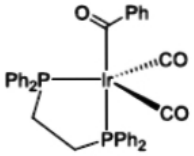
(a)one singlet
(b)one doublet
(c)two Singlets
(d)two doublets
Answer
Answer: D ✓ checked by 4AB · confidence high
The source book printed no answer; this one was worked out and checked — see the explanation.
Explanation
The two phosphorus atoms are chemically inequivalent and couple with each other, so the ³¹P{¹H} spectrum shows two doublets.
Study loop for Inorganic Spectroscopy