Q93 · CSIR-NET Chemistry, June 2011
Paper: CSIR-NET June 2011 · Subject: Organic Chemistry · Chapter: Organic Spectroscopy · Topic: NMR 1H · Marks: 2 · Difficulty: Hard
An organic compound $\mathrm{A}\left(\mathrm{C}_{8} \mathrm{H}_{16} \mathrm{O}_{2}\right)$ on treatment with an excess of methyl-magnesium chloride generated two alcohols $B$ and $C$, whereas reaction of $A$ with lithium aluminium hydride generated only a single alcohol C. Compound B on treatment with an acid yielded an olefin ( $\mathrm{C}_{6} \mathrm{H}_{12}$ ), which exhibited only a singlet at $\delta=1.6 \mathrm{ppm}$ in the ${ }^{\mathrm{1}} \mathrm{H ~ NMR}$ spectrum. The compound A is:
(a)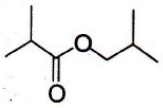
(b)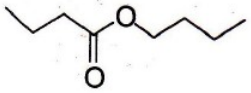
(c)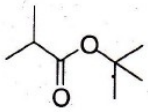
(d)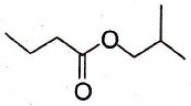
Answer
Answer: A ✓ checked by 4AB · confidence high
Explanation
LiAlH₄ gives a single alcohol, so the acyl and alkoxy halves give the same alcohol: isobutyl isobutyrate. MeMgCl gives 2,3-dimethylbutan-2-ol (B) plus isobutanol (C). B dehydrates to 2,3-dimethylbut-2-ene, which shows one singlet at δ 1.6 (a).
Study loop for Organic Spectroscopy