Q16 · CSIR-NET Chemistry, June 2013
Paper: CSIR-NET June 2013 · Subject: Organic Chemistry · Chapter: Organic Spectroscopy · Topic: NMR 13C · Marks: 2 · Difficulty: Medium
In the broad band decoupled $^{13}$C NMR spectrum, the number of signals appearing for the two pyrene diols A and B 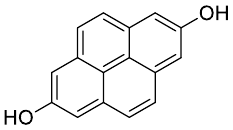 (A)
(A) 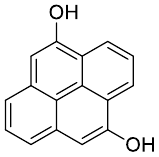 (B)
(B)
(A) (B)(a)eight and eight
(b)eight and sixteen
(c)five and ten
(d)five and eight.
Answer
Answer: D ✓ checked by 4AB · confidence high
The source book printed C; on checking, D is correct — see the explanation.
Explanation
Pyrene has 16 carbons. Diol A (OH groups at C-2 and C-7, on the long axis) keeps the full D₂h symmetry of pyrene, so the carbons fall into 5 sets: C-2/C-7, C-1/3/6/8, C-4/5/9/10, C-3a/5a/8a/10a and C-10b/10c. That gives 5 signals.
In diol B the two OH groups are related only by an inversion centre and a C₂ axis (C₂h), so the 16 carbons form 8 equivalent pairs, giving 8 signals. Answer: five and eight (d).
Study loop for Organic Spectroscopy