Q10 · CSIR-NET Chemistry, June 2014
Paper: CSIR-NET June 2014 · Subject: Organic Chemistry · Chapter: Reagents, Reaction Mechanisms & Named Reactions · Topic: Reagents, Reaction Mechanisms & Named Reactions – General · Marks: 2 · Difficulty: Medium
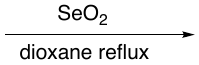
The major products A and B in the following reaction sequence are: 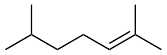
 $\xrightarrow[\text{i-PrOH, Me}_2\text{NH}]{\text{aq. NaCN, MnO}_2}$ B
$\xrightarrow[\text{i-PrOH, Me}_2\text{NH}]{\text{aq. NaCN, MnO}_2}$ B(a)

(b)
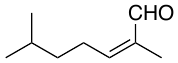 B =
B = 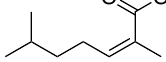

B = (c)
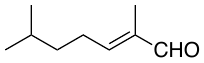

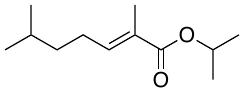
(d)
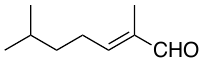 B =
B = 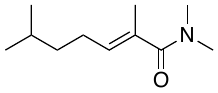
B = Answer
Answer: D ✓ checked by 4AB · confidence high
The source book printed A; on checking, D is correct — see the explanation.
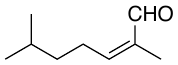
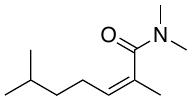
Restores the printed key (d). Scan: in (a)/(b) the CHO is cis to the chain (Z); in (c)/(d) it is trans (E). SeO₂ oxidises the E-methyl, and Me₂NH outcompetes i-PrOH, giving the (E)-dimethylamide of (d). The earlier override to (a) picked the Z isomer.
Explanation
SeO₂ (ene reaction, then [2,3]-sigmatropic shift) oxidises the methyl that is trans to the chain on the trisubstituted alkene, giving (E)-2,6-dimethylhept-2-enal A, with CHO trans to the chain. In the Corey–Gilman–Ganem oxidation, NaCN adds to the aldehyde to form the cyanohydrin. MnO₂ oxidises it to the acyl cyanide, which the more nucleophilic Me₂NH (rather than the i-PrOH solvent) converts into the amide. B is (E)-N,N,2,6-tetramethylhept-2-enamide, with the alkene geometry retained — option (d).
Study loop for Reagents, Reaction Mechanisms & Named Reactions