Q75 · CSIR-NET Chemistry, June 2015
Paper: CSIR-NET June 2015 · Subject: Organic Chemistry · Chapter: Organic Spectroscopy · Topic: Combined Structure Elucidation · Marks: 2 · Difficulty: Hard
An organic compounds shows following spectral data: IR ( $\mathrm{cm}^{-1}$ ): 1680 ${ }^{1} \mathrm{H} \mathrm{NMR}\left(\mathrm{CDCl}_{3}\right): \delta 7.66(\mathrm{m}, 1 \mathrm{H}), 7.60(\mathrm{m}, 1 \mathrm{H}), 7.10(\mathrm{m}, 1 \mathrm{H}), 2.50(\mathrm{s}, 3 \mathrm{H})$ ${ }^{13} \mathrm{C} \mathrm{NMR} \mathrm{CDCl}_{3}: \delta 190,144,134,132,128,28 \mathrm{m} / z(\mathrm{EI}): 126\left(\mathrm{M}^{+}, 100 \%\right), 128\left(\mathrm{M}^{+}+2,4.9 \%\right)$ The structure of the compound is
(a)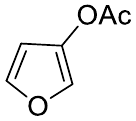
(b)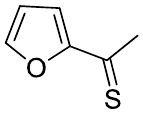
(c)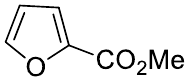
(d)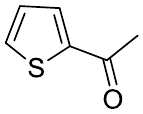
Answer
Answer: D ✓ checked by 4AB · confidence high
Explanation
M⁺ 126 with an M+2 of 4.9 % shows one S (³⁴S). ν 1680 cm⁻¹ is a conjugated ketone, the CH₃ singlet at 2.50 belongs to an acetyl group, and there are three heteroaryl H: 2-acetylthiophene (d).
Study loop for Organic Spectroscopy