Q14 · CSIR-NET Chemistry, June 2018
Paper: CSIR-NET June 2018 · Subject: Organic Chemistry · Chapter: Photochemical Reactions · Topic: Photocycloaddition · Marks: 2 · Difficulty: Medium
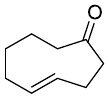
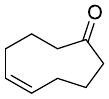
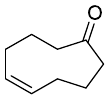
The major products formed in the following photochemical reaction are 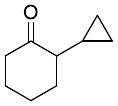


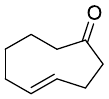
(a)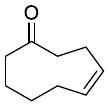 +
+ 
+ (b)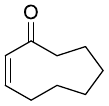 +
+ 
+ (c)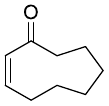 +
+ 
+ (d)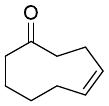 +
+ 
+ Answer
Answer: A ✓ checked by 4AB · confidence medium
The key stays A. The explanation is replaced because it was garbled and carried the next question's text.
Explanation
Norrish type I reaction. n→π* excitation of the ketone causes α-cleavage of the C1–C2 bond, on the more substituted α-carbon that carries the cyclopropyl group. This gives an acyl radical and a secondary cyclopropylcarbinyl radical. The cyclopropylcarbinyl radical opens rapidly to a primary homoallyl radical, which creates a new C=C at the old C-2. The primary radical then recombines with the acyl radical and closes a nine-membered ring (6 ring carbons + 3 cyclopropane carbons). The product is cyclonon-4-enone, formed as both the Z and the E isomer, as shown in option (a).
Study loop for Photochemical Reactions