Q52 · CSIR-NET Chemistry, June 2018
Paper: CSIR-NET June 2018 · Subject: Inorganic Chemistry · Chapter: Organometallic Compounds · Topic: Cluster Compounds Wade Rules · Marks: 2 · Difficulty: Hard
The reaction of $[(\eta^{5}\text{-}\mathrm{C_5H_5})\mathrm{Fe(CO)_2}]^{-}$ with $\mathrm{CH_3I}$ gives compound A. The $^{1}\mathrm{H}$ NMR spectrum of A shows two singlets in an integrated intensity ratio of 3:5. Compound A upon reaction with $\mathrm{PPh_3}$ give compound B. The $^{1}\mathrm{H}$ NMR spectrum of B shows 3 sets of signals in an integrated intensity ratio of 3:5:15. Compounds A and B respectively, are
(a)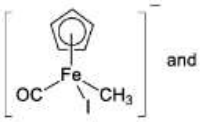
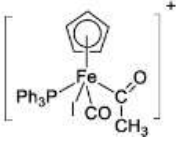
(b)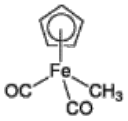 and
and 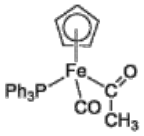
and (c)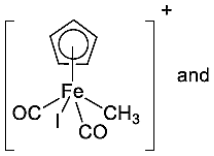
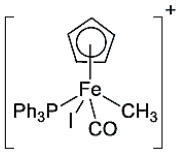
(d)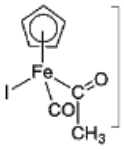 and
and 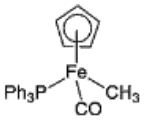
and Answer
Answer: B ✓ checked by 4AB · confidence high
Explanation
[CpFe(CO)₂]⁻ + CH₃I → CpFe(CO)₂CH₃ (Cp 5H : CH₃ 3H). PPh₃ induces migratory insertion to CpFe(CO)(PPh₃)(COCH₃), whose signals are 3 : 5 : 15 (b).
Study loop for Organometallic Compounds