Q59 · CSIR-NET Chemistry, June 2019
Paper: CSIR-NET June 2019 · Subject: Organic Chemistry · Chapter: Organic Spectroscopy · Topic: Combined Structure Elucidation · Marks: 2 · Difficulty: Hard
The compound that exhibits the following spectral data is IR: ($\nu$) $1685\,\mathrm{cm^{-1}}$; ${}^{1}\mathrm{H}$ NMR: $\delta = 7.84$ (d, $J=8$ Hz, 2H), 7.60 (d, $J=8$ Hz, 2H), 3.65 (t, $J=7$ Hz, 2H), 3.18 (t, $J=7$ Hz, 2H), 2.25 (pentet, $J=7$ Hz, 2H) ppm; ${}^{13}\mathrm{C}$ NMR: $\delta = 28, 36.45, 128, 130, 133, 137, 197$ ppm; EI MS $m/z$: 200, 198 (1:1), 185, 183 (1:1)
(a)
(b)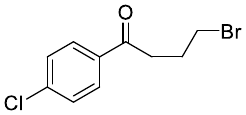
(c)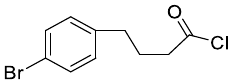
(d)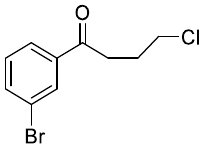
Answer
Answer: D ✓ checked by 4AB · confidence medium
The source book printed A; on checking, D is correct — see the explanation.
Explanation
m/z 183/185 (1 : 1) is BrC₆H₄CO⁺, so the ring carries Br. CH₂Cl appears at δ 3.65 (δC 45), and the McLafferty ion is at 198/200. ν 1685 cm⁻¹ is an aryl ketone. The compound is 4-chloro-1-(bromophenyl)butan-1-one (d); the AA′BB′ pattern indicates para, though (d) is drawn meta.
Study loop for Organic Spectroscopy