Camptothecin as a topoisomerase I anticancer poison — CSIR NET 2011 PYQ solved
This question from CSIR NET 2011 tests your knowledge of medicinal drugs and their biochemical targets in bioinorganic chemistry.
You will learn how camptothecin acts as an anticancer drug by poisoning topoisomerase I and how to classify the other options.
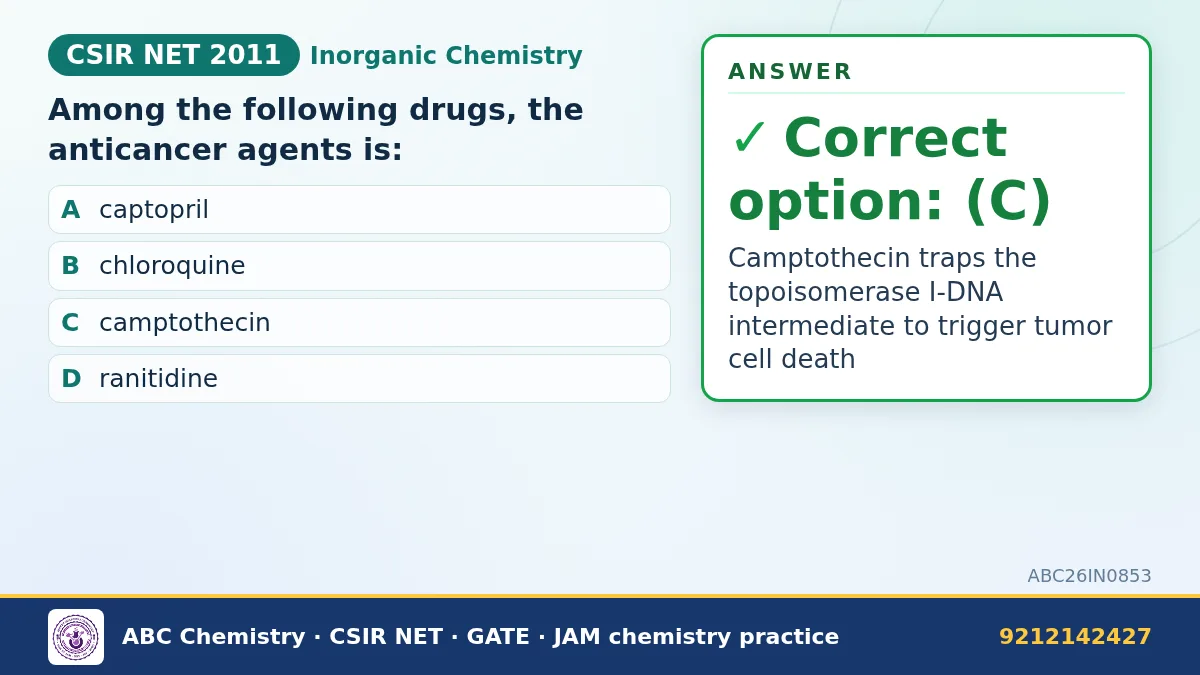
Correct option: (C) — camptothecin
What camptothecin is
Camptothecin is a natural pentacyclic alkaloid with a planar quinoline core fused to an indolizine ring and an α-hydroxy lactone ring. Pharmacologically, it acts as a topoisomerase poison rather than a catalytic inhibitor.
Topoisomerase I controls DNA topology. During replication, superhelical strain accumulates ahead of the fork. Topoisomerase I relieves this strain by cutting one strand, swiveling around the intact strand, and resealing the backbone. Camptothecin binds to the transient enzyme-DNA intermediate, trapping the enzyme on the cut strand and blocking religation. Rapidly dividing tumor cells accumulate these blockages, halting cell growth.
How it works
Topoisomerase I operates through a reversible transesterification mechanism without consuming adenosine triphosphate. An active-site tyrosine residue attacks the DNA backbone.
First, the enzyme binds duplex DNA:
enzyme + DNA ⇌ [enzyme · DNA]
Next, the active tyrosine attacks a phosphodiester bond, forming a covalent phosphotyrosyl linkage and releasing a free hydroxyl end:
enzyme-OH + DNA-phosphate ⇌ [enzyme-O-P-DNA] + free DNA strand
This covalent cleavage complex allows the broken strand to rotate. Normally, the free hydroxyl end attacks the phosphotyrosine bond to reseal the backbone:
[enzyme-O-P-DNA] + free DNA strand ⇌ enzyme + relaxed DNA
Camptothecin intercalates at the cleavage site, binding selectively to the cleavage complex:
[enzyme-O-P-DNA] + camptothecin ⇌ [enzyme-O-P-DNA · camptothecin]
This trapped complex prevents religation. When a replication fork hits this blockage during synthesis phase, an irreversible double-strand break forms, driving the cancer cell into apoptosis.
Why it behaves this way
Camptothecin traps the cleavage complex through its planar shape and functional groups. The molecule contains 5 fused rings, labeled A, B, C, D, and E. Rings A, B, and C form a flat planar system that inserts between base pairs through π-π stacking. Ring E contains an α-hydroxy lactone that forms hydrogen bonds with active-site residues.
This activity has a strict chemical limit. At physiological pH, the closed lactone ring hydrolyzes reversibly to an open carboxylate:
closed lactone (active) + H₂O ⇌ open carboxylate (inactive)
The open carboxylate cannot bind topoisomerase I effectively and binds serum albumin, lowering active drug levels. An acidic pH favors the active closed lactone.
Additionally, camptothecin is specific to the synthesis phase. In non-dividing cells, trapped nicks dissociate and reseal without triggering cell death.
Where the idea comes from
The discovery of camptothecin came from screening plant extracts for antitumor properties. Extracts from a deciduous tree showed strong cytotoxicity against animal tumors, yielding the pure pentacyclic alkaloid.
Early tests showed that the alkaloid caused no breaks in isolated, protein-free DNA. Yet, in living cancer cells, rapid DNA fragmentation occurred. This proved that the drug requires an intracellular protein partner, identified as topoisomerase I.
This finding established the concept of an enzyme poison: a drug that traps a catalytic intermediate, converting an essential enzyme into a cellular poison.
Where it is used
Natural camptothecin served as the template for two water-soluble anticancer drugs: topotecan and irinotecan. Topotecan treats ovarian and lung cancers. Irinotecan is a prodrug converted in tissues to an active metabolite used against colorectal cancer.
In laboratories, camptothecin is used to induce double-strand breaks, study DNA repair pathways, and map topoisomerase I cleavage sites. In bioinorganic chemistry, it is compared with platinum complexes like cisplatin to contrast topoisomerase poisons with DNA-crosslinking agents.
A fresh worked example
A chemist measures the hydrolysis equilibrium of a camptothecin analog in physiological buffer:
closed ring (active) + H₂O ⇌ open chain (inactive)
The equilibrium constant is K = [open chain] / [closed ring] = 3 at physiological pH. Total drug concentration is 80 μmol L⁻¹.
Calculate [closed ring] and [open chain] at this pH, and find the percentage of active drug. Then find [closed ring] in an acidic environment where K = 1.
Step 1: Apply mass balance at physiological pH.
[closed ring] + [open chain] = 80 μmol L⁻¹
Since [open chain] = 3 [closed ring]:
4 [closed ring] = 80 μmol L⁻¹
[closed ring] = 20 μmol L⁻¹
Step 2: Find [open chain] and active percentage.
[open chain] = 3 × 20 μmol L⁻¹ = 60 μmol L⁻¹
Active percentage = (20 / 80) × 100 = 25%
Step 3: Calculate [closed ring] at K = 1.
When K = 1, [open chain] = [closed ring]:
2 [closed ring] = 80 μmol L⁻¹
[closed ring] = 40 μmol L⁻¹
Active percentage = (40 / 80) × 100 = 50%
Acidification shifts the equilibrium toward the closed lactone form, doubling active drug concentration from 20 μmol L⁻¹ to 40 μmol L⁻¹.
Solving the question step by step
- Identify the required medical role. The question asks which compound is an anticancer agent.
- Evaluate option (a), captopril. Captopril coordinates to the catalytic zinc(II) ion in angiotensin-converting enzyme to treat hypertension. It is not an anticancer drug.
- Evaluate option (b), chloroquine. Chloroquine is a 4-aminoquinoline drug that blocks parasitic heme crystallization in malaria. It is not an anticancer agent.
- Evaluate option (c), camptothecin. Camptothecin traps the topoisomerase I-DNA cleavage complex, causing lethal double-strand breaks during replication in tumor cells. It is an anticancer agent.
- Evaluate option (d), ranitidine. Ranitidine antagonizes histamine H₂ receptors to reduce gastric acid in peptic ulcers. It is not an anticancer drug.
- Identify the correct option. Only camptothecin shows anticancer activity. The correct answer is option (c).
Why the other options fail
Option (a) fails because captopril treats hypertension. The misconception assumes any enzyme inhibitor with a metal-binding group is an anticancer drug. Captopril targets zinc-dependent angiotensin-converting enzyme to lower blood pressure.
Option (b) fails because chloroquine treats malaria. The misconception confuses the quinoline core of chloroquine with the pentacyclic framework of camptothecin. Chloroquine prevents heme crystallization in parasites, not topoisomerase turnover.
Option (d) fails because ranitidine treats gastric ulcers. The misconception confuses general therapeutic drugs with cytotoxic agents. Ranitidine selectively blocks histamine H₂ receptors to suppress stomach acid.
| Option | Drug name | Primary biological target | Medical classification | Anticancer agent? |
|---|---|---|---|---|
| (a) | Captopril | Angiotensin-converting enzyme (zinc-dependent) | Antihypertensive | No |
| (b) | Chloroquine | Parasitic heme biocrystallization | Antimalarial | No |
| (c) | Camptothecin | DNA topoisomerase I cleavage complex | Antineoplastic | Yes |
| (d) | Ranitidine | Histamine H₂ receptor | Gastric acid suppressor | No |
Common mistake
A common mistake in CSIR NET is choosing a drug based solely on a recognized heterocyclic ring without checking its physiological target. For instance, candidates confuse the quinoline core of chloroquine with the pentacyclic framework of camptothecin, or assume any enzyme inhibitor in bioinorganic chemistry must be an antitumor drug. Avoid this error by linking each drug to its specific target: captopril inhibits zinc-dependent angiotensin-converting enzyme, chloroquine blocks heme crystallization, ranitidine blocks histamine H₂ receptors, and camptothecin poisons topoisomerase I.
Key takeaways
- Camptothecin is a plant alkaloid that acts as an anticancer agent by trapping the covalent topoisomerase I-DNA cleavage complex.
- Collisions between trapped cleavage complexes and advancing replication forks create irreversible double-strand DNA breaks during synthesis phase.
- The closed α-hydroxy lactone ring is required for topoisomerase I binding; ring opening under neutral conditions yields the inactive carboxylate form.
- Captopril is an antihypertensive inhibitor of angiotensin-converting enzyme, chloroquine is an antimalarial drug, and ranitidine is a histamine H₂ antagonist that suppresses gastric acid.
Frequently asked questions
How often are medicinal agents and their targets tested in CSIR NET?
In CSIR NET, questions on bioinorganic chemistry regularly test the biochemical targets of clinical drugs. Examiners frequently ask you to match drug names with their therapeutic roles, enzyme targets, or coordinated metal ions. Reviewing common agents such as topoisomerase poisons, zinc-dependent enzyme inhibitors, and platinum complexes helps you secure these recall marks quickly.
Why is camptothecin called a topoisomerase poison rather than a catalytic inhibitor?
A pure catalytic inhibitor prevents an enzyme from binding its substrate or carrying out cleavage, leaving DNA unharmed. In contrast, camptothecin permits topoisomerase I to cleave DNA, but it traps the resulting covalent phosphotyrosine intermediate. By preventing religation, the drug converts an essential maintenance enzyme into a lethal obstacle that triggers double-strand breaks during replication.
Why does the intact lactone ring determine the therapeutic potency of camptothecin?
The closed α-hydroxy lactone ring provides the critical stereochemical orientation and hydrogen-bonding groups required to fit into the binding pocket at the enzyme-DNA interface. When the lactone ring hydrolyzes into an open carboxylate form at physiological pH, these interactions are lost. The carboxylate also binds human serum albumin tightly, depressing active drug levels.
Related previous-year questions
- The correct match for the drug molecules in the Column A with their medicinal use in Column B is Column A… CSIR NET
- The ligand system present in vitamin B12 is: CSIR NET
- The reduction of nitrogen to ammonia, carried out by the enzyme nitrogenase, needs, CSIR NET
- A metal ion that replace manganese (II) ion in mangano-proteins without changing its function, is CSIR NET
- Question record ABC26IN0853 with the original answer
- All bioinorganic chemistry previous-year questions
- CSIR NET previous-year question papers
- Is this in the syllabus? Chemistry syllabus tool
Practise this chapter. Solve more bioinorganic chemistry previous-year questions with answers, free.
All bioinorganic chemistry questions →