Environmental Chemistry MCQs: 5 Air and Water Pollution Questions
This post gives you five diagnostic questions on air and water pollution, each with the answer and the reason.
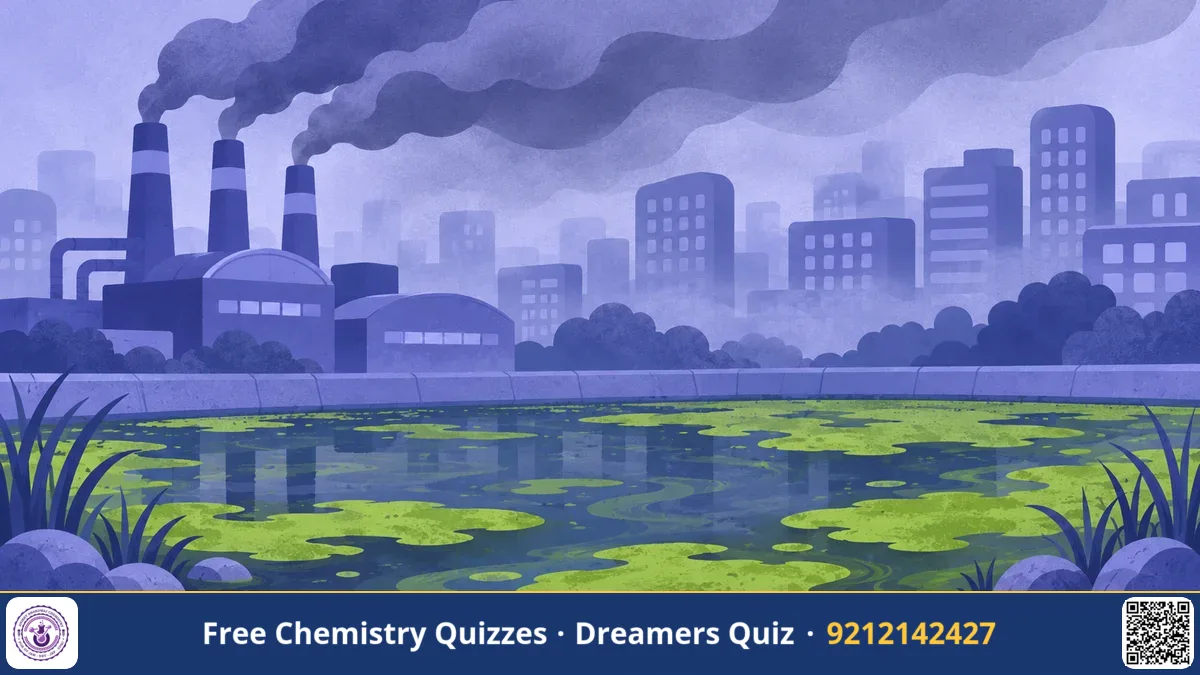
Use them to find which ideas you remember well and which need another read of your NCERT chapter.
How to use these five questions
Do not read the answers first. Cover them with a sheet of paper. Write your choice for each question in your notebook, then check.
Keep a simple tally. Mark each question as "knew it", "guessed" or "got it wrong". A lucky guess is not recall, so count it as a weak spot.
After you finish, read the reasons for the questions you missed. The reason matters more than the option letter, because exam papers change the wording but keep the idea.
Give yourself about one minute per question. If you need much more than that, the topic is not yet automatic for you, and that is useful to know before a test.
Questions 1 and 2: the two smog types
Smog is a word made from smoke and fog. It is a haze that forms over cities. There are two types, and students often mix them up.
Question 1. Which of the following describes classical smog?
- Oxidising, forms in warm sunny weather
- Reducing, forms in cool humid weather, mainly from smoke and sulphur dioxide
- Contains peroxyacetyl nitrate as the main irritant
- Forms only from vehicle exhaust in bright sunlight
Answer: (b). Classical smog forms in cool, humid conditions. It contains smoke, fog and sulphur dioxide (SO2). Sulphur dioxide is a reducing agent, meaning it tends to give away electrons, so this smog is called reducing smog. Options (a), (c) and (d) describe the other type.
Question 2. Which compound is a typical product of photochemical smog and irritates the eyes?
- Peroxyacetyl nitrate
- Carbon monoxide only
- Sulphur trioxide
- Methane
Answer: (a). Photochemical smog forms when sunlight acts on nitrogen oxides and hydrocarbons released by vehicles. The products include ozone, aldehydes and peroxyacetyl nitrate. These are oxidising, so this is oxidising smog. Peroxyacetyl nitrate and the aldehydes irritate the eyes.
Learn this comparison once and both questions become easy.
| Point | Classical smog | Photochemical smog |
|---|---|---|
| Weather | Cool and humid | Warm, dry and sunny |
| Main ingredients | Smoke, fog, SO2 | Nitrogen oxides, hydrocarbons, sunlight |
| Nature | Reducing | Oxidising |
| Typical products | Sulphur-containing pollutants | Ozone, peroxyacetyl nitrate, aldehydes |
| Needs sunlight? | No | Yes |
A quick trick: the word "photo" means light. If light is needed, the smog is photochemical.
Question 3: greenhouse gases
The greenhouse effect is the trapping of heat by certain gases in the atmosphere. Some warming of this kind is natural and keeps the planet warm enough for life. The concern is the extra warming from rising levels of these gases.
Question 3. Which of the following is not a greenhouse gas?
- Carbon dioxide
- Methane
- Nitrogen
- Nitrous oxide
Answer: (c). Nitrogen (N2) and oxygen (O2) make up most of dry air, but they do not absorb heat the way greenhouse gases do. The usual textbook list is:
- carbon dioxide (CO2)
- methane (CH4)
- nitrous oxide (N2O)
- chlorofluorocarbons
- ozone
- water vapour
Many students lose this question because they reason from quantity. They think a gas that makes up most of the air must be the one that traps heat. Quantity is not the test. The test is whether the gas absorbs heat.
Notice that the list has one gas that is also in Question 2. Ozone near the ground is a product of photochemical smog, and it also traps heat. Keep that link in your notes.
Questions 4 and 5: water pollution
Two ideas come up again and again here: biochemical oxygen demand and eutrophication.
Question 4. A river sample shows a very high biochemical oxygen demand. What does this tell you?
- The water is very clean
- The water has a lot of organic matter that bacteria are breaking down
- The water is acidic
- The water has no dissolved oxygen to begin with
Answer: (b). Biochemical oxygen demand is the amount of oxygen that bacteria need to break down the organic matter in a water sample. More organic waste means more oxygen used. So a high value points to polluted water, and clean water has a low value.
Option (d) is a common trap. A high value does not mean there was no oxygen at the start. It means the demand for oxygen is high.
Question 5. Excess phosphate and nitrate from fertilisers and detergents entering a lake mainly cause:
- Acid rain
- Eutrophication
- Photochemical smog
- Ozone depletion
Answer: (b). Eutrophication is the enrichment of a water body with nutrients. Algae grow very fast and cover the surface. When they die, bacteria decompose them and use up the dissolved oxygen. Fish and other water life then struggle to survive.
Notice the link between Questions 4 and 5. Eutrophication raises the amount of decaying organic matter, and that pushes the oxygen demand up.
Worked link: Suppose a pond receives runoff from a fertilised field.
- Nutrients increase, so algae multiply.
- Algae die and settle.
- Bacteria decompose them and use oxygen.
- Oxygen demand rises and dissolved oxygen falls.
If you can write these four steps in order, you can answer most questions on this topic.
What your score says about your recall
- Missed 1 or 2: You are mixing up the two smog types. Redraw the comparison table from memory.
- Missed 3: Revise the list of greenhouse gases and remember that the test is heat absorption.
- Missed 4 or 5: Revise oxygen demand and eutrophication together as one chain of events.
- Got all five: Move to timed practice, because speed is the next skill to build.
Do not worry if you miss one or two. This is a diagnostic, not a test. Its job is to show you where to spend your next hour of study.
Practise further on the Dreamers Quiz portal
Five questions only give you a first check. To go further, open the Dreamers Quiz portal in one tap from the chemistry quiz page.
The steps are simple: pick a class or exam, attempt the set against the clock, then see your score and the answer key. You can attempt as many times as you like.
The page lists these uses: chapter revision before a school test, a quick check after a class, or speed practice for the NEET and CUET MCQ sections.
A good routine is to attempt a set once, read the answer key, wait a day, and attempt it again. If your score does not rise, go back to the chapter, not to another quiz.
Key takeaways
- Classical smog is reducing (smoke and sulphur dioxide, cool humid weather). Photochemical smog is oxidising (nitrogen oxides, hydrocarbons, sunlight).
- Ozone, aldehydes and peroxyacetyl nitrate are products of photochemical smog.
- Nitrogen and oxygen are not greenhouse gases. A greenhouse gas must absorb heat.
- High biochemical oxygen demand means more organic matter and more polluted water.
- Eutrophication is nutrient enrichment that leads to algal growth and falling dissolved oxygen.
Frequently asked questions
Which smog is called reducing smog?
Classical smog is called reducing smog. It forms in cool, humid weather and contains smoke and sulphur dioxide, which acts as a reducing agent.
Why is photochemical smog called oxidising smog?
Its products, such as ozone and peroxyacetyl nitrate, are oxidising in nature. They form when sunlight acts on nitrogen oxides and hydrocarbons.
Does a high biochemical oxygen demand mean cleaner or dirtier water?
It means dirtier water. A high value shows that bacteria need a lot of oxygen to break down the organic matter present.
Which exams can I practise for on the quiz page?
The page describes free timed quizzes for Class 11, Class 12, NEET, JEE and CUET. It also mentions speed practice for the NEET and CUET MCQ sections.
What to do next. Try it yourself on the page below.
Chemistry Quiz — Free Timed Chemistry Quizzes →