Amines Class 12 Chemistry: Conversions and Tests Tutor Guide, Gurugram
This guide explains why amines trouble many Class 12 students in Dwarka and Gurugram.
It also gives a weekly routine for conversion chains and distinction tests that a family can follow at home.
Why amines feel hard in Class 12
An amine is an organic compound formed when hydrogen atoms of ammonia are replaced by alkyl or aryl groups. Alkyl means a carbon chain. Aryl means a benzene ring. If one hydrogen is replaced, the amine is primary. Two replaced gives secondary. Three replaced gives tertiary.
The chapter is hard for three reasons.
- Many reagents look alike, so students mix them up.
- Conversion questions need two or three steps in the correct order.
- Distinction tests need the exact observation, not only the name of the test.
A child may read the NCERT chapter calmly at home and still freeze when a question asks for aniline to be turned into chlorobenzene. The gap is practice, not ability. Recalling a chain under time pressure is a separate skill, and it grows only with a routine.
The conversions to master first
Start with the reactions that appear again and again inside chains. Treat each one as a tool with one job.
| Job | Method | Remember |
|---|---|---|
| Nitro compound to amine | Reduction with hydrogen and a metal catalyst, or with tin and hydrochloric acid | This is the usual way to get aniline from nitrobenzene |
| Alkyl halide to amine | Reaction with ammonia | Gives a mixture of primary, secondary, tertiary amines and a salt |
| Alkyl halide to nitrile to amine | Cyanide first, then reduction | The amine has one carbon more than the halide |
| Amide to primary amine | Bromine and sodium hydroxide | The amine has one carbon less than the amide |
| Phthalimide to primary amine | Phthalimide route with an alkyl halide | Suits aliphatic primary amines, not aromatic ones |
The carbon count is where students slip. Before writing any reagent, ask one question: does this step add a carbon, remove a carbon, or keep the count the same? The nitrile route adds one. The amide route with bromine and alkali removes one. Many conversion questions are really carbon-count questions.
Diazonium salts: the centre of aromatic chains
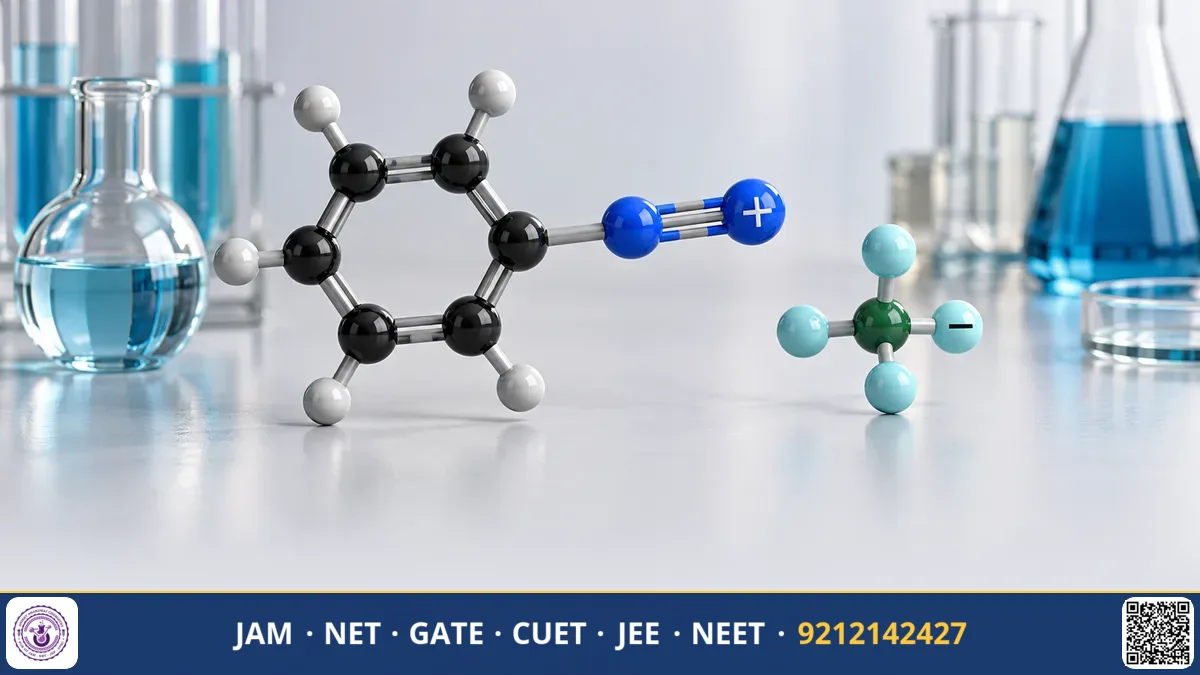
When aniline reacts with nitrous acid at a low temperature, near ice-cold, it forms a diazonium salt. Nitrous acid is made in the flask from sodium nitrite and hydrochloric acid. The salt breaks down if it is warmed, so the cold condition matters.
From the diazonium salt a student can reach many products.
- Chlorobenzene or bromobenzene using cuprous chloride or cuprous bromide.
- Fluorobenzene through fluoroboric acid, then heating.
- Phenol by warming with water.
- Benzene using hypophosphorous acid.
- Azo dyes by coupling with phenol or aniline.
Teach this as a hub with spokes. Draw aniline on the left, the diazonium salt in the centre and the products around it. A student who can redraw this wheel from memory can solve most aromatic conversions.
Worked example: nitrobenzene to chlorobenzene
- Reduce nitrobenzene to aniline.
- Treat aniline with sodium nitrite and hydrochloric acid at low temperature to get the diazonium salt.
- Treat the salt with cuprous chloride to get chlorobenzene.
Why it works: chlorine cannot replace the amino group directly. The diazonium group leaves easily as nitrogen gas, which lets chlorine enter the ring.
Distinction tests that earn marks
A distinction question asks how to tell two compounds apart with a simple test. A full answer gives the reagent, the observation and the reason, one line each.
| Test | Reagent | What it tells you |
|---|---|---|
| Carbylamine test | Chloroform and alcoholic potassium hydroxide, warmed | Only primary amines, aliphatic or aromatic, give a foul-smelling isocyanide |
| Benzenesulphonyl chloride test | Benzenesulphonyl chloride, then alkali | Primary: product dissolves in alkali. Secondary: product stays insoluble. Tertiary: no reaction with the reagent |
| Azo dye test | Nitrous acid at low temperature, then a naphthol solution | Aromatic primary amines give a brightly coloured dye |
| Nitrous acid test | Sodium nitrite and hydrochloric acid | An aliphatic primary amine gives bubbles of nitrogen gas and an alcohol |
| Bromine water test | Bromine water | Aniline gives a white precipitate of 2,4,6-tribromoaniline |
Many students write only smell for the carbylamine test and stop. A complete answer names the isocyanide and adds that secondary and tertiary amines do not give it.
Basic strength: the other reliable question
Amines are basic because nitrogen has a lone pair that can accept a proton. Alkyl groups push electrons towards nitrogen and raise basic strength. In aniline the lone pair spreads into the ring, so aniline is a weaker base than aliphatic amines.
In water, the order for ethyl amines is secondary, then tertiary, then primary. The order for methyl amines is secondary, then primary, then tertiary. Water solvates the ions formed, and this changes the order. Ask your child to write both orders on one card and read it daily. They are two separate lists, and mixing them is a common mistake.
A weekly cycle that works at home
A fixed cycle brings the same ideas back before they fade. Here is one way to run it.
- Day 1, preparation: Read one NCERT section. Write the reactions from memory on a blank sheet, then check and correct in a different colour.
- Day 2, chains: Solve conversion questions. For each one, write the carbon count change before any reagent.
- Day 3, tests: Answer distinction questions in three parts: reagent, observation, reason.
- Day 4, basic strength: Do the order-of-strength and give-reason questions.
- Day 5, mixed timed set: Attempt a short set of conversions and tests together, with a timer.
- Day 6, error review: Sort mistakes into three piles: wrong reagent, wrong carbon count, wrong observation.
- Day 7, light recall: Redraw the diazonium wheel and the test table from memory, then rest.
The error piles are the most useful record. If one pile keeps growing, next week's practice should go there.
How a home tutor helps with this chapter
In one-to-one teaching the tutor can watch the student write. That shows where the thinking breaks. A student who writes the wrong reagent has a memory problem. A student who writes the right reagent in the wrong step has an ordering problem. The fix differs, and a tutor can see which one it is while the child is still writing.
A good tutor also asks the student to speak the reasoning aloud, for example: nitro becomes amino first, because only then can the diazonium salt form. Saying this shows gaps that silent reading hides.
Great Home Tutors offers home tuition only, with no coaching centre and no group batch. You tell us the class, subject, board and locality, and a person from our team calls you back to understand the student. We say plainly whether a tutor is verified by us or not yet. The first class is a chance to see the fit before anything is fixed.
What parents can do without knowing chemistry
- Ask your child to explain one conversion to you in plain words. If they cannot, the chain is not yet learned.
- Keep the three error piles on one page so the pattern is visible.
- Make sure the blank-sheet recall happens before the notes are opened.
- Do not add new sheets of questions while the same mistakes keep repeating.
Key takeaways
- Learn amines as a few tools with single jobs, then chain them.
- Check the carbon count first in every conversion question.
- Draw the diazonium salt as a hub and keep the cold condition in mind.
- For tests, always write reagent, observation and reason.
- Run the same weekly cycle and let the error piles decide next week's focus.
Frequently asked questions
Which amine test should my child practise together?
Practise the carbylamine test, the benzenesulphonyl chloride test and the azo dye test as a set. Each one separates a different pair of amines, so together they cover most distinction questions.
Why does the phthalimide route not work for aniline?
It needs the nitrogen to attack an alkyl halide. Aryl halides do not react this way under these conditions, so the method suits aliphatic primary amines only.
Why must the diazonium salt be kept cold?
Aromatic diazonium salts are stable only at low temperature. On warming, they react with water to form phenol, which spoils the intended product.
How long should one amines session last?
That depends on the student. Keep each session short enough that the child can recall without notes at the end, and stop when mistakes begin to repeat from tiredness.
Can this routine be followed in both Dwarka and Gurugram?
Yes. The routine needs only a notebook, the NCERT chapter and a timer, so it works wherever the student studies. Home tuition can be requested for either area.
What to do next. Try it yourself on the page below.
Great Home Tutors — home tuition at your home · 4AB →