Chemical Kinetics Class 12: Order and Half-Life Sums, Gurugram
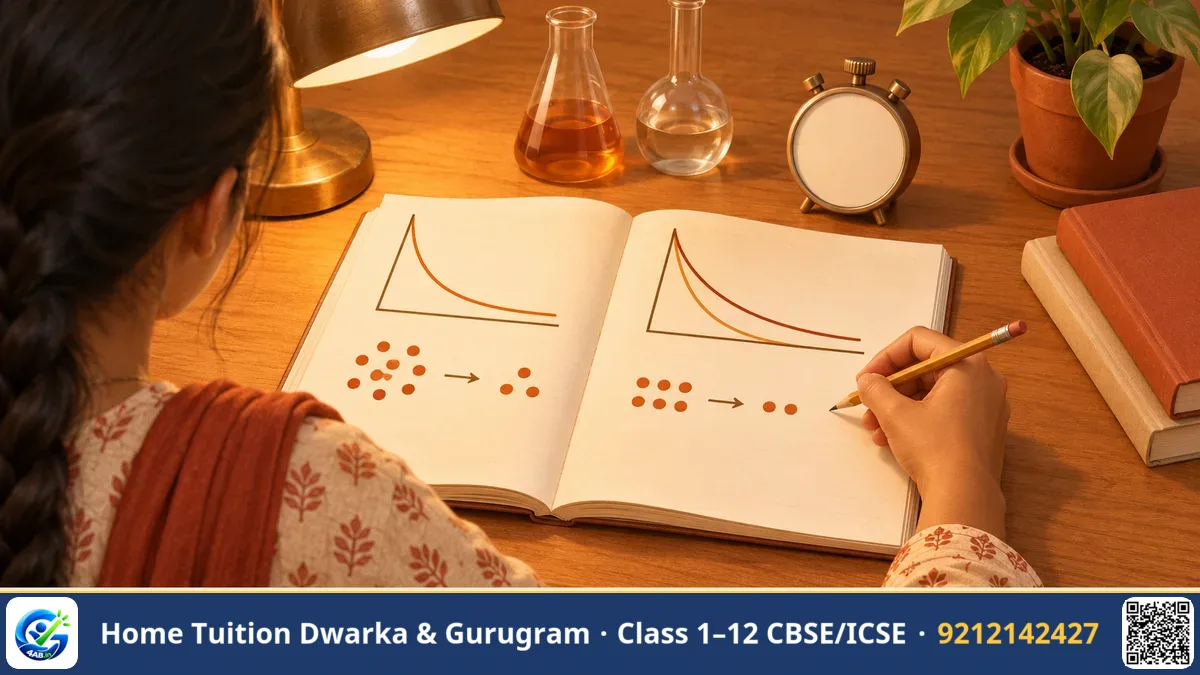
This guide explains how to identify reaction orders and solve half-life numerical problems in Class 12 Chemical Kinetics. Parents in Gurugram will discover practical ways a home tutor helps students master calculations and build an effective evening study routine.
Chemical kinetics challenges for Class 12 students in Gurugram
Class 12 students in Gurugram, including Sector 108, Sector 109, Sector 110, Sector 111, and Sector 112, face a demanding schedule. Between school hours, practical files, and travel, students return home fatigued. Chemical Kinetics appears early in physical chemistry. Its theoretical concepts seem straightforward, yet students drop marks on numerical problems under exam conditions.
The first difficulty is distinguishing reaction order from molecularity. Molecularity is the count of reacting species colliding simultaneously in an elementary step and must be a positive integer. Reaction order is an experimentally determined value that cannot be deduced from a balanced chemical equation. Students often mistake stoichiometric coefficients for reaction order, leading to incorrect differential rate laws.
The second challenge is arithmetic execution. Board questions regularly test logarithmic expressions, decimal divisions, and unit conversions. A student may understand half-life conceptually but stumble when converting minutes to seconds, or misapply base-ten logarithms. Without prompt correction, these errors become habitual.
Distinguishing zero, first, and second order formulas
The reaction order is the sum of exponents of concentration terms in the experimental rate law. Half-life, written as t1/2, is the time needed for reactant concentration to fall to half of its initial value. Each order uses a specific integrated equation and handles different problem types.
In a zero-order reaction, rate is independent of reactant concentration: rate = k[A]0 = k. The integrated rate equation is k = ([A]0 - [A]) / t, where [A]0 is initial concentration and [A] is concentration at time t. The half-life formula is t1/2 = [A]0 / (2k). Zero-order half-life is directly proportional to initial concentration. Doubling initial concentration doubles half-life.
In a first-order reaction, rate depends linearly on concentration: rate = k[A]. The integrated rate equation is k = (2.303 / t) log10([A]0 / [A]). Its half-life formula is t1/2 = 0.693 / k. Because [A]0 does not appear here, first-order half-life is independent of starting concentration. Changing initial concentration does not change the time needed to decompose half the reactant. Most Class 12 numericals follow this rule.
In a second-order reaction where rate = k[A]2, the integrated rate equation is kt = (1 / [A]) - (1 / [A]0). The half-life formula is t1/2 = 1 / (k[A]0). Here, half-life is inversely proportional to initial concentration.
| Reaction order | Differential rate law | Integrated rate equation | Half-life formula | Units of rate constant |
|---|---|---|---|---|
| Zero order | rate = k | k = ([A]0 - [A]) / t | t1/2 = [A]0 / (2k) | mol L-1 s-1 |
| First order | rate = k[A] | k = (2.303 / t) log10([A]0 / [A]) | t1/2 = 0.693 / k | s-1 |
| Second order | rate = k[A]2 | kt = (1 / [A]) - (1 / [A]0) | t1/2 = 1 / (k[A]0) | L mol-1 s-1 |
Worked example and recurring examination traps
Worked numerical: A first-order reaction has rate constant k = 2.31 × 10⁻³ s-1. Find its half-life, and calculate the time required for initial concentration to fall to one-fourth of its starting value.
Step 1: Calculate half-life.
The unit s-1 confirms first order.
t1/2 = 0.693 / k = 0.693 / (2.31 × 10⁻³ s-1) = 300 s.
Step 2: Remaining concentration.
When the reactant falls to one-fourth of its initial value, remaining [A] = [A]0 / 4.
The concentration ratio [A]0 / [A] = 4.
Step 3: Calculate time.
Formula: t = (2.303 / k) log10([A]0 / [A])
t = (2.303 / (2.31 × 10⁻³)) log10(4)
With log10(4) = 0.6020:
t = (2.303 × 0.6020) / (2.31 × 10⁻³) = 600 s.
Students regularly drop marks due to two common traps:
- Missing the clue in units: When an NCERT question omits the reaction order, check the unit of k. A value in s-1 indicates first order, whereas mol L-1 s-1 indicates zero order.
- Misreading completion phrasing: The phrase decomposed by indicates the amount consumed, while decomposed to specifies the unreacted remainder. Decomposing by three-fourths leaves one-fourth of the reactant, whereas decomposing to one-fourth means one-fourth remains. Substituting the reacted fraction instead of the remaining concentration into the logarithmic ratio causes errors.
How a home tutor helps students build an effective routine
In Gurugram sectors like Sector 108, Sector 110, and Sector 113, as well as nearby Sector 6 Dwarka and Sector 10 Dwarka, crowded coaching batches leave little room for personal attention. When a student struggles with logarithms or unit cancellations, doubts go unaddressed.
A one-to-one home tutor resolves this through targeted assistance:
- Catching calculation slips: A tutor checks intermediate steps and corrects algebraic slips before they turn into habits.
- Securing step marks: Board examiners award marks for formulas, proper unit substitutions, and final answers. A tutor ensures solutions follow board presentation standards.
- Verified guidance: Great Home Tutors connects parents with checked tutors holding a Verified mark. Families begin with an initial home session to confirm compatibility.
Students should follow this weekly routine for chemistry numericals:
- Monday: Write zero and first-order NCERT derivations from memory.
- Tuesday: Solve six numericals with your tutor, focusing on half-life formulas.
- Wednesday: Complete four numericals independently without a calculator.
- Thursday: Plot concentration and rate curves to understand slopes and intercepts.
- Saturday: Complete a twenty-minute timed test with two numericals to maintain exam pacing.
Key takeaways
- Check rate constant units to identify reaction order quickly: mol L-1 s-1 for zero order, s-1 for first order, and L mol-1 s-1 for second order.
- First-order half-life is independent of initial concentration, while zero-order half-life is directly proportional to it.
- Distinguish carefully between decomposed to and decomposed by when setting up logarithmic ratios.
- Write complete steps with formulas and units to secure full step marks on board exams.
- Follow a weekly home study routine with one-to-one tutor guidance in Gurugram to eliminate calculation errors.
Frequently asked questions
How can a student identify reaction order from the rate constant?
Check the units of k. A unit of mol L-1 s-1 indicates zero order, s-1 indicates first order, and L mol-1 s-1 indicates second order.
Why does first-order half-life remain constant?
In the first-order rate law, the concentration ratio simplifies to 2. Initial concentration cancels out, so t1/2 = 0.693 / k has no concentration term.
What is the difference between molecularity and reaction order?
Molecularity is the number of reacting species in an elementary step and must be a positive integer. Reaction order is an experimentally determined value that can be zero, fractional, or an integer.
How do parents in Gurugram find a verified home tutor for Class 12 Chemistry?
Parents can request a tutor on Great Home Tutors by submitting their class, subject, board, and locality. Great Home Tutors matches verified tutors, and families begin with an initial class to confirm the fit before scheduling regular sessions.
What to do next. Try it yourself on the page below.
Great Home Tutors — home tuition at your home · 4AB →