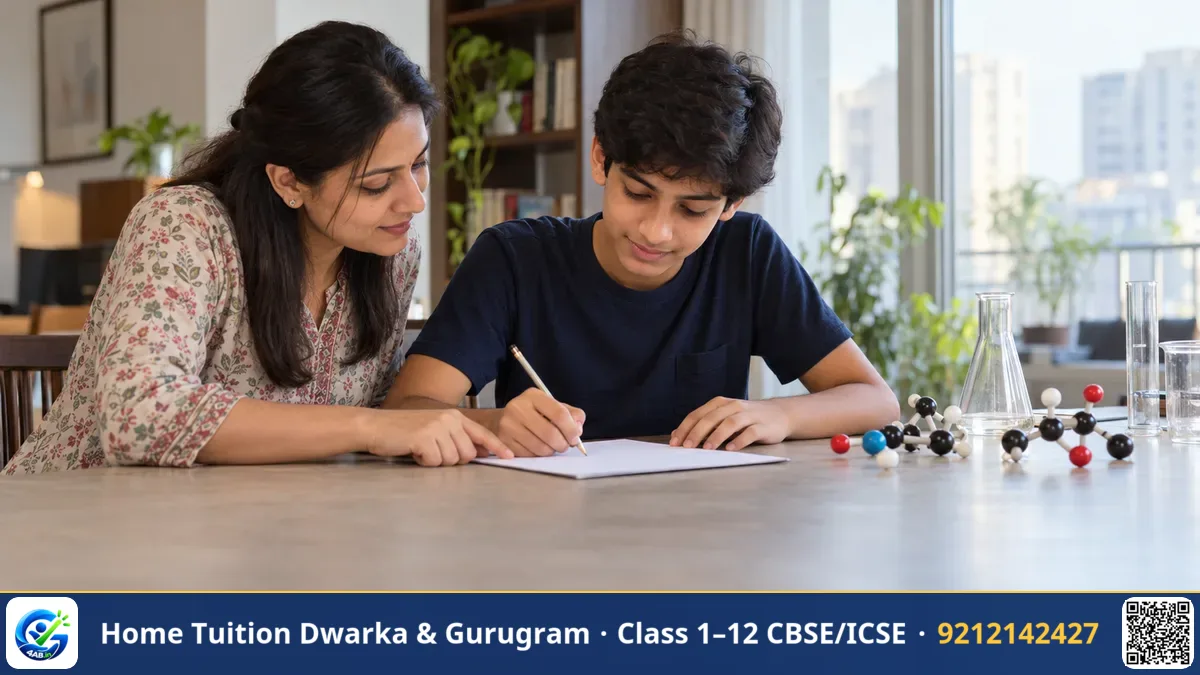
The first chapter of the book is also the one every later chemistry chapter leans on.
Why Chapter 1 is not the easy chapter it looks like
Chemical Reactions and Equations opens the Class 10 Science book, and most students feel they have seen it before. The words are familiar from Class 9, the experiments are simple, and the chapter has few definitions. That is exactly why it gets skimmed. Yet every later chemistry chapter, acids and bases, metals, carbon compounds, asks the student to write a balanced equation as if it were obvious. A child who cannot balance quickly loses time and marks in all of them.
Balancing: a method, not a knack
Students who “just see” the coefficients are rare. Everyone else needs a fixed order, and a good tutor teaches one and insists on it.
- Write the correct formulae first. Never balance by changing a subscript; that changes the substance. Only coefficients in front of formulae may change.
- Count atoms of each element on both sides and write the counts down in two columns.
- Start with the element that appears in the fewest formulae. Leave hydrogen and oxygen for the end because they usually appear in several places.
- If a fraction helps (for example half an oxygen molecule), use it, then multiply the whole equation to clear it.
- Recount every element at the end. Most errors are found in this last step, which students skip.
The common failure is a wrong formula, not wrong arithmetic. Writing magnesium oxide as MgO2 or sodium sulphate as NaSO4 makes a correct balance impossible. Spend ten minutes revisiting valency from Class 9 if formulae are shaky, because no amount of balancing practice fixes a wrong formula.
The five types of reaction and how to tell them apart
The NCERT chapter groups reactions as combination, decomposition, displacement, double displacement, and oxidation–reduction. Ask the child to identify the type from the equation alone, not from memory of the example.
- Combination: two or more reactants, one product. Burning of magnesium, formation of slaked lime from quicklime and water.
- Decomposition: one reactant, two or more products. Remember the three energy sources: heat (thermal), light (photolytic, silver chloride) and electricity (electrolysis of water).
- Displacement: a more reactive element pushes out a less reactive one from its compound. This links directly to the reactivity series in Chapter 3.
- Double displacement: two compounds exchange ions, usually giving a precipitate. The key phrase in answers is “precipitation reaction”.
- Oxidation and reduction: gain of oxygen or loss of hydrogen is oxidation; the reverse is reduction. In a redox reaction both occur together, so name both the oxidised and reduced substance.
Exothermic, endothermic, and the observation questions
Short-answer questions in this chapter often ask what is observed: colour change, gas evolved, precipitate formed, temperature change. Train the child to write the observation first and the explanation second. Example: when iron nails are placed in copper sulphate solution, the blue colour fades towards green and a reddish-brown deposit forms on the nail. A two-line answer with the colour change and the reason earns the marks.
Corrosion and rancidity
These two end-of-chapter ideas are favourites for one- and two-mark questions. Corrosion of iron needs both air and moisture; rancidity is oxidation of fats and oils. Prevention methods, such as painting, galvanisation, antioxidants and nitrogen flushing in chip packets, are worth learning as a short list. They come up in assertion–reason and case-study questions as well.
A one-week plan for this chapter
- Day 1: read the NCERT text and make a one-page table of the five types, with one equation each.
- Day 2: balance fifteen skeleton equations, writing the atom count columns. Do not skip the counts.
- Day 3: write the same equations with state symbols and conditions above the arrow.
- Day 4: identify the type for twenty equations, mixed. Mark and explain every wrong one.
- Day 5: observation-style questions and corrosion/rancidity.
- Day 6: NCERT intext and exercise questions, timed.
- Day 7: a ten-mark mini test and a review of mistakes.
Where a tutor helps in Dwarka and Gurugram
Many Class 10 students in Dwarka and Gurugram go to school all day and then to a group class in the evening, which leaves little time for the slow work of balancing practice and checking. A home tutor can sit with the notebook, see exactly where the counting goes wrong and fix the pattern the same evening. For this chapter one or two short sessions are usually enough; it does not need a long course.
Questions parents ask
Is balancing asked in the board paper every year?
Questions on writing or balancing equations appear regularly across the paper, in the objective and short-answer sections and inside later chapters. Treat it as a skill examiners can test anywhere rather than a topic with one fixed question.
My child knows the theory but balances slowly. What helps?
Slowness usually comes from skipping the atom-count table or from uncertain formulae. Ten balanced equations a day for a week, with the table written out, speeds most children up noticeably.
Do I need to memorise the reactivity series?
Yes, at least the main order from potassium down to gold. The displacement section and the whole metals chapter depend on it, so a short rhyme or a fixed list written daily works better than reading it once.
Is this chapter different for ICSE students?
ICSE Class 10 Chemistry covers equations within other units, with more weight on formulae and calculations. The balancing method above is the same; the question style differs, so ask the tutor to work from your school’s own papers.
Looking for home tuition in Dwarka or Gurugram?
Great Home Tutor offers Home, Online, Group and One-to-One tuition for Class 9 to 12 Science and Maths across Dwarka and Gurugram.
Call / Contact us: Support@4ab.in