The physics is not hard. The marks are lost on a minus sign.
Why this chapter feels harder than it is
Light – Reflection and Refraction is one of the biggest physics chapters in Class 10, with ray diagrams, formulae and numericals all together. Students who handle each of these separately do well. Those who attempt numericals by plugging numbers into a formula and hoping, lose marks to signs. The remedy is a routine.
Step one: the sign convention, as a table
The Cartesian convention taught in the NCERT book is simple once written down. Take the pole of the mirror or the optical centre of the lens as the origin, and the principal axis as the x-axis.
- The object is always placed on the left. Distances measured in the direction of the incident light (to the right) are positive; against it, negative.
- Heights above the principal axis are positive; below, negative.
- Therefore the object distance u is always negative in these problems.
- For a concave mirror, f is negative. For a convex mirror, f is positive.
- For a convex lens, f is positive. For a concave lens, f is negative.
Ask the child to write this on the first page of the physics notebook and copy it at the top of every numerical, until it is automatic.
Step two: the formulae and what they give
For mirrors, 1/v + 1/u = 1/f. For lenses, 1/v − 1/u = 1/f. Magnification is the ratio of image height to object height; for mirrors m = −v/u, for lenses m = v/u. Lens power is 1/f with f in metres, measured in dioptres. A good habit is to stay in centimetres for the image distance and convert to metres only for the power question.
Interpret the result, don’t just compute it. A negative m means an inverted, real image; a positive m means an erect, virtual one. If |m| is more than one, the image is enlarged. Writing these three conclusions in one line at the end of the solution is exactly what examiners credit.
Step three: the ray diagram as a check
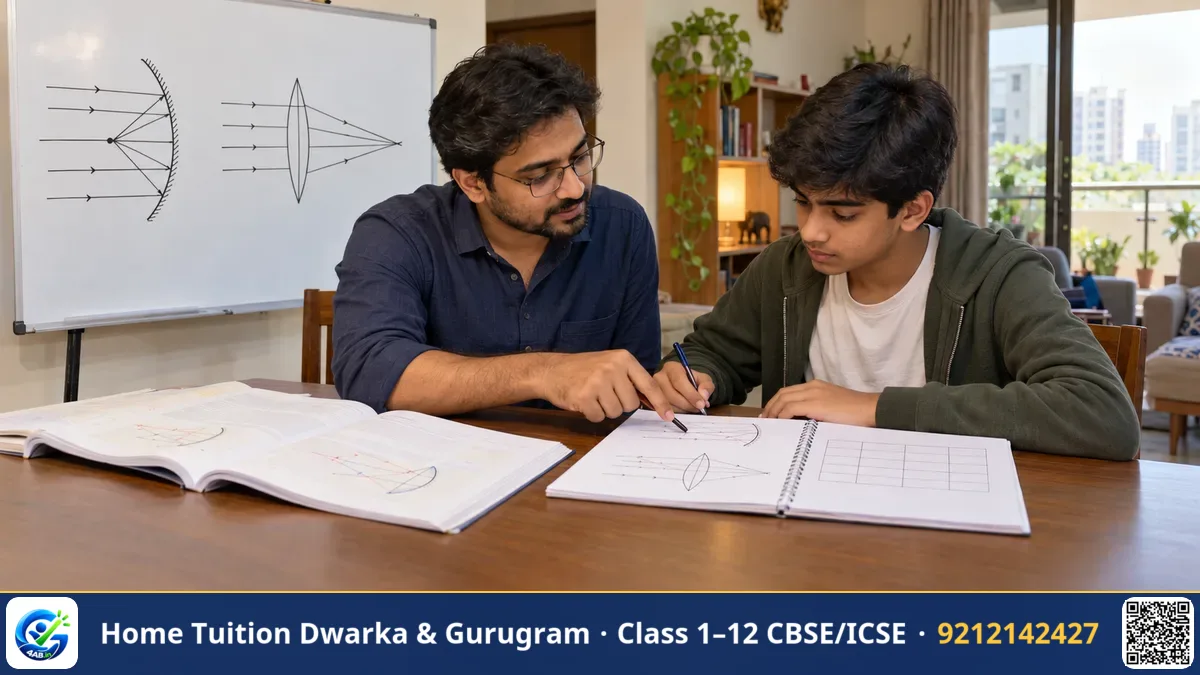
Before computing, draw the rough ray diagram using two of the standard rays: parallel to the axis, through the focus, or through the centre of curvature. The diagram tells you the expected nature of the image. If the calculation says a virtual image and the diagram shows real, something has gone wrong, perhaps a sign on f. A rough diagram takes a minute and catches most sign errors before they cost marks.
The cases to be able to draw from memory
For a concave mirror, the object at infinity, beyond C, at C, between C and F, at F, and between F and P. For a convex lens, the same set with 2F instead of C. For each, know the position, size and nature of the image. A one-page table makes this learnable. Many students memorise the table and forget the convex mirror and concave lens, which give one kind of image every time (virtual, erect, diminished) and are an easy few marks.
Refraction: laws and refractive index
For refraction, the rules are the two laws of refraction and the relation between refractive index and the speed of light in a medium. Numericals are short: find the refractive index from the speeds, or the speed of light in glass from the index. Do not skip the statement of the law in theory answers, because it is a definition-type mark.
A weekly plan for this chapter
- Monday: sign convention and mirror formula, six numericals, with signs written first.
- Tuesday: ray diagrams for all mirror cases, drawn with a ruler.
- Wednesday: lens formula, power, and six numericals.
- Thursday: refraction laws and refractive index.
- Friday: mixed ten-question set, timed at twenty minutes.
- Weekend: review mistakes by category: sign, formula, unit, interpretation.
What a home tutor adds
Physics errors are visible only when someone watches the working. A tutor sitting beside a Class 10 student in Dwarka or Gurugram can see the moment a minus sign is dropped, ask the child to explain it, and fix the habit. That is difficult to achieve in a class of thirty or in a recorded lesson.
One fully worked pattern to copy
Take a concave mirror of focal length 15 cm with an object 30 cm in front of it. Write the data with signs: u = −30 cm, f = −15 cm. The mirror formula gives 1/v = 1/f − 1/u = −1/15 + 1/30 = −1/30, so v = −30 cm. The negative sign means the image is in front of the mirror, so it is real. The magnification is −v/u = −(−30)/(−30) = −1, so the image is inverted and the same size as the object. Every line of this is a separate mark in a board-style marking scheme: the signed data, the formula, the substitution, the value of v, and the nature of the image. Ask your child to redo this one with an object at 20 cm and see how the answer changes before moving to mixed questions.
Questions parents ask
Are numericals from this chapter compulsory in the paper?
Numerical questions from Light appear regularly, but the pattern changes by year. Prepare for them as a standard section of the paper, not an optional one.
Why does the mirror formula look different from the lens formula?
Because in a mirror the reflected light returns to the same side, so the sign relationship is different. Learn them as two separate formulae and do not substitute one for the other.
My child draws accurate diagrams but gets the numerical wrong.
Then the problem is the sign convention or the interpretation step. Insist on the data-with-signs line at the top of every solution.
Is this the same for ICSE?
The ICSE physics syllabus covers reflection, refraction and lenses in its own sequence and style. The sign handling is the same idea, but follow your school’s textbook for the exact convention and question forms.
Looking for home tuition in Dwarka or Gurugram?
Great Home Tutor offers Home, Online, Group and One-to-One tuition for Class 9 to 12 Science and Maths across Dwarka and Gurugram.
Call / Contact us: Support@4ab.in