Class 10 Science Metals and Non-Metals Tutor in Dwarka
This guide explains why Class 10 students struggle with the metals and non-metals chapter and how one-to-one home sessions resolve these gaps.
Parents in Dwarka will find a clear roadmap covering reactivity trends, extraction steps, study routines, and verified home tuition.
Why students struggle with metals and non-metals
Class 10 Science marks a transition from simple observational facts to systematic chemical concepts. The metals and non-metals chapter requires students to understand electronic configurations, reaction conditions, and quantitative balancing. Several syllabus areas routinely create difficulties during school tests:
- Exceptions to physical properties: While metals are typically hard, sodium and potassium can be cut with a knife, and mercury is liquid at room temperature. Similarly, non-metals are generally dull, but iodine is lustrous, and carbon as graphite conducts electricity. Students often lose marks on these exceptions.
- Amphoteric oxides: Amphoteric oxides are metal oxides that react with both acids and bases to yield salt and water. Students frequently struggle to write balanced products for aluminium oxide reacting with sodium hydroxide or hydrochloric acid.
- Reactions with nitric acid: When metals react with dilute nitric acid (HNO3), hydrogen gas is usually not evolved because nitric acid is a strong oxidising agent that oxidises hydrogen to water. Only magnesium and manganese produce hydrogen gas with very dilute nitric acid.
- Reactivity series application: The reactivity series arranges metals in decreasing order of chemical reactivity. When students rely on rote memorisation without applying displacement logic, they fail to predict reactions in aqueous solutions.
Metallurgy extraction steps and reactivity series logic
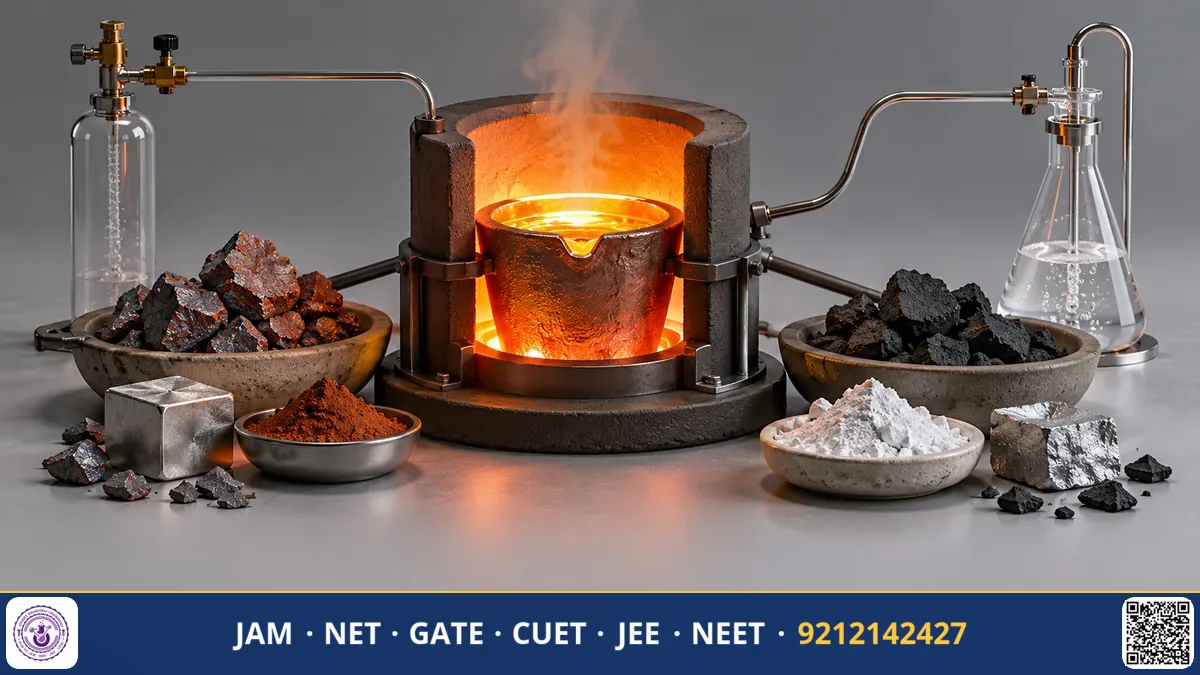
Metallurgy is the scientific process of extracting metals from their ores and refining them for practical use. An ore is a naturally occurring mineral from which a metal can be extracted profitably. The extraction route depends on where a metal sits in the reactivity series:
| Reactivity level | Ore type | Extraction method | Key chemical process |
|---|---|---|---|
| Low reactivity | Sulphide ores | Heating in air alone | Roasting sulphide to oxide, followed by thermal reduction to metal. |
| Medium reactivity | Carbonate and sulphide ores | Calcination or roasting, then reduction | Heating in limited air (calcination) or excess air (roasting), followed by reduction using carbon. |
| High reactivity | Chloride and oxide ores | Electrolytic reduction | Electrolysis of molten salts; pure metal deposits at the negative cathode. |
Students frequently confuse roasting and calcination. Roasting involves heating sulphide ores strongly in the presence of excess air to produce metal oxides. Calcination involves heating carbonate ores strongly in limited or absent air to produce metal oxides.
Once converted to oxides, medium reactivity metals are reduced using carbon or through displacement via the thermite reaction. High reactivity metals cannot be reduced with carbon because their affinity for oxygen exceeds that of carbon, requiring electrolytic reduction of molten salts.
Finally, crude metals undergo electrolytic refining. In copper refining, impure copper forms the anode, pure copper forms the cathode, and acidified copper sulphate serves as the electrolyte. Pure copper deposits on the cathode while insoluble impurities settle as anode mud.
How one-to-one home sessions resolve chemistry confusion
In school classrooms, teachers must progress through the syllabus according to a fixed schedule. When a student hesitates over chemical equations or ionic bonding, the gap often goes unnoticed. One-to-one home tuition provides the focused attention needed to address these specific misunderstandings.
A dedicated home tutor supports the student through targeted teaching methods:
- Checking fundamental concepts: The tutor verifies foundational skills such as valency and formula writing before proceeding with multi-step metallurgy reactions.
- Visualising electron dot structures: The tutor guides the student in drawing electron transfer diagrams for ionic compounds like sodium chloride (NaCl) and magnesium chloride (MgCl2). The student learns why ionic solids have high melting points and conduct electricity only in molten or dissolved states.
- Equation writing drills: Students practise writing every chemical reaction with correct physical states (solid, liquid, gas, aqueous), eliminating habitual presentation errors.
- Immediate doubt clearance: When a student hesitates over displacement questions, the tutor helps them reason through the reactivity series instead of relying on guesswork.
Initiating home tuition through a personal callback
Finding suitable academic support should be clear and straightforward. Great Home Tutors follows a four-step process for families seeking tuition in Dwarka and across Delhi NCR:
- Tell us what you need: You submit your request with the student's class (Class 10), subject (Science or Chemistry), board (such as CBSE or ICSE), and your locality, such as Sector 6 Dwarka, Sector 10 Dwarka, or Janakpuri.
- We call you back: A person from Great Home Tutors calls you to understand the student. This conversation reviews your child's specific academic challenges, test schedule, and timing preferences.
- Meet the tutor: We tell you plainly whether a tutor is verified by us or not yet. Verified tutors carry a Verified mark, confirming that their identity, qualifications, and teaching ability have been checked through a direct conversation.
- Start at home: A first class is conducted at home to assess the teaching fit before fixing regular sessions.
Building a weekly study routine for Class 10 Science
Mastering this chapter requires steady, weekly revision rather than hasty preparation before tests. A planned four-week study structure helps students master the syllabus step by step:
- Week 1: Properties and reactions: Master reactions with oxygen, water, and acids. Memorise exceptions and write equations for amphoteric oxides and nitric acid reactions.
- Week 2: Ionic compounds: Practise electron dot structures and summarise physical properties, focusing on lattice stability and electrical conductivity.
- Week 3: Metallurgy pathways: Draw extraction flowcharts, grouping metals by reactivity. Practise equations for roasting, calcination, reduction, and electrolytic refining.
- Week 4: Corrosion and textbook exercises: Review rusting conditions, prevention methods like galvanisation and alloying, and solve all in-text and chapter-end questions from the NCERT textbook.
During each weekly session, the tutor conducts a short written test to check equation accuracy and concept recall, ensuring steady progress.
Key takeaways
- Metals and non-metals requires understanding reactivity trends, chemical exceptions, and extraction logic rather than rote memorisation.
- Metallurgy extraction divides metals by reactivity: heating alone for low reactivity, calcination or roasting with reduction for medium reactivity, and electrolytic reduction for high reactivity metals.
- One-to-one home sessions provide immediate error correction, structured equation writing, and personalised pacing.
- Tuition in Dwarka begins by submitting student details, followed by a personal callback to assess learning needs before a trial class.
- Consistent revision with the NCERT textbook and weekly equation quizzes builds long-term retention.
Frequently asked questions
What is the difference between roasting and calcination?
Roasting is heating sulphide ores strongly in the presence of excess air to convert them into metal oxides. Calcination is heating carbonate ores strongly in limited or absent air to convert them into metal oxides. Both processes prepare ores for subsequent chemical reduction.
Why is sodium extracted by electrolytic reduction instead of carbon reduction?
Because sodium has a higher affinity for oxygen than carbon does, carbon cannot reduce sodium oxide to sodium metal. Therefore, sodium is extracted by passing electric current through molten sodium chloride, depositing pure sodium at the cathode.
How does Great Home Tutors assess student needs in Dwarka?
After a parent submits details regarding class, subject, board, and locality, a representative calls back to discuss the student's current performance, specific topic difficulties, and study requirements.
What does a Verified mark signify on a tutor profile?
A tutor with a Verified mark has undergone direct checks by Great Home Tutors, covering identity, academic qualifications, and an evaluation conversation before student assignments.
What to do next. Try it yourself on the page below.
Great Home Tutors — home tuition at your home · 4AB →