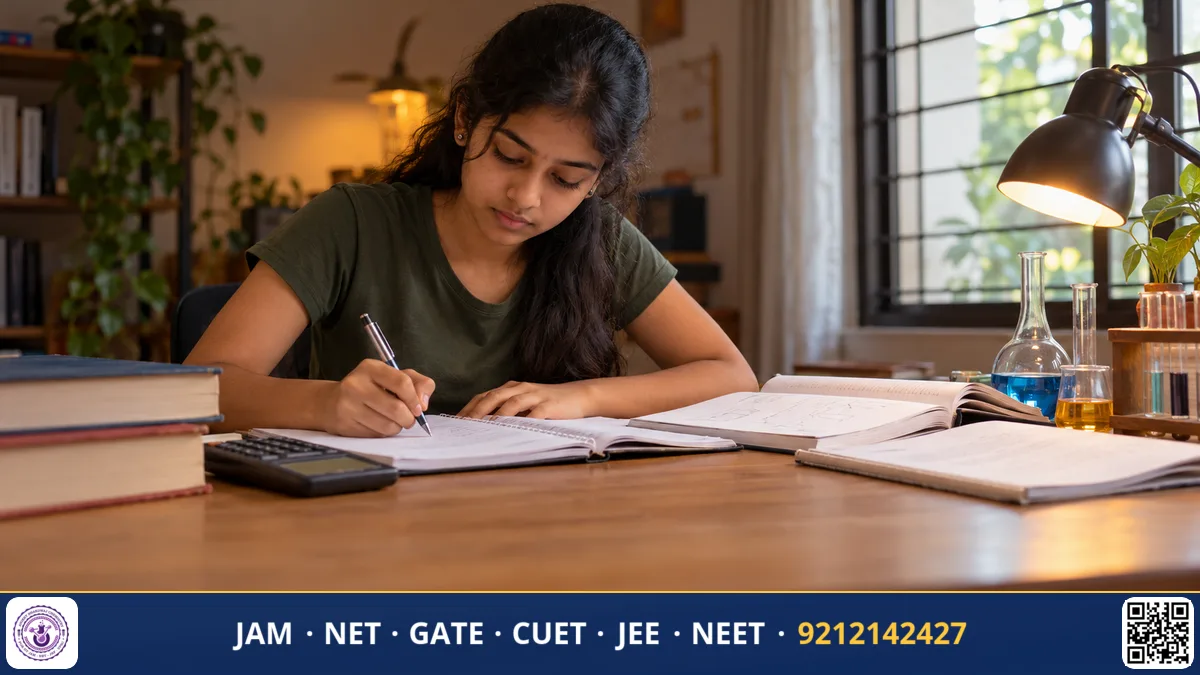
Class 11 Chemistry: Mole concept to thermodynamics plan

This guide gives parents in Dwarka and Gurugram a clear study roadmap for Class 11 Chemistry during the first term. You will learn the syllabus progression from the mole concept to thermodynamics, practical study habits, and how personal tutoring prevents early learning gaps.
Why Class 11 Chemistry creates an early gap for students
The shift from Class 10 to Class 11 is sharp. In Class 10, chemistry focuses on descriptive definitions and direct observations. In Class 11, physical chemistry dominates the first term. Physical chemistry is the branch of chemistry that applies physics principles and mathematical calculations to chemical systems. This shift requires quantitative problem solving rather than simple memorization.
For students in Dwarka and Gurugram, school timetables and long commutes across Delhi NCR leave little evening energy. Students often read textbooks passively instead of calculating on paper. Passive reading creates an illusion of understanding. A student might follow a lecture easily, yet get stuck when solving an independent problem.
The first hurdle is the mole concept. A mole is the standard scientific unit used to measure the amount of a substance. Closely linked is stoichiometry, which is the calculation of relative quantities of reactants and products in a balanced chemical reaction. If stoichiometry is neglected early in the term, subsequent chapters become difficult to understand.
The syllabus map from mole concept to thermodynamics
The first term connects four core chapters, with each unit building directly upon the principles of the preceding one.
| Chapter | Core technical concepts | Primary learning challenge | Weekly study focus |
|---|---|---|---|
| Some basic concepts of chemistry | The mole concept, molar mass, and stoichiometry. | Translating word problems into balanced equations and finding limiting reagents. | Solving numerical problems with unit conversions and concentration terms. |
| Structure of atom | Wave-particle duality, the uncertainty principle, and quantum numbers. | Visualizing electron probability distributions and writing configurations. | Writing electronic configurations and calculating orbital energies. |
| Chemical bonding and molecular structure | Electron dot representations, molecular geometry, and orbital hybridization. | Understanding spatial geometries and predicting molecular polarity. | Drawing molecular shapes and determining bond characteristics. |
| Thermodynamics | The first law of thermodynamics, enthalpy, the heat summation principle, and entropy. | Connecting heat changes with work, internal energy, and reaction spontaneity. | Calculating standard reaction enthalpies and deriving energy terms. |
Thermodynamics is where early learning gaps become obvious. Thermodynamics is the branch of physical science dealing with relations between heat, work, and other forms of energy. Students study enthalpy, the total heat content of a chemical system at constant pressure. They also study entropy, a measure of molecular disorder within a system. Finally, they examine reaction spontaneity, which indicates whether a process occurs naturally without continuous external energy. When students struggle with stoichiometric ratios, calculating enthalpy changes becomes frustrating.
Specific pain points across first-term chapters
Understanding where marks slip helps parents intervene before minor confusion turns into serious discouragement.
In the opening unit, the primary stumbling block is the limiting reagent. A limiting reagent is the reactant completely consumed first in a reaction, thereby limiting the maximum product formed. Many students memorize the definition but struggle when a problem provides quantities for multiple reactants. Instead of calculating mole ratios, they mistakenly assume the reactant with smaller mass is limiting. Overcoming this error requires converting given quantities into moles before comparing proportions.
In atomic structure, students study the atomic orbital, which is a three-dimensional region of space where electron probability is highest. Visualizing these probability clouds requires abstract spatial thinking unfamiliar after Class 10.
The chemical bonding unit introduces hybridization, which is the mixing of atomic orbitals of different energies and shapes to form equivalent hybrid orbitals for bonding. Students must combine valence electron counts with geometry to determine whether molecules are planar or three-dimensional.
In thermodynamics, sign conventions cause frequent errors. Heat absorbed carries a positive sign, while heat released carries a negative sign. Work done on a system differs in sign from work done by a system. A single reversed sign in a multi-step problem invalidates the final result.
A weekly study routine for Dwarka and Gurugram students
A manageable daily routine prevents academic stress from building up before school examinations.
- Daily calculation practice: Dedicate regular time each day to solving numerical exercises with pen and paper. Work through problems from the NCERT textbook without consulting solutions in advance. Consistent practice builds mathematical speed and conceptual confidence.
- Theory consolidation: Read the assigned chapter in the NCERT textbook carefully. Write concise notes summarizing key definitions and governing principles, such as the principle of constant heat summation.
- Dedicated doubt notebook: Maintain a notebook specifically for recording confusing steps or unclear derivations to review during tuition classes.
- Weekend review: Revisit numerical problems from earlier chapters during weekend study sessions. When studying atomic structure, solve a couple of stoichiometry questions to keep earlier concepts active.
How one-to-one home tuition stabilizes first-term performance
Many families in Dwarka, Janakpuri, and Gurugram enroll students in large coaching batches. In crowded classrooms, teachers follow rigid timetables, and hesitant students rarely receive individual attention.
One-to-one home tuition provides focused support right at the student's study desk. Through Great Home Tutors, parents request a tutor by providing the student's class, subject, board, and locality or PIN. Great Home Tutors matches families with verified home tutors across Delhi NCR. Checked tutors carry a verified mark after reviews covering identity, qualification, and a teaching conversation. This ensures an experienced educator guides your child under CBSE, ICSE, or a State board.
A dedicated tutor observes how a student solves problems line by line, correcting arithmetic or conceptual mistakes immediately. Home tuition also saves students from travelling across crowded roads in Dwarka or Gurugram after school. A first class allows the family to evaluate the teaching fit before fixing any ongoing schedule.
With over twenty years of teaching experience, Aniket Bhardwaj emphasizes that physical chemistry rewards patient problem solving. Establishing solid foundations in the first term protects student confidence for the remainder of Class 11 and Class 12.
Key takeaways
- Class 11 Chemistry introduces mathematical physical chemistry, beginning with the mole concept and stoichiometry.
- Foundational chapters link sequentially; gaps in early stoichiometry create serious confusion in thermodynamics.
- Students need a daily problem-solving routine focused on NCERT textbook exercises.
- Maintaining a dedicated doubt notebook helps students resolve confusing derivation steps systematically.
- One-to-one home tuition provides personalized feedback at home, eliminating travel fatigue and clearing doubts promptly.
Frequently asked questions
Why do students find Class 11 Chemistry harder than Class 10?
Class 10 chemistry relies largely on descriptive facts. Class 11 introduces quantitative derivations and multi-step calculations. Students who do not practice calculations regularly often struggle during the first term.
Which topics in the first term need the most numerical practice?
The mole concept, limiting reagent problems, and thermodynamic enthalpy derivations require the most practice. Mastering these topics provides a solid base for the entire academic year.
How does one-to-one home tuition assist with physical chemistry?
A home tutor observes the student's calculation steps directly, catching unit conversion errors and conceptual misunderstandings immediately. This personalized guidance helps students build confidence without group batch pressure.
How can parents request a verified home tutor through Great Home Tutors?
Parents submit a request specifying the class, subject, board, and locality or PIN. A coordinator calls back to discuss student requirements, matches a verified tutor, and arranges a first home session to check the fit before anything is fixed.
What to do next. Try it yourself on the page below.
Great Home Tutors — home tuition at your home · 4AB →