Class 11 Physics Kinematics Home Tutor: Graphs and Equations, Gurugram
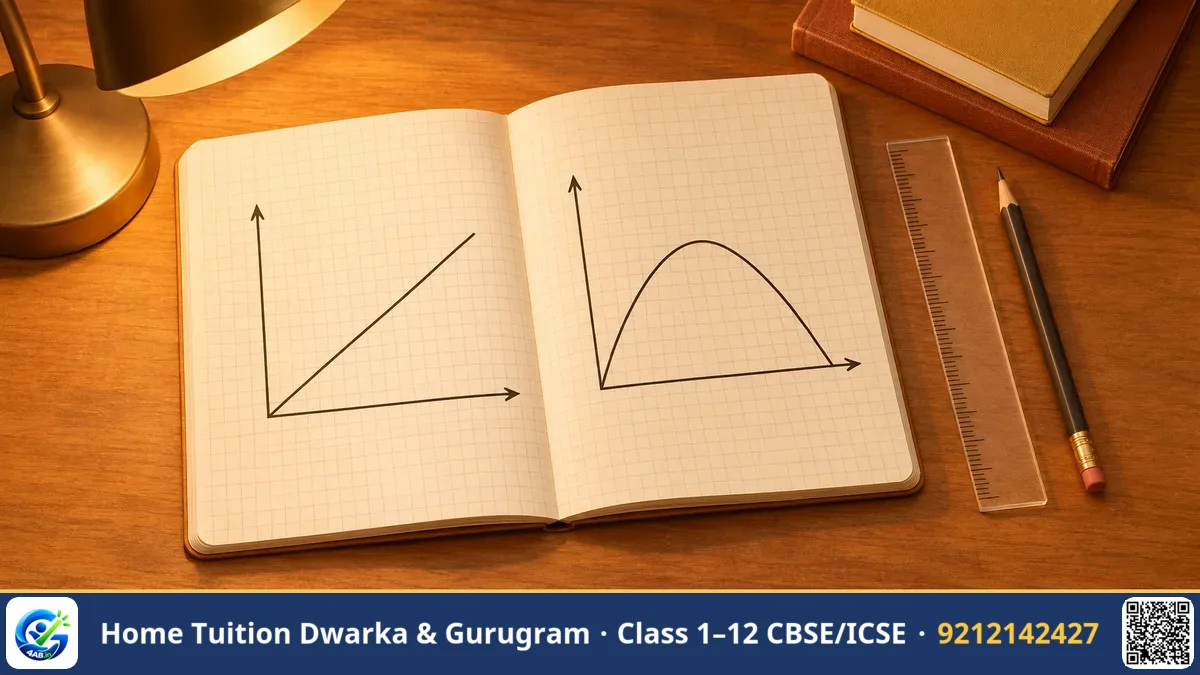
This guide explains how Class 11 students master kinematics graphs, select equations correctly, and build a productive physics routine at home.
Parents in Gurugram and Dwarka will find practical diagnostic steps to support school tests and board preparation.
Transitioning from Class 10 to Class 11 kinematics
Class 10 science treats motion mainly through scalar quantities and simple formulas like speed equals distance divided by time. Class 11 physics introduces vectors where direction is just as critical as numerical magnitude. Students must track signs alongside values.
Students must master three foundational terms immediately:
- Displacement: The shortest straight-line vector from initial to final position, carrying a positive or negative sign.
- Velocity: The rate of change of displacement over time. Instantaneous velocity indicates speed and direction at a single instant.
- Acceleration: The rate of change of velocity over time. It can be positive, negative, or zero based on the coordinate frame.
Classroom teaching often moves too fast to address why rising objects accelerate downward. Unresolved doubts cause persistent errors in school exams.
Reading motion graphs through slopes and areas
Students often try to memorize curve shapes rather than applying geometric principles. Motion graphs rely on two mathematical properties: slope and enclosed area.
Slope represents steepness, defined as vertical change divided by horizontal change. On a position-time graph, slope gives instantaneous velocity. A flat horizontal line indicates zero velocity. A straight diagonal line shows constant velocity, while a curved line indicates non-zero acceleration. On a velocity-time graph, slope gives instantaneous acceleration. An upward slope indicates increasing velocity, whereas a downward slope indicates deceleration.
Area under a curve represents the product of the plotted variables. On a velocity-time graph, the area between the curve and the time axis equals displacement. Areas below the time axis represent negative displacement and must be subtracted from areas above it. To find total distance, a scalar measuring path length, add all areas as positive values. On an acceleration-time graph, enclosed area gives change in velocity, which must be added to initial velocity to find final velocity.
Selecting the right kinematic equation
For straight-line motion with constant acceleration, NCERT defines three primary kinematic equations. Selecting the right equation requires confirming uniform acceleration, listing known variables, and matching the required unknown.
The core condition is uniform acceleration. If acceleration changes with time or position, calculus differentiation and integration must be used instead. With constant acceleration, five variables define motion: initial velocity (u), final velocity (v), acceleration (a), displacement (s), and time (t). Each equation connects four variables and omits one.
| Equation | Variables Present | Omitted Variable | When to Choose |
|---|---|---|---|
| v = u + at | u, v, a, t | s (displacement) | Find velocity or time without displacement. |
| s = ut + ½at2 | u, s, a, t | v (final velocity) | Calculate displacement or time without final velocity. |
| v2 = u2 + 2as | u, v, a, s | t (time) | Calculate velocity or displacement without time. |
Establish a coordinate frame before substituting numbers. Designate upward as positive and downward as negative. In vertical motion, acceleration due to gravity always points downward. It must be entered as a negative value, such as -9.8 m/s2 or -10 m/s2, even while an object rises.
Worked example of vertical motion under gravity
This standard NCERT problem illustrates how kinematic equations and sign rules work together in vertical motion.
Problem: A ball is thrown vertically upward from the ground at 20 m/s. Taking downward acceleration due to gravity as 10 m/s2, find maximum height reached and total flight time.
Step 1: Identify given variables.
Upward is positive. Initial velocity u = +20 m/s, acceleration a = -10 m/s2. At maximum height, instantaneous velocity v = 0 m/s.
Step 2: Calculate maximum height.
Time is not given, so apply v2 = u2 + 2as:
0 = (20)2 + 2(-10)s
0 = 400 - 20s
20s = 400
s = 20 metres.
Maximum height reached is 20 metres.
Step 3: Calculate total round-trip time.
When the ball returns to the ground, displacement s equals 0 metres. Apply s = ut + ½at2:
0 = 20t + ½(-10)t2
0 = 20t - 5t2
5t(4 - t) = 0
This yields two roots: t = 0 seconds (launch) and t = 4 seconds (return). Total flight time is 4 seconds.
Building a study routine with home tuition in Gurugram
Kinematics provides the foundation for Newton's laws of motion, work, and energy. Students should maintain a weekly four-session routine:
- Session 1: Concept check. Read NCERT theory and sketch motion graphs by hand.
- Session 2: NCERT numericals. Solve textbook exercises, recording coordinate signs for every variable.
- Session 3: Graph conversions. Deduce acceleration from slopes and displacement from enclosed areas.
- Session 4: Error analysis. Keep an error logbook to review whether mistakes were conceptual or algebraic.
In large batches across Delhi NCR, individual misconceptions often go unnoticed. One-to-one home tuition provides focused supervision at the student's desk. On Great Home Tutors, parents in Gurugram localities—such as Sector 108, Sector 109, Sector 110, Sector 111, Sector 112, and Sector 113—as well as Dwarka can find verified physics tutors.
Parents can use Request a home tutor by entering parent or student name, 10-digit mobile number, Class 11 Physics, board (CBSE, ICSE, or State board), and locality or PIN. A coordinator calls back to discuss student needs. Great Home Tutors connects a tutor with a Verified mark. Families then complete a first class at home to check fit before establishing regular tuition.
Key takeaways
- Confirm uniform acceleration before applying kinematic equations; use calculus if acceleration varies.
- Find instantaneous velocity from position-time slopes and acceleration from velocity-time slopes.
- Calculate displacement from the signed area under a velocity-time graph, subtracting negative areas.
- Set a consistent coordinate sign convention before solving any numerical problem under gravity.
- One-to-one home tuition in Gurugram and Dwarka provides personalized diagnostic support for physics numericals.
Frequently asked questions
When is it incorrect to use standard kinematic equations?
Standard kinematic equations cannot be used when acceleration changes with time, velocity, or position. They apply strictly to uniform acceleration. If acceleration varies, the student must use calculus through differentiation or integration to determine velocity and position.
What is the difference between distance and displacement on a velocity-time graph?
Displacement is a vector quantity that accounts for direction, so area below the time axis is negative and subtracted from the upper area. Distance is a scalar quantity measuring total path traveled, meaning all enclosed areas are treated as positive and added together.
How can parents in Gurugram find a verified physics home tutor?
Parents can submit a request on Great Home Tutors with their name, mobile number, Class 11 Physics, board, and locality, including Gurugram sectors 108 through 113. A coordinator calls to understand requirements, connects a tutor with a Verified mark, and arranges a first class at home.
How much weekly self-study is recommended for Class 11 kinematics?
Students should spend four to five hours each week on independent physics study outside school. This time should be balanced between reviewing NCERT theory, drawing motion graphs, solving numerical problems, and analyzing previous calculation mistakes.
What to do next. Try it yourself on the page below.
Great Home Tutors — home tuition at your home · 4AB →