Class 12 Organic Reagent Cheat Sheet: Build Your Own, Dwarka
This guide explains how Class 12 students build an organic reagent cheat sheet to master chemical conversions. Parents in Dwarka and Gurgaon will discover how one-to-one home tuition resolves chemistry syllabus hurdles through a structured routine.
Why Class 12 organic chemistry challenges students in Dwarka and Gurgaon
Class 12 chemistry introduces extensive equations across organic chemistry. The NCERT textbook divides transformations across four units: haloalkanes and haloarenes, alcohols, phenols and ethers, aldehydes, ketones and carboxylic acids, and amines. In Dwarka and Gurgaon schools, teachers must cover these chapters rapidly before preliminary examinations.
Most students attempt to study by memorising reactions chapter by chapter. When asked to convert an alcohol into an aldehyde or an alkyl halide into an amine, recall falters because reactions were learned in isolation. A reagent is a chemical substance added to bring about a chemical transformation. Without a comparative index, students confuse reagents that share similar elements, such as acidified potassium permanganate and pyridinium chlorochromate.
In residential areas like Sector 6 Dwarka and Sector 10 Dwarka, students balance school tests, laboratory records, and board preparation. Evening fatigue makes unstructured study unproductive. Organic chemistry demands systematic classification rather than passive memorisation.
The reagent-to-reaction framework: sorting by chemical role
The solution to reaction confusion is the reagent-to-reaction lookup framework. Instead of organising notes by starting reactant families, the learner classifies reagents by the chemical work they perform: oxidation, reduction, halogenation, dehydration, and carbon chain modification.
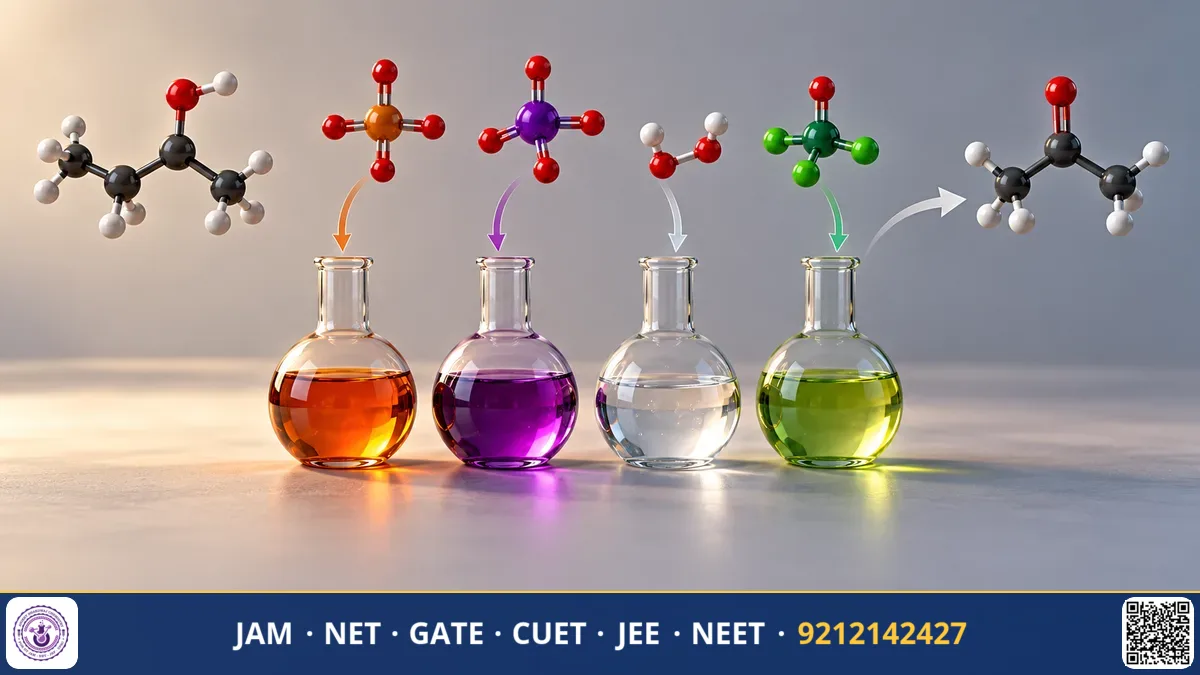
Oxidation in organic chemistry involves adding oxygen or losing hydrogen. Acidified potassium permanganate converts a primary alcohol into a carboxylic acid, whereas pyridinium chlorochromate halts oxidation cleanly at the aldehyde stage.
Reduction involves removing oxygen or adding hydrogen. Lithium aluminium hydride reduces carboxylic acids into primary alcohols, whereas sodium borohydride reduces aldehydes and ketones while leaving carboxylic acids untouched.
Organising reagents alongside functional outcomes creates an effective reference tool. The table below shows how a student should arrange this foundational lookup sheet.
| Reagent | Reaction category | Starting functional group | Resulting organic product |
|---|---|---|---|
| Thionyl chloride | Halogenation | Alcohol | Alkyl chloride |
| Pyridinium chlorochromate | Mild oxidation | Primary alcohol | Aldehyde |
| Acidified potassium permanganate | Strong oxidation | Primary alcohol | Carboxylic acid |
| Sodium borohydride | Selective reduction | Aldehyde or ketone | Alcohol |
| Lithium aluminium hydride | Strong reduction | Carboxylic acid | Primary alcohol |
| Concentrated sulphuric acid with heat | Dehydration | Alcohol | Alkene |
Step-by-step: how to build your personal lookup reference
Constructing the cheat sheet is an active learning exercise. Writing transformations by hand creates tactile recall and forces the student to evaluate each reaction pathway carefully.
First, allocate sheets into dedicated sections: oxidising agents, reducing agents, halogenating agents, dehydrating agents, and substitution reagents. An electrophile is an electron-seeking species that accepts an electron pair, whereas a nucleophile donates an electron pair. Noting whether a reagent supplies an electrophile or a nucleophile clarifies why a functional group undergoes substitution or addition.
Second, note experimental conditions. Organic transformations depend on medium, heat, or catalysts. For instance, ethanol treated with concentrated sulphuric acid under strong heating undergoes elimination to form an alkene, whereas moderate heating yields an ether. Leaving out conditions causes lost marks in CBSE examinations.
Third, apply the sheet directly to NCERT conversion problems. Practising retrosynthetic analysis, working backwards from target molecule to starting material, allows the student to select the appropriate reagent step by step.
Consider converting ethanol into propanoic acid, a standard multi-step conversion problem from the NCERT syllabus.
- First stage: React ethanol with thionyl chloride. The hydroxyl group is displaced by chlorine, producing chloroethane alongside gaseous byproducts.
- Second stage: Treat chloroethane with alcoholic potassium cyanide. The cyanide ion substitutes chlorine, adding one carbon atom to yield propanenitrile.
- Third stage: Heat propanenitrile in dilute aqueous acid. Complete hydrolysis converts the nitrile group into a carboxylic acid, producing propanoic acid.
How an experienced home tutor guides reagent mastery at home
Building an accurate reference table requires supervision so that a student avoids transcribing incorrect mechanisms into notes. An experienced chemistry home tutor provides direct guidance at the student's study desk. In a one-to-one setting, the tutor spots individual gaps in foundational concepts such as electronic effects and reaction intermediates.
Great Home Tutors connects families across Dwarka and Gurgaon with checked educators for one-to-one tuition at your home. Great Home Tutors checks every tutor by reviewing identity, academic qualification, and conducting a short teaching conversation before sending them to a family. Checked tutors carry a Verified mark and are listed first. Home tuition focuses on individual learning without coaching centre distractions.
During weekly sessions, a home tutor conducts rapid oral conversion drills. The tutor names an initial molecule alongside an intended product, asking the student to outline required reagents without hesitation. When the student selects an unsuitable reagent, the tutor explains the competing pathway. This immediate feedback prevents errors from hardening into habits before board exams.
A practical weekly revision routine for Class 12 students
Mastering organic chemistry requires regular exposure rather than occasional cramming. Parents can assist their Class 12 child by establishing a consistent weekly study routine linking classroom lessons, reference sheet updates, and home tutor evaluations.
- Monday and Tuesday: Review reaction mechanisms taught at school. Add newly introduced reagents to your master lookup table, recording the functional group changed, the reagent name, and reaction conditions.
- Wednesday and Thursday: Solve conversion exercises directly from NCERT textbook questions using your handwritten cheat sheet as an open reference.
- Friday: Retest yourself on those same conversion questions without looking at the reference sheet. Place a mark in pencil next to any reagent you struggled to recall from memory.
- Weekend home tuition session: Review marked difficulties with your home tutor. The tutor tests challenging multi-step conversions and sets timed written tests under examination conditions.
Spending thirty minutes each evening on this routine eliminates anxiety, reinforces reaction pathways, and builds steady confidence for the board examination.
Key takeaways
- Classify Class 12 organic reagents by reaction function rather than isolated textbook chapters to master conversion problems.
- Record specific reaction conditions, heating requirements, and catalysts alongside each reagent to prevent incorrect products.
- Construct your lookup sheet by hand and practise NCERT conversion questions through retrosynthetic reasoning.
- One-to-one home tuition provides personalized reagent drills and clarifies reaction mechanisms at home.
- Follow a consistent weekly cycle of sheet expansion, open-book exercises, memory retrieval, and tutor-guided testing.
Frequently asked questions
How does a reagent cheat sheet differ from textbook chapter notes?
Standard textbook notes organize reactions under chapter headings based on starting chemical families. A reagent cheat sheet rearranges those reactions by chemical function, such as oxidation or reduction, allowing students to select the appropriate reagent quickly during multi-step conversions.
Are students permitted to use a cheat sheet during CBSE board examinations?
No, external summary sheets or reference notes are strictly prohibited inside the examination hall. The cheat sheet serves as a structured study framework for home practice, training memory and pattern recognition so that students recall reagents independently during exams.
Why is the NCERT textbook sufficient for Class 12 organic chemistry conversions?
CBSE board examination questions, conversion problems, and marking schemes are based directly on the reactions and mechanisms presented in the NCERT textbook. Mastering the reagents and conditions in NCERT provides comprehensive preparation for board assessments.
How does Great Home Tutors verify chemistry home tutors?
Great Home Tutors checks every tutor by verifying identity, academic qualification, and conducting a short teaching conversation before assigning them to students. Tutors checked by Great Home Tutors carry a Verified mark and are listed first.
What to do next. Try it yourself on the page below.
Great Home Tutors — home tuition at your home · 4AB →